


Shopping Cart
Remove All Your shopping cart is currently empty

Synonyms: AVN492

| Pack Size | Price | USA Stock | Global Stock | Quantity |
|---|---|---|---|---|
| 1 mg | $33 | In Stock | In Stock | |
| 2 mg | $45 | In Stock | In Stock | |
| 5 mg | $74 | In Stock | In Stock | |
| 10 mg | $123 | In Stock | In Stock | |
| 25 mg | $249 | In Stock | In Stock | |
| 50 mg | $373 | In Stock | In Stock | |
| 100 mg | $537 | - | In Stock | |
| 1 mL x 10 mM (in DMSO) | $82 | In Stock | In Stock |
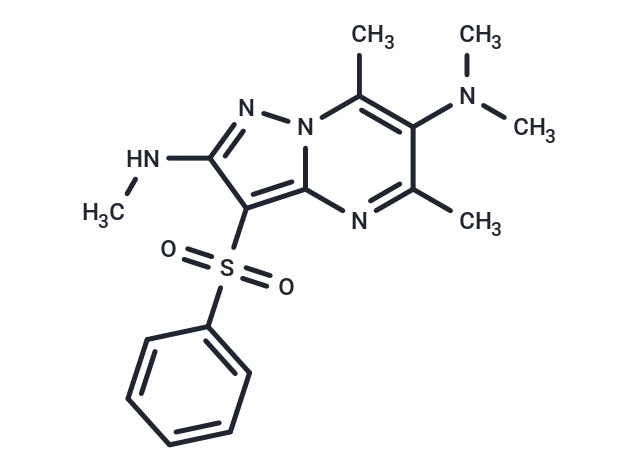
| Description | AVN-49 is a potent and selective 5-HT6R Antagonist (Ki: 91 pM). |
| Targets & IC50 | 5-HT6 receptor:91 pM (Ki, cell free) |
| In vitro | Affinity of AVN-492, Ki^b, to compete with [3H]LSD for binding to 5-HT6R was estimated to be 91 pM (IC50^b = 194 pM). Affinity of 509 AVN-492 to the 5-HT2BR, Ki^b = 170 nM (IC50^b = 268 nM) was more than three orders of magnitude lower. Despite being metabolized by human microsomes, AVN-492 did not appreciably inhibit five major human recombinant CYP isoforms, CYP3A4, 1A2, 2C9, 2C19, and 2D6 at concentrations as high as 10 M [1]. |
| In vivo | AVN-492 has high oral bioavailability and good brain permeability in rodents. In behavioral tests, AVN-492 shows an anxiolytic effect in the elevated plus-maze model, prevents an apomorphine-induced disruption of startle pre-pulse inhibition (the PPI model) and reverses scopolamine- and MK-801-induced memory deficit in passive avoidance model. No anti-obesity effect of AVN-492 was found in a murine model [1]. |
| Synonyms | AVN492 |
| Kinase Assay | Assessment of AVN-492 selectivity was performed on a panel of 69 therapeutic targets including receptors, ion channels, neuromediator transporters, and enzymes. The full list of the targets is presented in the Supplementary Material. AVN-492 interactions with therapeutic targets were assessed by either equilibrium competitive displacement of corresponding radiolabeled ligands or inhibition of corresponding enzymatic activities. The studies were performed at Eurofins in accordance with their internally optimized procedures as briefly described in. The displacement of radioligands and inhibition of enzymatic activities were measured at AVN-492 concentration of 1 M in duplicates. Affinities of AVN-492 to both the 5-HT6R and 5-HT2BR were assessed in an equilibrium competitive [3H]LSD displacement assay. AVN-492 was provided at different concentrations and [3H]LSD was kept at a concentration of 1.50 nM for 5-HT6R, or 1.20 nM for 5-HT2BR. The ligands were added to corresponding receptor-membrane suspensions (plasma membranes obtained from engineered HeLa cells expressing recombinant human 5-HT6R or engineered CHO-K1 cells expressing recombinant human 5-HT2BR). The cell membrane/ligands mixtures were incubated in buffer of the following composition: For 5-HT6R: 50 mM Tris-HCl, pH 7.4, 150 mM NaCl, 2 mM ascorbic acid, 0.001% BSA – 120 min at 37?C; for 5-HT2BR: 50 mM Tris-HCl, pH 7.4, 4 mM CaCl2, 0.1% ascorbic acid – 60 min at 37?C. Specific radio-ligand binding was measured as a difference between total binding and binding in the presence of excessive concentration of cold serotonin [1]. |
| Animal Research | For pharmacokinetic, behavior, and toxicity studies, male Wistar rats (220–242 g), male CD1 mice (24–30 g), male SHK mice (20–25 g), and male Balb/C mice (15–20 g) were used. Rodents were obtained from Jackson Laboratories and housed in a standard laboratory animal facility in groups of 5–7 animals per cage. Before entering the investigation, the animals were acclimated at least for seven days. Obese C57BL/6 male 18-week-old mice were obtained from Jackson Laboratories. The mice were fed on a high-fat diet (60% kcal Research Diet 12492i) from the age of 6 weeks. Upon arrival, the mice were maintained on the same high fat diet with free access to both food and water. The mice were individually housed in solid bottom static isolators with Bed-O'Cobs? bedding inside a BioBUBBLE? clean room that provided HEPA-filtered air into the clean room environment at a rate of 100 complete air changes per hour. All treatments and procedures including body weight determinations, drug administration, and glucose measurements were carried out in the clean room environment [1]. |
| Molecular Weight | 359.45 |
| Formula | C17H21N5O2S |
| Cas No. | 1220646-23-0 |
| Smiles | CNc1nn2c(C)c(N(C)C)c(C)nc2c1S(=O)(=O)c1ccccc1 |
| Relative Density. | 1.31 g/cm3 (Predicted) |
| Storage | Powder: -20°C for 3 years | In solvent: -80°C for 1 year Shipping with blue ice/Shipping at ambient temperature. | |||||||||||||||||||||||||
| Solubility Information | DMSO: 7.5 mg/mL (20.87 mM), Sonication is recommended.  | |||||||||||||||||||||||||
| In Vivo Formulation | 10% DMSO+40% PEG300+5% Tween 80+45% Saline: 1 mg/mL (2.78 mM), Sonication is recommended. Please add the solvents sequentially, clarifying the solution as much as possible before adding the next one. Dissolve by heating and/or sonication if necessary. Working solution is recommended to be prepared and used immediately. The formulation provided above is for reference purposes only. In vivo formulations may vary and should be modified based on specific experimental conditions. | |||||||||||||||||||||||||
Solution Preparation Table | ||||||||||||||||||||||||||
DMSO
Note : The dilution table applies only to solid products. For liquid products, please calculate the stock solution based on the stated concentration and/or density. | ||||||||||||||||||||||||||
 For example, if the intended dosage is 10 mg/kg for animals weighing 20 g , with a dosing volume of 100 μL per animal, and a total of 10 animals are to be administered, using a formulation of
  10% DMSO+ 40% PEG300+ 5% Tween 80+ 45% Saline/PBS/ddH2O , the resulting working solution concentration would be 2 mg/mL.
Dissolve 2 mg of the compound in 100 μL DMSO to obtain a stock solution at a concentration of 20 mg/mL . If the required concentration exceeds the compound's known solubility, please contact us for technical support before proceeding.
1) Add 100 μL of the DMSO stock solution to 400 µL PEG300 and mix thoroughly until the solution becomes clear.
2) Add 50 µL Tween 80 and mix well until fully clarified.
3) Add 450 µL Saline,PBS or ddH2O and mix thoroughly until a homogeneous solution is obtained.
| Size | Quantity | Unit Price | Amount | Operation |
|---|
 Feedback
 Hello! How can I help you today?
Copyright © 2015-2026 TargetMol Chemicals Inc. All Rights Reserved.
