


Shopping Cart
Remove All Your shopping cart is currently empty


Synonyms: NSC-330915, DL-Aminoglutethimide, BA-16038
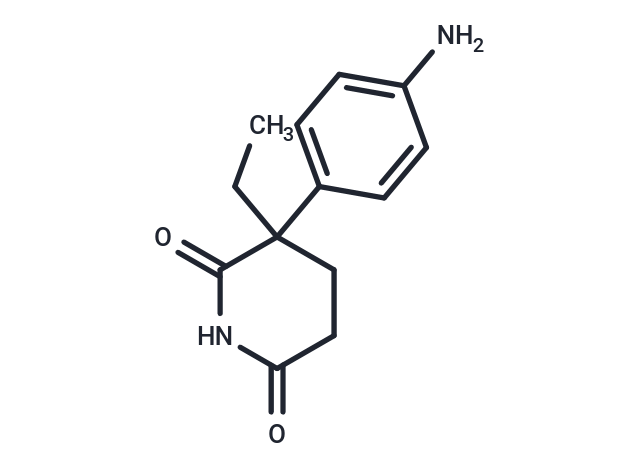
| Pack Size | Price | USA Stock | Global Stock | Quantity |
|---|---|---|---|---|
| 10 mg | $30 | In Stock | In Stock | |
| 25 mg | $47 | In Stock | In Stock | |
| 50 mg | $67 | In Stock | In Stock | |
| 1 mL x 10 mM (in DMSO) | $50 | In Stock | In Stock |
| Description | Aminoglutethimide (BA-16038), an aromatase inhibitor, is used in the therapy of advanced BREAST Y. |
| Targets & IC50 | Aromatase:10 μM |
| In vivo | Aminoglutethimide accelerates its own metabolism from a basal value of 2.6±0.3 (S.E.) liters/24 hours to 5.3±1.4 liters/24 hours after 1 to 2 weeks of Aminoglutethimide administration, and markedly accelerates the metabolism of the synthetic glucocorticoid and dexamethasone, from basal values of 145±26.6 liters/24 hours to 568±127 liters/24 hours (p < 0.02) after 2 weeks of Aminoglutethimide administration. [3] Aminoglutethimide (150 mg/kg) abolishes the induction of ornithine decarboxylase (ODC) and almost depletes the gonads and plasma of progesterone or testosterone elicited by human chorionic gonadotropin (hCG) in the ovary of adult female mice and the testis of immature male mice, which is related to an inhibition of cAMP-dependent protein kinase (IC50 287 μM) rather than blockade of the steroidogenic pathway. [4] |
| Synonyms | NSC-330915, DL-Aminoglutethimide, BA-16038 |
| Kinase Assay | Concentration–response and kinetic studies: The microsomal protein (30 μg), [1β-3H]androstenedione (6.6 × 10⁵ dpm) and NADPH (270 μM) are used for the concentration–response experiment with an incubation time of 20 minutes. The Aminoglutethimide is initially tested at 10 μM and 100 μM concentrations, followed by a full concentration–response study with at least 8 concentrations ranging from 0.01 μM to 160 μM. For the initial velocity study the concentration of [1β-3H]androstenedione is varied from 7.5 to 100 nM and the incubation time is set to 5 minutes. The tritiated water formed during the conversion of the tritiated substrate, [1β-3H]androstenedione, to estrone is quantified by liquid scintillation counting. Each assay is performed three times in duplicate and the results are treated by nonlinear regression analysis allowing the determination of the half-maximal inhibitory concentration (IC50). |
| Cell Research | The NCI-h295 tumor cell line is maintained in RPMI 1640 medium supplemented with transferrin (0.1 mg/mL), insulin (5 μg/mL), selenium (5.2 μg/mL) and 2% FCS. The cells are incubated for 48 hours with Aminoglutethimide (3, 30, 300 μM). Then cells are examined by trypan blue staining for cell viability, counted with a coulter counter. For the assessment of ACTH-R mRNA, cells are harvested, and total RNA is extracted, electrophoresed, blotted and hybridized with a human ACTH-R cDNA probe.(Only for Reference) |
| Molecular Weight | 232.28 |
| Formula | C13H16N2O2 |
| Cas No. | 125-84-8 |
| Smiles | CCC1(CCC(=O)NC1=O)c1ccc(N)cc1 |
| Relative Density. | 1.173 g/cm3 |
| Storage | Powder: -20°C for 3 years | In solvent: -80°C for 1 year Shipping with blue ice/Shipping at ambient temperature. | ||||||||||||||||||||||||||||||||||||||||
| Solubility Information | Ethanol: 7 mg/mL (30.14 mM), Sonication is recommended. DMSO: 55 mg/mL (236.78 mM), Sonication is recommended.  | ||||||||||||||||||||||||||||||||||||||||
| In Vivo Formulation | 10% DMSO+40% PEG300+5% Tween 80+45% Saline: 2 mg/mL (8.61 mM), Sonication is recommended. Please add the solvents sequentially, clarifying the solution as much as possible before adding the next one. Dissolve by heating and/or sonication if necessary. Working solution is recommended to be prepared and used immediately. The formulation provided above is for reference purposes only. In vivo formulations may vary and should be modified based on specific experimental conditions. | ||||||||||||||||||||||||||||||||||||||||
Solution Preparation Table | |||||||||||||||||||||||||||||||||||||||||
Ethanol/DMSO
DMSO
Note : The dilution table applies only to solid products. For liquid products, please calculate the stock solution based on the stated concentration and/or density. | |||||||||||||||||||||||||||||||||||||||||
 For example, if the intended dosage is 10 mg/kg for animals weighing 20 g , with a dosing volume of 100 μL per animal, and a total of 10 animals are to be administered, using a formulation of
  10% DMSO+ 40% PEG300+ 5% Tween 80+ 45% Saline/PBS/ddH2O , the resulting working solution concentration would be 2 mg/mL.
Dissolve 2 mg of the compound in 100 μL DMSO to obtain a stock solution at a concentration of 20 mg/mL . If the required concentration exceeds the compound's known solubility, please contact us for technical support before proceeding.
1) Add 100 μL of the DMSO stock solution to 400 µL PEG300 and mix thoroughly until the solution becomes clear.
2) Add 50 µL Tween 80 and mix well until fully clarified.
3) Add 450 µL Saline,PBS or ddH2O and mix thoroughly until a homogeneous solution is obtained.
| Size | Quantity | Unit Price | Amount | Operation |
|---|
 Feedback
 Hello! How can I help you today?
Copyright © 2015-2026 TargetMol Chemicals Inc. All Rights Reserved.
