


Shopping Cart
Remove All Your shopping cart is currently empty


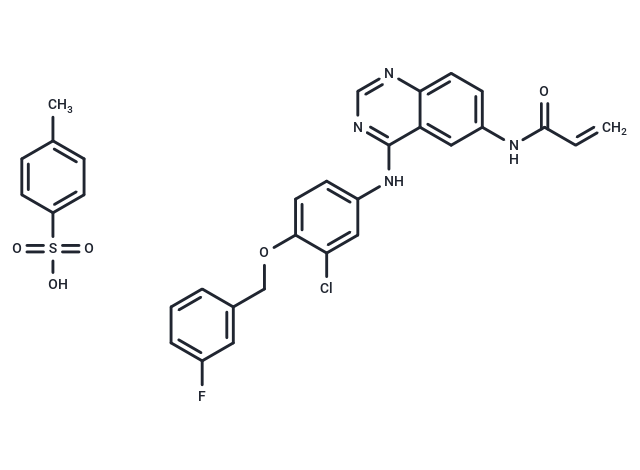
Synonyms: AST-1306 TsOH, AST-1306 (TsOH)
| Pack Size | Price | USA Stock | Global Stock | Quantity |
|---|---|---|---|---|
| 1 mg | $30 | In Stock | In Stock | |
| 5 mg | $68 | In Stock | In Stock | |
| 10 mg | $111 | In Stock | In Stock | |
| 25 mg | $208 | In Stock | In Stock | |
| 50 mg | $311 | In Stock | In Stock | |
| 100 mg | $442 | In Stock | In Stock | |
| 1 mL x 10 mM (in DMSO) | $94 | In Stock | In Stock |
| Description | Allitinib tosylate (AST-1306) is a novel irreversible inhibitor of EGFR and ErbB2 with IC50 of 0.5 nM and 3 nM, respectively. |
| Targets & IC50 | ERB4:0.8 nM, EGFR:0.5 nM, ErbB2:3.0 nM, EGFR L858R/T790M:12 nM |
| In vitro | Allitinibalso ErB2 and EGFR T790M/L858R double mutant. Allitinibis approximately 500-fold more potent than lapatinib and more than 3000-fold selective for ErbB family kinases over other kinase families including PDGFR, KDR and c-Met. Allitinibmight covalently bind to specific amino acid residues of EGFR and ErbB2. Allitinibacts in a concentration dependent manner to significantly inhibit the growth of HIH3T3-EGFR T790M/L858R cells. Allitinibeffectively suppresses EGFR phosphorylation in HIH3T3-EGFR T790M/L858R cells. Moreover, Allitinibblocks the growth of NCI-H1975 cells that harbor the EGFR T790M/L858R mutation in a concentration-dependent manner. Allitinibblocks phosphorylation of EGFR and downstream pathways as well. In addition, Allitinibdose-dependently and markedly inhibits EGF-induced EGFR phosphorylation in A549 cells. Allitinibinhibits the phosphorylation of EGFR and ErbB2, and downstream signaling in human cancer cells including A549 cells, Calu-3 cells and SK-OV-3 cells. [1] |
| In vivo | Twice daily oral administration of Allitinibgives rise to a dramatic prevention of tumor growth in SK-OV-3 and Calu-3 xenograft models. In SK-OV-3 models, tumors nearly disappears after treatment with Allitinibfor 7 days. In contrast, Allitinibonly slightly inhibits the growth of tumor in HO-8910 and A549 xenograft models. Therefore, the antitumor efficacy of Allitinibis greater in ErbB2-overexpressing tumor models than in models expressing low levels of ErbB2. Allitinibis well tolerated. Lapatinib displays antitumor activity in these ErbB2-overexpressing tumor models, but Allitinibis more efficacious than lapatinib in the SK-OV-3 xenograft tumor model when given at the same dose and schedule. In addition, oral administration of Allitinibtwice daily for 3 weeks dramatically suppresses the growth of tumor in the FVB-2/Nneu models. After treatment for 11 days, tumors almost completely disappears. The body weights of the mice reduces by less than 20% during treatment. [1] |
| Synonyms | AST-1306 TsOH, AST-1306 (TsOH) |
| Kinase Assay | Tyrosine kinase assays: The tyrosine kinase activities are determined in 96-well ELISA plates precoated with 20 μg/mL Poly (Glu,Tyr)4:1. First, 80 μL of 5 μM ATP solution diluted in kinase reaction buffer (50 mM HEPES pH 7.4, 20 mM MgCl2, 0.1 mM MnCl2, 0.2 mM Na3VO4, 1 mM DTT) is added to each well. Various concentrations of AST-1306 diluted in 10 μL of 1% DMSO (v/v) are then added to each reaction well, with 1% DMSO (v/v) used as the negative control. Subsequently, the kinase reaction is initiated by the addition of purified tyrosine kinase proteins diluted in 10 μL of kinase reaction buffer solution. Experiments at each concentration are performed in duplicate. After incubation for 60 min at 37 °C, the plate is washed three times with phosphate buffered saline (PBS) containing 0.1% Tween 20 (T-PBS). Next, 100 μL anti-phosphotyrosine antibody (PY99, 1:500 dilution) diluted in T-PBS containing 5 mg/mL BSA is added. After 30 min incubation at 37 °C, the plate is washed three times as before. Horseradish peroxidase-conjugated goat anti-mouse IgG (100 μL) diluted 1:2000 in T-PBS containing 5 mg/mL BSA is added. The plate is reincubated at 37 °C for 30 min, and then washed with PBS. Finally, 100 μL of a solution containing 0.03 % Water2 and 2 mg/mL o-phenylenediamine in 0.1 M citrate buffer, pH 5.5, is added and samples are incubated at room temperature until color emerged. The reaction is terminated by the addition of 50 μL of 2 M H2SO4, and the plate is read using a multi-well spectrophotometer at 490 nm. The inhibition rate (%) is calculated using the following equation: [1-(A490 treated /A490 control)] ×100%. IC50 values are determined from the results of at least three independent tests and calculated by Logit method. |
| Cell Research | Cell (including Calu-3, A-549 cell line et al.) proliferation is evaluated using the SRB (Sulforhodamine B) assay. Briefly, cells are seeded into 96-well plates and grown for 24 hours. The cells are then treated with increasing concentrations of AST-1306 and grown for a further 72 hours. The medium remains unchanged until the completion of the experiment. The cells are then fixed with 10% precooled trichloroacetic acid (TCA) for 1 hour at 4 °C and stained for 15 min at room temperature with 100 μL of 4 mg/mL SRB solution in 1% acetic acid. The SRB is then removed, and the cells are quickly rinsed five times with 1% acetic acid. After cells are air-dried, protein-bound dye is dissolved in 150 μL of 10 mM Tris base for 5 min and measured at 515 nm using a multiwell spectrophotometer. The inhibition rate on cell proliferation is calculated as (1 - A515 treated/A515 control) × 100%. The IC50 value is obtained by the Logit method and is determined from the results of at least 3 independent tests.(Only for Reference) |
| Molecular Weight | 621.08 |
| Formula | C31H26ClFN4O5S |
| Cas No. | 1050500-29-2 |
| Smiles | Cc1ccc(cc1)S(O)(=O)=O.Fc1cccc(COc2ccc(Nc3ncnc4ccc(NC(=O)C=C)cc34)cc2Cl)c1 |
| Relative Density. | no data available |
| Storage | Powder: -20°C for 3 years | In solvent: -80°C for 1 year Shipping with blue ice/Shipping at ambient temperature. | |||||||||||||||||||||||||||||||||||
| Solubility Information | H2O: < 1 mg/mL (insoluble or slightly soluble) Ethanol: < 1 mg/mL (insoluble or slightly soluble) DMSO: 114 mg/mL (183.55 mM), Sonication is recommended. | |||||||||||||||||||||||||||||||||||
| In Vivo Formulation | 10% DMSO+40% PEG300+5% Tween 80+45% Saline: 4 mg/mL (6.44 mM), Sonication is recommended. Please add the solvents sequentially, clarifying the solution as much as possible before adding the next one. Dissolve by heating and/or sonication if necessary. Working solution is recommended to be prepared and used immediately. The formulation provided above is for reference purposes only. In vivo formulations may vary and should be modified based on specific experimental conditions. | |||||||||||||||||||||||||||||||||||
Solution Preparation Table | ||||||||||||||||||||||||||||||||||||
DMSO
Note : The dilution table applies only to solid products. For liquid products, please calculate the stock solution based on the stated concentration and/or density. | ||||||||||||||||||||||||||||||||||||
 For example, if the intended dosage is 10 mg/kg for animals weighing 20 g , with a dosing volume of 100 μL per animal, and a total of 10 animals are to be administered, using a formulation of
  10% DMSO+ 40% PEG300+ 5% Tween 80+ 45% Saline/PBS/ddH2O , the resulting working solution concentration would be 2 mg/mL.
Dissolve 2 mg of the compound in 100 μL DMSO to obtain a stock solution at a concentration of 20 mg/mL . If the required concentration exceeds the compound's known solubility, please contact us for technical support before proceeding.
1) Add 100 μL of the DMSO stock solution to 400 µL PEG300 and mix thoroughly until the solution becomes clear.
2) Add 50 µL Tween 80 and mix well until fully clarified.
3) Add 450 µL Saline,PBS or ddH2O and mix thoroughly until a homogeneous solution is obtained.
| Size | Quantity | Unit Price | Amount | Operation |
|---|
 Feedback
 Hello! How can I help you today?
Copyright © 2015-2026 TargetMol Chemicals Inc. All Rights Reserved.
