


Shopping Cart
Remove All Your shopping cart is currently empty

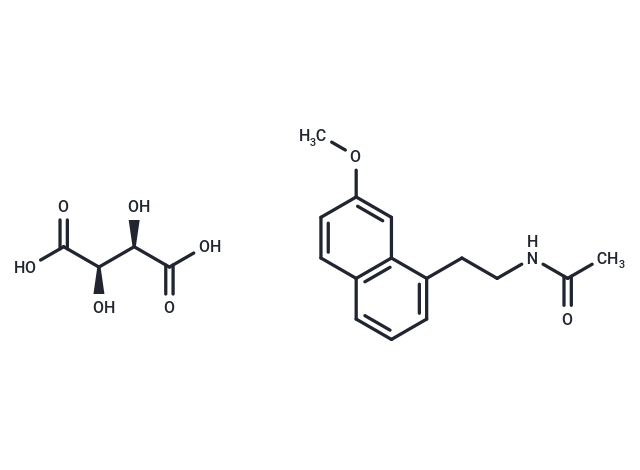
Synonyms: S-20098 L(+)-Tartaric acid
| Pack Size | Price | USA Stock | Global Stock | Quantity |
|---|---|---|---|---|
| 2 mg | $34 | - | In Stock | |
| 5 mg | $52 | - | In Stock | |
| 10 mg | $73 | - | In Stock | |
| 25 mg | $118 | - | In Stock | |
| 50 mg | $172 | - | In Stock | |
| 100 mg | $252 | - | In Stock | |
| 1 mL x 10 mM (in DMSO) | $58 | - | In Stock |
| Description | Agomelatine (L(+)-Tartaric acid) is a specific agonist of MT1 and MT2 receptors (Kis: 0.1, 0.06, 0.12, and 0.27 nM for CHO-hMT1, HEK-hMT1, CHO-hMT2, and HEK-hMT2), and Agomelatine (S-20098). L(+)-Tartaric acid also functions as a selective 5-HT2C receptor antagonist (pKis: 6.4 and 6.2 at native porcine and cloned human 5-HT2C receptors), actively supporting research into melatonergic signaling pathways, receptor-mediated regulation, and novel psychiatric therapeutics by enabling precise modulation of circadian and serotonergic systems in cellular models to improve neuropharmacological understanding and experimental reproducibility across neuroscientific and clinical translational studies. |
| Targets & IC50 | MT2 (human):0.27 nM (Ki), 5-HT2C receptor (native porcine):6.4 (pKi), MT2 (human, CHO cells):0.12 nM (Ki), MT1 (human, CHO cells):0.1 nM (Ki), MT1 (human):0.06 nM (ki), 5-HT2C receptor (human):6.2 (pKi) |
| In vitro | In the experimental system where human MT1 receptors (hMT1) and human MT2 receptors (hMT2) are expressed on the cell membranes of CHO cells (or HEK cells), the EC₅₀ values of Agomelatine (L(+)-Tartaric acid) acting on CHO-hMT1 and CHO-hMT2 are 1.6±0.4 nM and 0.10±0.04 nM, respectively[1]. |
| In vivo | Agomelatine (L(+)-Tartaric acid) (25, 50, or 75 mg/kg, intraperitoneal injection) exhibits antioxidant activity in strychnine- or pilocarpine-induced seizure models in mice. However, compared with the control group, Agomelatine (L(+)-Tartaric acid) did not demonstrate any antioxidant effects on oxidative stress-related indicators in pentylenetetrazole (PTZ)- or picrotoxin (PTX)-induced seizure models [3]. |
| Synonyms | S-20098 L(+)-Tartaric acid |
| Molecular Weight | 393.39 |
| Formula | C19H23NO8 |
| Cas No. | 824393-18-2 |
| Smiles | [C@@H]([C@H](C(O)=O)O)(C(O)=O)O.C(CNC(C)=O)C=1C2=C(C=CC(OC)=C2)C=CC1 |
| Relative Density. | no data available |
| Storage | Store at low temperature Powder: -20°C for 3 years | In solvent: -80°C for 1 year Shipping with blue ice/Shipping at ambient temperature. | |||||||||||||||||||||||||||||||||||
| Solubility Information | DMSO: 80 mg/mL (203.36 mM), Sonication is recommeded. | |||||||||||||||||||||||||||||||||||
Solution Preparation Table | ||||||||||||||||||||||||||||||||||||
DMSO
Note : The dilution table applies only to solid products. For liquid products, please calculate the stock solution based on the stated concentration and/or density. | ||||||||||||||||||||||||||||||||||||
 For example, if the intended dosage is 10 mg/kg for animals weighing 20 g , with a dosing volume of 100 μL per animal, and a total of 10 animals are to be administered, using a formulation of
  10% DMSO+ 40% PEG300+ 5% Tween 80+ 45% Saline/PBS/ddH2O , the resulting working solution concentration would be 2 mg/mL.
Dissolve 2 mg of the compound in 100 μL DMSO to obtain a stock solution at a concentration of 20 mg/mL . If the required concentration exceeds the compound's known solubility, please contact us for technical support before proceeding.
1) Add 100 μL of the DMSO stock solution to 400 µL PEG300 and mix thoroughly until the solution becomes clear.
2) Add 50 µL Tween 80 and mix well until fully clarified.
3) Add 450 µL Saline,PBS or ddH2O and mix thoroughly until a homogeneous solution is obtained.
| Size | Quantity | Unit Price | Amount | Operation |
|---|
 Feedback
 Hello! How can I help you today?
Copyright © 2015-2026 TargetMol Chemicals Inc. All Rights Reserved.
