


Shopping Cart
Remove All Your shopping cart is currently empty


Synonyms: R428, BGB324
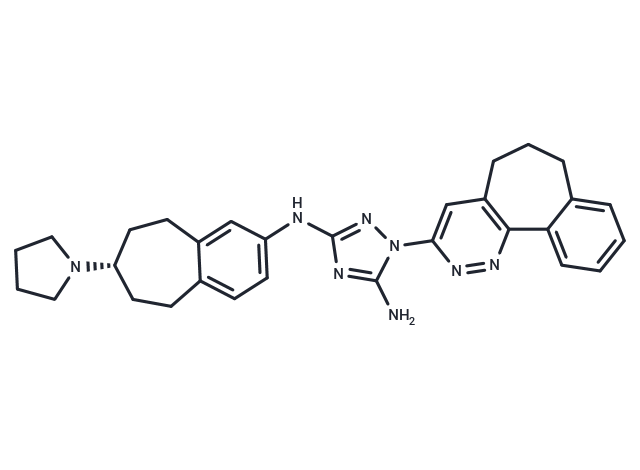

| Pack Size | Price | USA Stock | Global Stock | Quantity |
|---|---|---|---|---|
| 1 mg | $34 | In Stock | In Stock | |
| 2 mg | $48 | In Stock | In Stock | |
| 5 mg | $79 | In Stock | In Stock | |
| 10 mg | $147 | In Stock | In Stock | |
| 25 mg | $224 | In Stock | In Stock | |
| 50 mg | $288 | In Stock | In Stock | |
| 100 mg | $490 | In Stock | In Stock | |
| 200 mg | $654 | In Stock | In Stock | |
| 500 mg | $997 | In Stock | In Stock | |
| 1 mL x 10 mM (in DMSO) | $93 | In Stock | In Stock |
| Description | Bemcentinib (R428) belongs to small molecule inhibitors and is a highly selective oral Axl inhibitor (IC50 = 14 nM) with oral bioavailability and potent cell permeability. This compound effectively inhibits cancer cell migration and invasion, blocks tumor dissemination, and prolongs survival in various tumor models. |
| Targets & IC50 | cells:14 nM (cell free) |
| In vitro | Methods: In HCC827 parental and erlotinib-resistant ER3 and ER10 cells, Bemcentinib (0.1–2.0 μM) was administered for 120 hours, and real-time growth curves were measured using IncuCyte. Results: Bemcentinib dose-dependently inhibited cell proliferation and induced growth arrest in resistant cells. [1] Methods: In SET-2 and BaF3-EpoR-JAK2V617F cells, Bemcentinib (0.5–5 μM) was administered for 48 hours; cells were also treated for 24 hours (SET-2) or 12 hours (BaF3). Results: After 48 hours of treatment, WST-1 assay demonstrated dose-dependent inhibition of cell viability; BrdU incorporation and Annexin V staining confirmed inhibition of cell proliferation and induction of apoptosis. [2] Methods: In LX2 human hepatic stellate cells, Bemcentinib (0.25 μM) was administered as a 1-hour pretreatment followed by GAS6 stimulation; in primary mouse Kupffer cells, Bemcentinib (0.25 μM) pretreatment was followed by LPS stimulation for 2 hours. Results: ELISA demonstrated inhibition of MCP-1 release and p-AKT levels; RT-qPCR confirmed reduced expression of IL-1β and IL-6 mRNA. [3] |
| In vivo | Methods: In an HCC827 cell xenograft nude mouse model, Bemcentinib (50 or 100 mg/kg, twice daily, oral gavage) was combined with erlotinib (50 mg/kg, once daily) for 138 days of treatment. Results: The combination therapy significantly delayed the emergence of tumor resistance, with maximum tumor suppression maintained until the experimental endpoint. [1] Methods: In a SET-2 cell xenograft NSG mouse model, Bemcentinib (50 mg/kg, twice daily, oral gavage) was administered until tumors reached 1500 mm³, achieving 60% tumor growth inhibition. Results: In a BaF3-EpoR-JAK2V617F systemic model, Bemcentinib (50 mg/kg, twice daily) significantly prolonged survival, reduced splenomegaly, and improved anemia. [2] Methods: In C57BL/6 mice with MCD- or HFD-induced NASH models, Bemcentinib (50 mg/kg, twice daily, oral gavage) was administered during the final 2 weeks of dietary induction. Results: Bemcentinib significantly reduced hepatic collagen deposition (confirmed by hydroxyproline assay and Sirius Red staining) and decreased expression of pro-inflammatory and pro-fibrotic genes. [3] |
| Synonyms | R428, BGB324 |
| Kinase Assay | A five-point R428 dose titration was performed in radiometric in vitro kinase assays on 133 kinases at the Km(ATP) for each kinase. Axl, Mer, and Tyro3 assays were also performed using a fluorescence polarization protocol. HER2 activity was determined by Z'-LYTE assay [1]. |
| Cell Research | MDA-MB-231 or 4T1 cells (1 × 10^5) were allowed to migrate through Matrigel toward 20% FCS in an 8-μm pore 24-well Transwell plate at 37°C for 16 to 24 h. Noninvaded cells and Matrigel were removed by swabbing. Invaded cells were fixed in 4% formaldehyde, stained with 1% crystal violet, and quantified as for Axl cell-based assay. Cells were preincubated with R428 for 3 h. R428 was added to both upper and lower Transwell chambers [1]. |
| Animal Research | Female BALB/c mice were inoculated in the mammary fat pad with 0.5 × 10^6 4T1 cells. Forty-eight hours after inoculation, mice were randomized into treatment groups (n = 10). Oral dosing with R428 (7–75 mg/kg twice daily) or vehicle continued until days 19 to 21. Cisplatin (1.2 or 4 mg/kg) was administered i.v. once weekly. Body weight and tumor size were measured thrice per week. Lungs were exposed postmortem. Total number and size of surface lung macrometastases were measured (small, <2 mm; medium, ≥2 mm and <3 mm; large, ≥3 mm). Half of each primary tumor was snap frozen in liquid nitrogen. The other half, and the livers were fixed in paraformaldehyde/lysine/periodate solution, paraffin embedded and sectioned (5 μm thick). Two H&E-stained liver sections per animal were examined microscopically for micrometastases in three view fields. Synergism was determined using Clark's synergy calculation [1]. |
| Molecular Weight | 506.64 |
| Formula | C30H34N8 |
| Cas No. | 1037624-75-1 |
| Smiles | Nc1nc(Nc2ccc3CC[C@@H](CCc3c2)N2CCCC2)nn1-c1cc2CCCc3ccccc3-c2nn1 |
| Relative Density. | 1.41 g/cm3 (Predicted) |
| Storage | Store at low temperature Powder: -20°C for 3 years | In solvent: -80°C for 1 year Shipping with blue ice/Shipping at ambient temperature. | |||||||||||||||||||||||||
| Solubility Information | H2O: < 1 mg/mL (insoluble or slightly soluble) Ethanol: < 1 mg/mL (insoluble or slightly soluble) DMSO: 23.4 mg/mL (46.19 mM), Sonication and heating are recommended.  | |||||||||||||||||||||||||
| In Vivo Formulation | 10% DMSO+40% PEG300+5% Tween-80+45% Saline: 1 mg/mL (1.97 mM), Sonication is recommended. Please add the solvents sequentially, clarifying the solution as much as possible before adding the next one. Dissolve by heating and/or sonication if necessary. Working solution is recommended to be prepared and used immediately. The formulation provided above is for reference purposes only. In vivo formulations may vary and should be modified based on specific experimental conditions. | |||||||||||||||||||||||||
Solution Preparation Table | ||||||||||||||||||||||||||
DMSO
Note : The dilution table applies only to solid products. For liquid products, please calculate the stock solution based on the stated concentration and/or density. | ||||||||||||||||||||||||||
 For example, if the intended dosage is 10 mg/kg for animals weighing 20 g , with a dosing volume of 100 μL per animal, and a total of 10 animals are to be administered, using a formulation of
  10% DMSO+ 40% PEG300+ 5% Tween 80+ 45% Saline/PBS/ddH2O , the resulting working solution concentration would be 2 mg/mL.
Dissolve 2 mg of the compound in 100 μL DMSO to obtain a stock solution at a concentration of 20 mg/mL . If the required concentration exceeds the compound's known solubility, please contact us for technical support before proceeding.
1) Add 100 μL of the DMSO stock solution to 400 µL PEG300 and mix thoroughly until the solution becomes clear.
2) Add 50 µL Tween 80 and mix well until fully clarified.
3) Add 450 µL Saline,PBS or ddH2O and mix thoroughly until a homogeneous solution is obtained.
| Size | Quantity | Unit Price | Amount | Operation |
|---|
 Feedback
 Hello! How can I help you today?
Copyright © 2015-2026 TargetMol Chemicals Inc. All Rights Reserved.
