


Shopping Cart
Remove All Your shopping cart is currently empty

Synonyms:

| Pack Size | Price | USA Stock | Global Stock | Quantity |
|---|---|---|---|---|
| 1 mg | $106 | - | In Stock | |
| 5 mg | $257 | - | In Stock | |
| 10 mg | $380 | - | In Stock | |
| 25 mg | $638 | - | In Stock | |
| 50 mg | $890 | - | In Stock | |
| 100 mg | $1,230 | - | In Stock | |
| 1 mL x 10 mM (in DMSO) | $270 | - | In Stock |
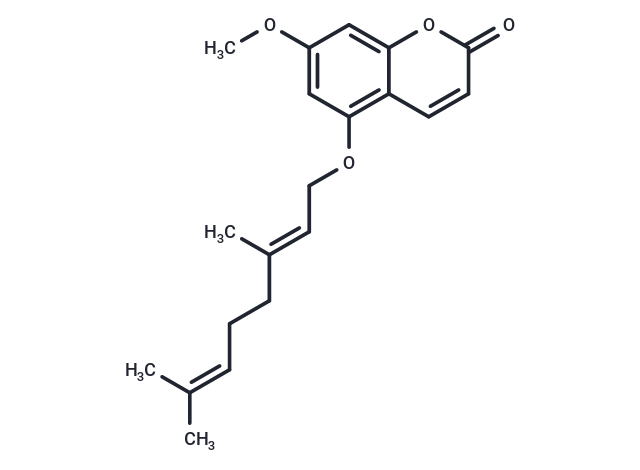
| Description | 5-Geranoxy-7-methoxycoumarin shows antifungal activity. |
| In vitro | Two mechanisms of the resistance of citrus fruits against pathogens-preformed and induced antifungal materials-were investigated. METHODS AND RESULTS: Flavedo tissue of lemon contains the following preformed antifungal materials: citral, limettin, 5-Geranoxy-7-methoxycoumarin, and isopimpinellin, which act as the first line of defense against pathogens. Exogenous application of citral to Penicillium-inoculated lemon fruit prevented development of decay. Being subjected to fungal challenge and/or abiotic stress, citrus fruits are elicited to produce the phytoalexin scoparone, considered as another line of fruit defense. According to median effective dose (ED50) of the inhibition of germ-tube elongation or percent germination, scoparone had higher fungitoxicity against Penicillium digitatum Sacc. than the preformed antifungal materials. Different citrus species (lemon, orange, grapefruit, lime, kumquat) varied in their capacities to produce scoparone responding to the combined Penicillium inoculation and heat treatment or to UV illumination. UV illumination of lemon fruit reduced its susceptibility to P. digitatum. CONCLUSIONS: Expression of this effect was directly related to the level of scoparone in illuminated fruit. UV light and citral application were visibly injurious to the flavedo tissues in high dose. |
| Molecular Weight | 328.4 |
| Formula | C20H24O4 |
| Cas No. | 7380-39-4 |
| Smiles | O(C/C=C(/CCC=C(C)C)\C)C1=C2C(=CC(OC)=C1)OC(=O)C=C2 |
| Relative Density. | 1.092g/cm3 |
| Storage | Store at low temperature Pure form: -20°C for 3 years | In solvent: -80°C for 1 year Shipping with blue ice/Shipping at ambient temperature. | ||||||||||||||||||||
| Solubility Information | DMSO: 3.29 mg/mL (10.02 mM), Sonication is recommended.  | ||||||||||||||||||||
Solution Preparation Table | |||||||||||||||||||||
DMSO
Note : The dilution table applies only to solid products. For liquid products, please calculate the stock solution based on the stated concentration and/or density. | |||||||||||||||||||||
 For example, if the intended dosage is 10 mg/kg for animals weighing 20 g , with a dosing volume of 100 μL per animal, and a total of 10 animals are to be administered, using a formulation of
  10% DMSO+ 40% PEG300+ 5% Tween 80+ 45% Saline/PBS/ddH2O , the resulting working solution concentration would be 2 mg/mL.
Dissolve 2 mg of the compound in 100 μL DMSO to obtain a stock solution at a concentration of 20 mg/mL . If the required concentration exceeds the compound's known solubility, please contact us for technical support before proceeding.
1) Add 100 μL of the DMSO stock solution to 400 µL PEG300 and mix thoroughly until the solution becomes clear.
2) Add 50 µL Tween 80 and mix well until fully clarified.
3) Add 450 µL Saline,PBS or ddH2O and mix thoroughly until a homogeneous solution is obtained.
| Size | Quantity | Unit Price | Amount | Operation |
|---|
 Feedback
 Hello! How can I help you today?
Copyright © 2015-2026 TargetMol Chemicals Inc. All Rights Reserved.
