Shopping Cart
Remove All
  • TargetMol
    Your shopping cart is currently empty

Influenza A H3N2 (A/Babol/36/2005) Neuraminidase/NA Protein (His)

(Synonyms: NA Protein) Copy Product Info

Synonyms: NA Protein

Catalog No. TMPY-02336 Copy Product Info
Influenza A H3N2 (A/Babol/36/2005) Neuraminidase/NA Protein (His) is expressed in HEK293 mammalian cells with His tag. The predicted molecular weight is 49.6 kDa and the accession number is C0LU95.
Pack SizePriceUSA StockGlobal StockQuantity
5 µg$61-In Stock
10 µg$97-In Stock
20 µg$158-In Stock
50 µg$297-In Stock
100 µg$517-In Stock
200 µg$8837-10 days7-10 days
500 µg$1,7807-10 days7-10 days
For In stock only · Estimated delivery: USA Stock (1-2 days) Global Stock (5-7 days)
Add to Cart
Add to Quotation
For research use only—not for human use. No sales to individuals. Use as intended only.
Questions
TargetMol
View More

Batch Information

Select Batch
Purity:91.2%
Appearance:Lyophilized powder
Color:White
Contact us for more batch information

Product Introduction

Bioactivity
Bioactivity
Activity testing is in progress. It is theoretically active, but we cannot guarantee it. If you require protein activity, we recommend choosing the eukaryotic expression version first.
Description
Influenza A H3N2 (A/Babol/36/2005) Neuraminidase/NA Protein (His) is expressed in HEK293 mammalian cells with His tag. The predicted molecular weight is 49.6 kDa and the accession number is C0LU95.
Species
H3N2
Expression System
HEK293 Cells
TagN-His
Accession NumberC0LU95
ConstructionA DNA sequence encoding the Influenza A H3N2 virus (A/Babol/36/2005) Neuraminidase (ACN50232.1) (His 36-Pro 459) was fused with a polyhistidine tag at the N-terminus. Predicted N terminal: His
Protein Purity
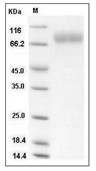
> 90 % as determined by SDS-PAGE
Influenza A H3N2 (A/Babol/36/2005) Neuraminidase/NA Protein (His)
Endotoxin< 1.0 EU/μg of the protein as determined by the LAL method.
FormulationLyophilized from a solution filtered through a 0.22 μm filter, containing PBS, pH 7.4. Typically, a mixture containing 5% to 8% trehalose, mannitol, and 0.01% Tween 80 is incorporated as a protective agent before lyophilization.
ReconstitutionReconstituted with sterile deionized water to 0.25 mg/mL. Reconstitution conditions may vary depending on the lot.
SynonymsNA Protein
Research Background
Neuraminidases are enzymes that cleave sialic acid groups from glycoproteins. Influenza neuraminidase is a type of neuraminidase found on the surface of influenza viruses that enables the virus to be released from the host cell. Influenza neuraminidase is composed of four identical subunits arranged in a square. It is normally attached to the virus surface through a long protein stalk. The active sites are in a deep depression on the upper surface. They bind to polysaccharide chains and clip off the sugars at the end. The surface of neuraminidase is decorated with several polysaccharide chains that are similar to the polysaccharide chains that decorate our cell surface proteins. Neuraminidase (NA) and hemagglutinin (HA) are major membrane glycoproteins found on the surface of the influenza virus. Hemagglutinin binds to the sialic acid-containing receptors on the surface of host cells during initial infection and at the end of an infectious cycle. Neuraminidase, on the other hand, cleaves the HA-sialic acid bondage from the newly formed virions and the host cell receptors during budding. Neuraminidase thus is described as a receptor-destroying enzyme that facilitates virus release and efficient spread of the progeny virus from cell to cell. Influenza antibody and influenza antibodies are very important research tools for influenza diagnosis, influenza vaccine development, and anti-influenza virus therapy development. The monoclonal or polyclonal antibody can be raised with protein based antigen or peptide-based antigen. Antibodies raised with protein-based antigen could have better specificity and/or binding affinity than antibodies raised with peptide based antigen, but the cost associated with the recombinant protein antigen is usually higher. Anti-influenza virus hemagglutinin (HA) monoclonal antibody or polyclonal antibody can be used for ELISA assay, western blotting detection, Immunohistochemistry (IHC), flow cytometry, neutralization assay, hemagglutinin inhibition assay, and early diagnosis of influenza viral infection. Sino Biological has developed state-of-the-art monoclonal antibody development technology platforms: mouse monoclonal antibody and rabbit monoclonal antibody. Our rabbit monoclonal antibody platform is one of a kind and offers some unique advantages over mouse monoclonal antibodies, such as high affinity, low cross-reactivity with rabbit polyclonal antibodies.
Chemical Properties
Molecular Weight49.6 kDa (predicted); 80 kDa (reducing condition, due to glycosylation)
Storage & Solubility Information
ShippingIn general, lyophilized powders are shipped with blue ice, while solutions are shipped with dry ice.
StorageIt is recommended to store recombinant proteins at -20°C to -80°C for future use. Lyophilized powders can be stably stored for over 12 months, while liquid products can be stored for 6-12 months at -80°C. For reconstituted protein solutions, the solution can be stored at -20°C to -80°C for at least 3 months. Please avoid multiple freeze-thaw cycles and store products in aliquots.

Calculator

  • Reconstitution Calculator
  • Recombinant Protein Dilution Calculator
  • Specific Activity Calculator

Dose Conversion

You can also refer to dose conversion for different animals. More Dose Conversion

Tech Support

Related Tags: Influenza A H3N2 (A/Babol/36/2005) Neuraminidase/NA Protein (His) chemical structure | Influenza A H3N2 (A/Babol/36/2005) Neuraminidase/NA Protein (His) molecular weight