Your shopping cart is currently empty
Immunoglobulin superfamily member 11(IGSF11) is expressed on the plasma membrane in the testis and brain. These IGSF proteins undergo final modifications during capacitation and/or the acrosome reaction. IGSF proteins share significant homology with endothelial cell-selective adhesion molecule and coxsackievirus and adenovirus receptor, which mediates cell attachment and homotypic intercellular interactions. In clinical, the IGSF11 has been reported to overexpressed in colorectal cancers and hepatocellular carcinomas, as well as intestinal-type gastric cancers, compared to their corresponding non-cancerous tissues. The IGSF11 has also been found expressed abundantly in the testis and ovary and the IGSF11 can be used as a candidate of cancer-testis antigen.

| Pack Size | Price | USA Stock | Global Stock | Quantity |
|---|---|---|---|---|
| 5 μg | $68 | 7-10 days | 7-10 days | |
| 10 μg | $109 | 7-10 days | 7-10 days | |
| 20 μg | $178 | - | In Stock | |
| 50 μg | $373 | 7-10 days | 7-10 days | |
| 100 μg | $660 | 7-10 days | 7-10 days | |
| 200 μg | $1,120 | 7-10 days | 7-10 days | |
| 500 μg | $2,270 | 7-10 days | 7-10 days |
| Biological Activity | Activity testing is in progress. It is theoretically active, but we cannot guarantee it. If you require protein activity, we recommend choosing the eukaryotic expression version first. |
| Description | Immunoglobulin superfamily member 11(IGSF11) is expressed on the plasma membrane in the testis and brain. These IGSF proteins undergo final modifications during capacitation and/or the acrosome reaction. IGSF proteins share significant homology with endothelial cell-selective adhesion molecule and coxsackievirus and adenovirus receptor, which mediates cell attachment and homotypic intercellular interactions. In clinical, the IGSF11 has been reported to overexpressed in colorectal cancers and hepatocellular carcinomas, as well as intestinal-type gastric cancers, compared to their corresponding non-cancerous tissues. The IGSF11 has also been found expressed abundantly in the testis and ovary and the IGSF11 can be used as a candidate of cancer-testis antigen. |
| Species | Human |
| Expression System | HEK293 Cells |
| Tag | C-His |
| Accession Number | AAH34411.1 |
| Synonyms | VSIG3,immunoglobulin superfamily, member 11,Igsf13,CXADRL1,CT119,BT-IgSF |
| Construction | A DNA sequence encoding the extracellular domain of human IGSF11 (AAH34411.1) (Met 1-Gly 240) was fused with a polyhistidine tag at the C-terminus Predicted N terminal: Glu 23 |
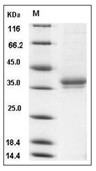
| Protein Purity | ≥ 85 % as determined by SDS-PAGE. ≥ 85 % as determined by SEC-HPLC. ![]() |
| Molecular Weight | 24.6 kDa (predicted); 36 kDa (reducing condition, due to glycosylation) |
| Endotoxin | < 1.0 EU/μg of the protein as determined by the LAL method. |
| Formulation | Lyophilized from a solution filtered through a 0.22 μm filter, containing PBS, pH 7.4. Typically, a mixture containing 5% to 8% trehalose, mannitol, and 0.01% Tween 80 is incorporated as a protective agent before lyophilization. |
| Reconstitution | Reconstituted with sterile deionized water to 0.25 mg/mL. Reconstitution conditions may vary depending on the lot. |
| Stability & Storage | It is recommended to store recombinant proteins at -20°C to -80°C for future use. Lyophilized powders can be stably stored for over 12 months, while liquid products can be stored for 6-12 months at -80°C. For reconstituted protein solutions, the solution can be stored at -20°C to -80°C for at least 3 months. Please avoid multiple freeze-thaw cycles and store products in aliquots. |
| Shipping | In general, lyophilized powders are shipped with blue ice, while solutions are shipped with dry ice. |
| Research Background | Immunoglobulin superfamily member 11(IGSF11) is expressed on the plasma membrane in the testis and brain. These IGSF proteins undergo final modifications during capacitation and/or the acrosome reaction. IGSF proteins share significant homology with endothelial cell-selective adhesion molecule and coxsackievirus and adenovirus receptor, which mediates cell attachment and homotypic intercellular interactions. In clinical, the IGSF11 has been reported to overexpressed in colorectal cancers and hepatocellular carcinomas, as well as intestinal-type gastric cancers, compared to their corresponding non-cancerous tissues. The IGSF11 has also been found expressed abundantly in the testis and ovary and the IGSF11 can be used as a candidate of cancer-testis antigen. |
| Size | Quantity | Unit Price | Amount | Operation |
|---|

Copyright © 2015-2026 TargetMol Chemicals Inc. All Rights Reserved.