


Shopping Cart
Remove All Your shopping cart is currently empty


Synonyms: Trifluridine-tipiracil hydrochloride mixture, TAS-102, TAS102, TAS 102

| Pack Size | Price | USA Stock | Global Stock | Quantity |
|---|---|---|---|---|
| 2 mg | $33 | In Stock | In Stock | |
| 5 mg | $52 | In Stock | In Stock | |
| 10 mg | $89 | In Stock | In Stock | |
| 25 mg | $159 | In Stock | In Stock | |
| 50 mg | $263 | In Stock | In Stock | |
| 100 mg | $397 | In Stock | In Stock | |
| 200 mg | $598 | In Stock | In Stock | |
| 500 mg | $936 | In Stock | In Stock | |
| 1 mL x 10 mM (in DMSO) | $71 | In Stock | In Stock |
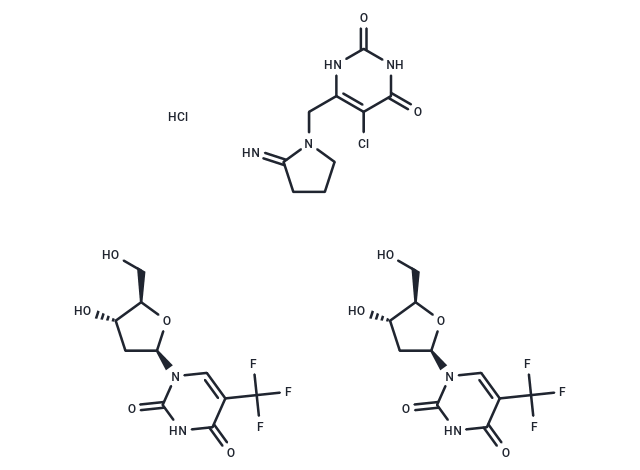
| Description | Trifluridine/tipiracil hydrochloride mixture (TAS-102) is a novel oral combination drug containing trifluridine (TFT) and tipiracil hydrochloride (TTP) in a 2:1 molar ratio. |
| In vitro | Trifluridine/tipiracil hydrochloride mixture is an oral combination drug consisting of trifluridine (FTD), which is a thymidine-based nucleoside analog, and tipiracil hydrochloride (TPI), which improves the bioavailability of FTD by inhibiting its catabolism by thymidine phosphorylase (TP)[1]. Phosphorylated form of trifluridine is incorporated into DNA resulting in DNA dysfunction and cell cycle arrest. Thymidine phosphorylase inhibitor inhibits degradation of FTD and inhibits angiogenesis. Thus, Trifluridine/tipiracil hydrochloride mixture treatment results in massive trifluridine incorporation into DNA and in activation of similar DNA damage response pathways, which involve phosphorylation of Chk1 and cycle arrest during the G2/M-phase[2]. |
| In vivo | The elimination half-life of FTD after intravenous administration to humans is very rapid (18 minutes), due to the rapid degradation of FTD to its major metabolite, 5-trifluoromethyl-2,4(1H,3H)-pyrimidinedione. In monkeys, the plasma FTD level after oral administration alone is very low, suggesting extensive first-pass metabolism by the liver and intestine TPase. However, the addition of TPI(tipiracil hydrochloride) is found to enable oral administration. By inhibiting TP, TPI inhibits the degradation of FTD in the liver and intestines following oral administration and thereby improves its bioavailability. The TP enzyme catalyzes the phosphorolysis of pyrimidine 2'-deoxynucleosides such as FTD. Studies using human CRC tumor xenografts in mice determine that the maximum antitumor activity is achieved with a 1:0.5 molar ratio, and studies in mice and monkeys show that the maximum plasma concentration of FTD is almost achieved with the same ratio. Moreover, this ratio produces a favorable balance between antitumor activity and toxicity. Lower toxicity in mice is observed with TPI coadministration than with FTD alone. Trifluridine/tipiracil hydrochloride mixture (FTD) can overcome acquired resistance to 5-FU because the main mechanism of Trifluridine/tipiracil hydrochloride mixture is not associated with main metabolic enzymes of 5-FU, such as TS and OPRT. Trifluridine/tipiracil hydrochloride mixture has demonstrated efficacy in 5-FU-refractory cancers[1]. |
| Synonyms | Trifluridine-tipiracil hydrochloride mixture, TAS-102, TAS102, TAS 102 |
| Kinase Assay | IC50 determination of compounds against EGFR enzymes: The inhibition potency of compounds against EGFR WT and mutant enzymes is assessed using CisBio homogenous time resolved fluorescence approach (HTRF, Cat No. 62TK0PEJ) according to manufacturer's instruction. The final enzyme concentrations used in this assay are 0.1 nM, 0.03 nM, and 0.026 nM for EGFR wild type, L858R and Exon19Del, respectively, and 0.8 μM, 4 μM and 25 μM ATP, corresponding to the Km values of EGFR enzymes, are applied accordingly. In brief, 3 μL of ATP and 2 μM TK biotin-peptide substrate are incubated in the presence or absence of serially diluted compound at room temperature in 384-well Greiner white polystyrene assay plates. The reaction is initiated by addition of 3 μL kinase which could phosphorylate the substrate peptide, and the assay buffer contains 1 mM DTT, 5 mM MgCl2, 1 mM MnCl2, and 0.01% CHAPS. After 30 minutes incubation, the reaction is stopped by the addition of 6 μl detection reagent mix containing 250 nM Strep-XL665 and TK Ab Europium Cryptate diluted in detection buffer. The plates are incubated for 1 h before the fluorescence is then measured at 615 nm and 665 nm, respectively with excitation wavelength at 320 nm by EnVision Multilabel Reader from Perkin Elmer using standard HTRF settings. The calculated signal ratio of 665 nm/615 nm is proportional to the kinase activity. The concentration of compound producing 50% inhibition of the respective kinase (IC50) is calculated using four-parameter logistic fit. |
| Molecular Weight | 871.53 |
| Formula | C29H34Cl2F6N8O12 |
| Cas No. | 733030-01-8 |
| Smiles | Cl.Clc1c(CN2CCCC2=N)[nH]c(=O)[nH]c1=O.OC[C@H]1O[C@H](C[C@@H]1O)n1cc(c(=O)[nH]c1=O)C(F)(F)F.OC[C@H]1O[C@H](C[C@@H]1O)n1cc(c(=O)[nH]c1=O)C(F)(F)F |
| Relative Density. | no data available |
| Storage | Powder: -20°C for 3 years | In solvent: -80°C for 1 year Shipping with blue ice/Shipping at ambient temperature. | ||||||||||||||||||||||||||||||||||||||||
| Solubility Information | H2O: 50 mg/mL (57.37 mM), Sonication is recommended.  Ethanol: 100 mg/mL (114.74 mM), Sonication is recommended. DMSO: 100 mg/mL (114.74 mM), Sonication is recommended. | ||||||||||||||||||||||||||||||||||||||||
Solution Preparation Table | |||||||||||||||||||||||||||||||||||||||||
H2O/Ethanol/DMSO
Ethanol/DMSO
Note : The dilution table applies only to solid products. For liquid products, please calculate the stock solution based on the stated concentration and/or density. | |||||||||||||||||||||||||||||||||||||||||
 For example, if the intended dosage is 10 mg/kg for animals weighing 20 g , with a dosing volume of 100 μL per animal, and a total of 10 animals are to be administered, using a formulation of
  10% DMSO+ 40% PEG300+ 5% Tween 80+ 45% Saline/PBS/ddH2O , the resulting working solution concentration would be 2 mg/mL.
Dissolve 2 mg of the compound in 100 μL DMSO to obtain a stock solution at a concentration of 20 mg/mL . If the required concentration exceeds the compound's known solubility, please contact us for technical support before proceeding.
1) Add 100 μL of the DMSO stock solution to 400 µL PEG300 and mix thoroughly until the solution becomes clear.
2) Add 50 µL Tween 80 and mix well until fully clarified.
3) Add 450 µL Saline,PBS or ddH2O and mix thoroughly until a homogeneous solution is obtained.
| Size | Quantity | Unit Price | Amount | Operation |
|---|
 Feedback
 Hello! How can I help you today?
Copyright © 2015-2026 TargetMol Chemicals Inc. All Rights Reserved.
