


Shopping Cart
Remove All Your shopping cart is currently empty


Synonyms:

| Pack Size | Price | USA Stock | Global Stock | Quantity |
|---|---|---|---|---|
| 5 mg | $47 | In Stock | In Stock | |
| 10 mg | $72 | In Stock | In Stock | |
| 25 mg | $122 | In Stock | In Stock | |
| 50 mg | $198 | In Stock | In Stock | |
| 100 mg | $372 | In Stock | In Stock | |
| 1 mL x 10 mM (in DMSO) | $52 | In Stock | In Stock |
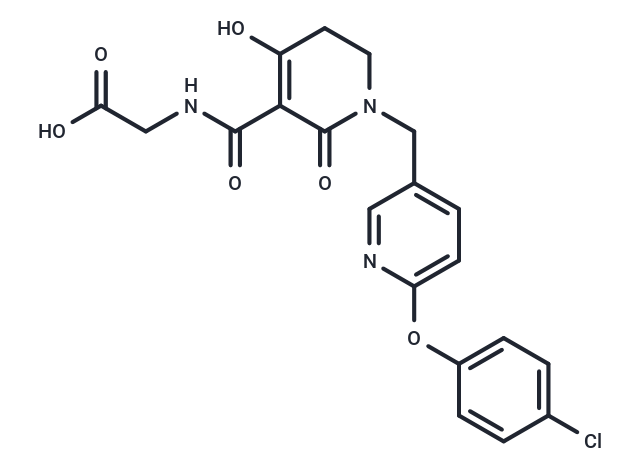
| Description | TP-0463518 is a highly potent HIF prolyl hydroxylase (PHD) inhibitor (IC50s: 13 nM and 18 nM for human and rat PHD2, respectively). |
| Targets & IC50 | PHD1 (human):18 nM (cell free), PHD3 (human):63 nM (cell free), PHD2 (rat):18 nM (cell free), PHD2 (human):13 nM (cell free) |
| In vitro | TP0463518 competitively inhibited human PHD2 with a Ki value of 5.3?nM. TP0463518 also inhibited human PHD1/3 with IC50 values of 18 and 63?nM as well as monkey PHD2 with an IC50 value of 22?nM. |
| In vivo | In normal mice and rats, TP0463518 significantly increased the serum EPO levels at doses of 5 and 20?mg/kg, respectively. TP0463518 also increased the serum EPO level in 5/6 nephrectomized chronic kidney disease model rats at a dose of 10?mg/kg, with a correlation factor for serum EPO and the serum TP0463518 levels of 0.82. TP0463518 was promptly removed with a half-life of 5.2?h and increased the area under the curve (AUC) of EPO at a dose of 5?mg/kg. |
| Kinase Assay | The PHDs inhibition studies were performed using fluorescence polarization.FITC-HIF and 2-oxoglutarate were mixed with enzyme solution in a reaction buffer (20 mM Tris-HCl [pH 7.5],5 mM KCl,1.5 mM MgCl2,10 μM FeSO4,2 mM ascorbic acid,1 mM DTT) with or without various concentrations of TP0463518.The concentrations of FITC-HIF and 2-oxoglutarate were twice the Km values of each enzyme.The reaction temperature was 30?C,and the reaction time was optimized to each PHD enzyme to obtain the initial velocity (9 to 20 min).At the end of the reaction,a stop solution containing 20 mM of EDTA and anti-hydroxylated HIF antibody was added to the reaction buffer.Then,the fluorescence (ex: 480 nm,em: 535 nm) was measured using EnVision to calculate the millipolarization (mP) value.The mP values and the corresponding hydroxylated HIF concentration were proportional,so we used the mP values as the activities.The IC50 values were calculated using SAS version 9.2 using a nonlinear least-squares method.To determine the mode of inhibition,the activity of PHD2 was measured with various concentrations of 2-oxoglutarate (0.025 to 8 μM) and TP0463518 (0 to 40 μM).Then the apparent Vmax and Km corresponding to each TP0463518 concentration were compared.The mode of inhibition was confirmed using a double reciprocal plot. |
| Animal Research | Nine-week-old Balb/c mice were randomly assigned to a vehicle or a 5 to 40 mg/kg dose of TP0463518 group. The mice were orally treated with 0.5% methylcellulose or a TP0463518 dosing suspension. Blood was collected at 6 h after administration from the orbital plexus under deep anesthesia, and euthanasia was performed without awakening. An aliquot of blood was mixed with EDTA, and the remaining blood sample was left to stand at room temperature for 15 min. The samples were then centrifuged (2130 x g for 10 min at 4°C) to prepare the plasma and serum. |
| Molecular Weight | 431.83 |
| Formula | C20H18ClN3O6 |
| Cas No. | 1558021-37-6 |
| Smiles | OC(=O)CNC(=O)C1=C(O)CCN(Cc2ccc(Oc3ccc(Cl)cc3)nc2)C1=O |
| Relative Density. | 1.512 g/cm3 (Predicted) |
| Storage | Powder: -20°C for 3 years | In solvent: -80°C for 1 year Shipping with blue ice/Shipping at ambient temperature. | |||||||||||||||||||||||||||||||||||
| Solubility Information | DMSO: 125 mg/mL (289.47 mM), Sonication is recommended.  | |||||||||||||||||||||||||||||||||||
| In Vivo Formulation | 10% DMSO+90% Saline: < 10 mg/mL (23.16 mM), Lower concentrations may be soluble, but exact solubility limit is unknown. 10% DMSO+40% PEG300+5% Tween 80+45% Saline: 10 mg/mL (23.16 mM), Solution. Please add the solvents sequentially, clarifying the solution as much as possible before adding the next one. Dissolve by heating and/or sonication if necessary. Working solution is recommended to be prepared and used immediately. The formulation provided above is for reference purposes only. In vivo formulations may vary and should be modified based on specific experimental conditions. | |||||||||||||||||||||||||||||||||||
Solution Preparation Table | ||||||||||||||||||||||||||||||||||||
DMSO
Note : The dilution table applies only to solid products. For liquid products, please calculate the stock solution based on the stated concentration and/or density. | ||||||||||||||||||||||||||||||||||||
 For example, if the intended dosage is 10 mg/kg for animals weighing 20 g , with a dosing volume of 100 μL per animal, and a total of 10 animals are to be administered, using a formulation of
  10% DMSO+ 40% PEG300+ 5% Tween 80+ 45% Saline/PBS/ddH2O , the resulting working solution concentration would be 2 mg/mL.
Dissolve 2 mg of the compound in 100 μL DMSO to obtain a stock solution at a concentration of 20 mg/mL . If the required concentration exceeds the compound's known solubility, please contact us for technical support before proceeding.
1) Add 100 μL of the DMSO stock solution to 400 µL PEG300 and mix thoroughly until the solution becomes clear.
2) Add 50 µL Tween 80 and mix well until fully clarified.
3) Add 450 µL Saline,PBS or ddH2O and mix thoroughly until a homogeneous solution is obtained.
| Size | Quantity | Unit Price | Amount | Operation |
|---|
 Feedback
 Hello! How can I help you today?
Copyright © 2015-2026 TargetMol Chemicals Inc. All Rights Reserved.
