


Shopping Cart
Remove All Your shopping cart is currently empty


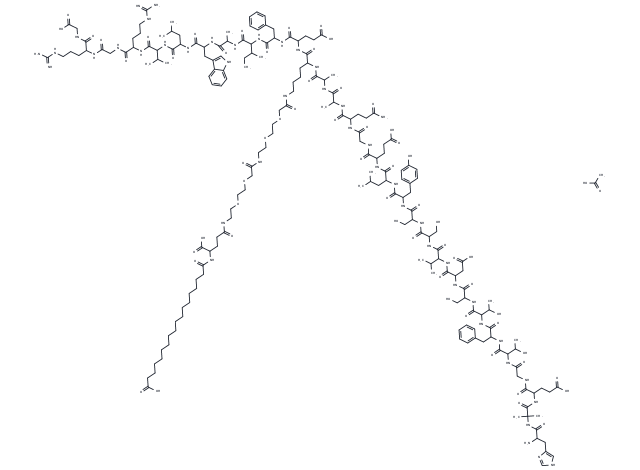
Synonyms: Semaglutide Acetate(910463-68-2 Free base)
| Pack Size | Price | USA Stock | Global Stock | Quantity |
|---|---|---|---|---|
| 500 µg | $129 | In Stock | In Stock | |
| 1 mg | $213 | In Stock | In Stock | |
| 5 mg | $463 | In Stock | In Stock | |
| 10 mg | $662 | In Stock | In Stock | |
| 25 mg | $987 | In Stock | In Stock | |
| 50 mg | $1,370 | In Stock | In Stock | |
| 100 mg | $1,850 | In Stock | In Stock | |
| 200 mg | $2,490 | In Stock | In Stock |
| Description | Semaglutide Acetate is a GLP-1R agonist (EC50=6.2 pM) with long-acting, selective, competitive, and oral efficacy. Semaglutide acetate can be used in the study of type 2 diabetes. |
| Targets & IC50 | GLP1:0.38 nM (Ki) |
| In vitro | METHODS: SH-SY5Y cells were treated with Semaglutide acetate (0, 1, 10, and 100 nM) for 24 hours, and cell viability was measured using MTT assay. RESULTS: Semaglutide acetate significantly increased the survival rate of SH-SY5Y cells. [1] METHODS: SH-SY5Y cells were treated with Semaglutide acetate for 48 hours, and target protein expression was detected using Western Blot. RESULTS: Semaglutide acetate increased the expression of autophagy-related proteins such as LC3II, Atg7, Beclin-1, and P62, inhibited Bax and up-regulated Bcl-2, thereby protecting nerve cells by enhancing autophagy and inhibiting apoptosis. [2] METHODS: Oral squamous cell carcinoma (OSCC) cells were treated with Semaglutide acetate (5-40 μM) for 48 hours, and target protein expression was detected using Western Blot. RESULTS: Semaglutide acetate up-regulated E-cadherin and down-regulated Vimentin, activated P38 MAPK signaling pathway (p-P38 expression increased), and induced cell apoptosis. [3] |
| In vivo | METHODS: To study the antitumor activity of Semaglutide Acetate, Semaglutide (3 μmol/kg) was subcutaneously injected into nude mice with oral squamous cell carcinoma (OSCC) transplanted tumors for 3 weeks per week for 3 consecutive weeks. RESULTS: Semaglutide Acetate significantly inhibited the growth of oral squamous cell carcinoma (OSCC) xenografts in nude mice, down-regulated the proliferation markers Ki67 and PCNA, up-regulated the pro-apoptotic protein Bax and down-regulated the anti-apoptotic protein Bcl-xL. Tumor cell apoptosis was induced by activation of P38 MAPK pathway. [3] METHODS: To investigate the effect of Semaglutide Acetate on Parkinson's disease, a mouse model of chronic MPTP-induced Parkinson's disease was induced by intraperitoneal injection of Semaglutide (25 nmol/kg) every 2 days for 30 consecutive days. RESULTS: Semaglutide Acetate improved chronic MPTP-induced Parkinson's disease and motor dysfunction in mice. Semaglutide acetate increased the number of tyrosine (TH) -positive neurons in the substantia nigra, reduced α-synuclein aggregation and glial cell activation, and decreased the level of oxidative stress marker 4-HNE. [4] METHODS: To study the effect of Semaglutide Acetate on fatty liver disease, metabolic dysfunction associated fatty liver disease (MASLD) mice were subcutaneously injected with Semaglutide (25 μg/kg, 100 μg/kg) once a week for 11 weeks. RESULTS: Semaglutide Acetate reduced body weight, blood glucose, serum liver enzymes (ALT, AST, and AP), reduced intrahepatic triglyceride deposition, ameliorated hepatic steatosis and hepatocyte balloon-like degeneration, and down-regulated de novo lipogenesis markers Acaca and Scd1. [5] |
| Synonyms | Semaglutide Acetate(910463-68-2 Free base) |
| Molecular Weight | 4174.68 |
| Formula | C189H295N45O61 |
| Cas No. | 1997361-85-9 |
| Smiles | CCC(C)C(C(=O)NC(C)C(=O)NC(CC1=CNC2=CC=CC=C21)C(=O)NC(CC(C)C)C(=O)NC(C(C)C)C(=O)NC(CCCNC(=N)N)C(=O)NCC(=O)NC(CCCNC(=N)N)C(=O)NCC(=O)O)NC(=O)C(CC3=CC=CC=C3)NC(=O)C(CCC(=O)O)NC(=O)C(CCCCNC(=O)COCCOCCNC(=O)COCCOCCNC(=O)CCC(C(=O)O)NC(=O)CCCCCCCCCCCCCCCCC(=O)O)NC(=O)C(C)NC(=O)C(C)NC(=O)C(CCC(=O)N)NC(=O)CNC(=O)C(CCC(=O)O)NC(=O)C(CC(C)C)NC(=O)C(CC4=CC=C(C=C4)O)NC(=O)C(CO)NC(=O)C(CO)NC(=O)C(C(C)C)NC(=O)C(CC(=O)O)NC(=O)C(CO)NC(=O)C(C(C)O)NC(=O)C(CC5=CC=CC=C5)NC(=O)C(C(C)O)NC(=O)CNC(=O)C(CCC(=O)O)NC(=O)C(C)(C)NC(=O)C(CC6=CNC=N6)N.CC(=O)O |
| Sequence | H-His-Aib-Glu-Gly-Thr-Phe-Thr-Ser-Asp-Val-Ser-Ser-Tyr-Leu-Glu-Gly-Gln-Ala-Ala-{Lys(AEEA-AEEA-γGlu-18-carboxyheptadecanoyl)}-Glu-Phe-Ile-Ala-Trp-Leu-Val-Arg-Gly-Arg-Gly-OH |
| Sequence Short | HXEGTFTSDVSSYLEGQAAKEFIAWLVRGRG |
| Storage | Keep away from moisture Powder: -20°C for 3 years | In solvent: -80°C for 1 year Shipping with blue ice/Shipping at ambient temperature. | ||||||||||
| Solubility Information | H2O: < 0.05 mg/mL (insoluble)  DMSO: 4.17 mg/mL (1 mM), Sonication and heating are recommended. | ||||||||||
Solution Preparation Table | |||||||||||
DMSO
Note : The dilution table applies only to solid products. For liquid products, please calculate the stock solution based on the stated concentration and/or density. | |||||||||||
 For example, if the intended dosage is 10 mg/kg for animals weighing 20 g , with a dosing volume of 100 μL per animal, and a total of 10 animals are to be administered, using a formulation of
  10% DMSO+ 40% PEG300+ 5% Tween 80+ 45% Saline/PBS/ddH2O , the resulting working solution concentration would be 2 mg/mL.
Dissolve 2 mg of the compound in 100 μL DMSO to obtain a stock solution at a concentration of 20 mg/mL . If the required concentration exceeds the compound's known solubility, please contact us for technical support before proceeding.
1) Add 100 μL of the DMSO stock solution to 400 µL PEG300 and mix thoroughly until the solution becomes clear.
2) Add 50 µL Tween 80 and mix well until fully clarified.
3) Add 450 µL Saline,PBS or ddH2O and mix thoroughly until a homogeneous solution is obtained.
| Size | Quantity | Unit Price | Amount | Operation |
|---|
 Feedback
 Hello! How can I help you today?
Copyright © 2015-2026 TargetMol Chemicals Inc. All Rights Reserved.
