


Shopping Cart
Remove All Your shopping cart is currently empty


Synonyms: Scutellarein-7-glucuronide, Breviscapinun, Breviscapine, Breviscapin
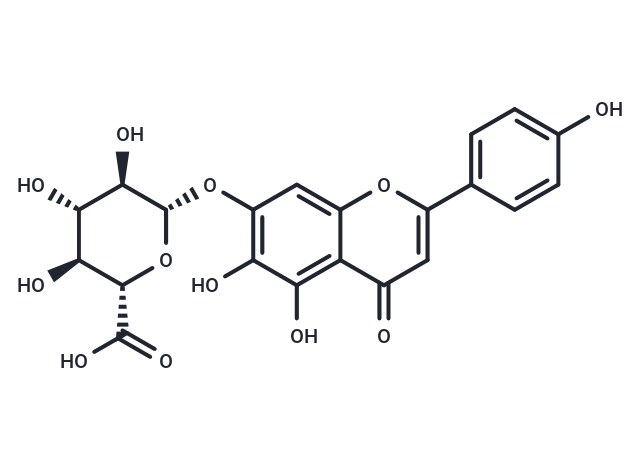
| Pack Size | Price | USA Stock | Global Stock | Quantity |
|---|---|---|---|---|
| 5 mg | $30 | In Stock | In Stock | |
| 10 mg | $41 | In Stock | In Stock | |
| 25 mg | $68 | In Stock | In Stock | |
| 50 mg | $121 | In Stock | In Stock | |
| 100 mg | $155 | In Stock | In Stock | |
| 500 mg | $377 | In Stock | In Stock | |
| 1 mL x 10 mM (in DMSO) | $30 | In Stock | In Stock |
| Description | Scutellarin (Breviscapin) is a natural flavonoid isolated from Scutellaria baicalensis that exhibits antioxidant, anti-inflammatory, antithrombotic, neuroprotective, and cardioprotective and neuroprotective activities. Scutellarin demonstrates antiviral activity against HIV-1 IIIB, HIV-1 (74V), and HIV-1 KM018. Scutellarin inhibits the RANKL-mediated MAPK/NF-κB pathway (IC₅₀ = 10 μM) and activates the Nrf2/HO-1 antioxidant pathway (EC₅₀ = 5 μM). Scutellarin can be used in natural product development and basic research on cardiovascular and cerebrovascular diseases. |
| Targets & IC50 | CYP1A2:95.2 µM (Ki), Rosuvastatin uptake (mediated via hOATP1B3):45.54 ± 6.67 μM, K562 cells viability:6 μM, 4-acetamidophenol:108.20 ± 0.657 µM, Rosuvastatin uptake (mediated via rOATP1B2):27.58 ± 3.97 μM |
| In vitro | Methods: Different concentrations of Scutellarin (0 μg/mL, 23.14 μg/mL, 42.68 μg/mL, 92.56 μg/mL) were added to SF-295 cells and incubated for 48 hours. Apoptosis was detected using flow cytometry. Results: Scutellarin significantly induced apoptosis in a dose-dependent manner, with the apoptosis rate increasing with concentration. [1] Methods: In rat primary liver cells, hepatocytes were co-incubated with RSV (20 μM) and different concentrations of Scutellarin (20, 50, 100 μM) at 37°C for 40 seconds. Intracellular RSV accumulation was detected using LC-MS/MS. Results: Scutellarin inhibited RSV uptake in a concentration-dependent manner: 20 μM inhibited uptake by 4.71%, 50 μM by 22.73%, and 100 μM by 45.89%.[2] |
| In vivo | Methods: Rats were injected with 10 μL of U251 cell suspension (1 × 10⁷ cells/mL) to induce an orthotopic tumor model. They were divided into a DMSO negative control group, a temozolomide positive control group, a low-dose scutellarin treatment group (20 mg/kg), and a high-dose scutellarin treatment group (50 mg/kg). administered intraperitoneally once daily. Results: Scutellarin administration improved animal survival rates. [1] |
| Synonyms | Scutellarein-7-glucuronide, Breviscapinun, Breviscapine, Breviscapin |
| Cell Research | HepG2 cells (1×10⁵/well) are cultured in 96-well plates and treated in triplicate with scutellarin at concentrations of 5, 10, 20, 30, and 100 μM or vehicle alone for 24 h. The cellular viability is tested by 3-(4,5-dimethylthiazol-2-yl)-2,5-diphenyltetrazolium bromide (MTT) assay, and is expressed as a percentage of proliferation versus controls. |
| Molecular Weight | 462.36 |
| Formula | C21H18O12 |
| Cas No. | 27740-01-8 |
| Smiles | O[C@H]1[C@H](Oc2cc3oc(cc(=O)c3c(O)c2O)-c2ccc(O)cc2)O[C@@H]([C@@H](O)[C@@H]1O)C(O)=O |
| Relative Density. | 1.81 g/cm3 |
| Storage | Keep away from direct sunlight Powder: -20°C for 3 years | In solvent: -80°C for 1 year Shipping with blue ice/Shipping at ambient temperature. | |||||||||||||||||||||||||||||||||||
| Solubility Information | DMSO: 240 mg/mL (519.08 mM), Sonication is recommended.  H2O: insoluble | |||||||||||||||||||||||||||||||||||
Solution Preparation Table | ||||||||||||||||||||||||||||||||||||
DMSO
Note : The dilution table applies only to solid products. For liquid products, please calculate the stock solution based on the stated concentration and/or density. | ||||||||||||||||||||||||||||||||||||
 For example, if the intended dosage is 10 mg/kg for animals weighing 20 g , with a dosing volume of 100 μL per animal, and a total of 10 animals are to be administered, using a formulation of
  10% DMSO+ 40% PEG300+ 5% Tween 80+ 45% Saline/PBS/ddH2O , the resulting working solution concentration would be 2 mg/mL.
Dissolve 2 mg of the compound in 100 μL DMSO to obtain a stock solution at a concentration of 20 mg/mL . If the required concentration exceeds the compound's known solubility, please contact us for technical support before proceeding.
1) Add 100 μL of the DMSO stock solution to 400 µL PEG300 and mix thoroughly until the solution becomes clear.
2) Add 50 µL Tween 80 and mix well until fully clarified.
3) Add 450 µL Saline,PBS or ddH2O and mix thoroughly until a homogeneous solution is obtained.
| Size | Quantity | Unit Price | Amount | Operation |
|---|
 Feedback
 Hello! How can I help you today?
Copyright © 2015-2026 TargetMol Chemicals Inc. All Rights Reserved.
