


Shopping Cart
Remove All Your shopping cart is currently empty


Synonyms: SB415286
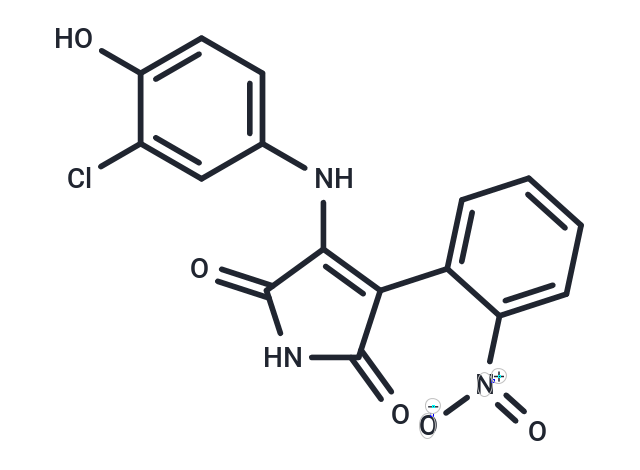

| Pack Size | Price | USA Stock | Global Stock | Quantity |
|---|---|---|---|---|
| 5 mg | $40 | In Stock | In Stock | |
| 10 mg | $64 | In Stock | In Stock | |
| 25 mg | $129 | In Stock | In Stock | |
| 50 mg | $213 | In Stock | In Stock | |
| 100 mg | $347 | In Stock | In Stock | |
| 1 mL x 10 mM (in DMSO) | $43 | In Stock | In Stock |
| Description | SB 415286 is a potent GSK3α inhibitor with IC50/Ki of 78 nM/31 nM with equally effective inhibition of GSK-3β. |
| Targets & IC50 | GSK-3α:78 nM, GSK-3β:31 nM(ki) |
| In vitro | SB 415286 inhibits GSK3α in an ATP competitive manner with Ki of 31 nM and shows similar potency against GSK3β. SB 415286 has little or no activity against 24 other protein kinases with IC50 > 10 μ M. SB 415286 stimulates glycogen synthesis in the Chang human liver cell line with EC50 of 2.9 μM, and induces expression of a β-catenin-LEF/TCF regulated reporter gene in HEK293 cells. [1] SB 415286 protects both central and peripheral nervous system neurones in culture from death induced by reduced PI3-kinase pathway activity in a concentration-dependent manner, which is correlated with inhibition of GSK-3 activity and modulation of GSK-3 substrates tau and β-catenin. [2] In L6 myotubes, SB 415286 induces a much greater activation of GS (6.8-fold) compared to that elicited by insulin (4.2-fold) or Li (4-fold). [3] SB 415286 (10 μM) inhibits rapamycin-induced down-regulation of cyclin D1, and blocks rapamycin and paclitaxel-induced apoptosis, suggesting a critical role for GSK3β in rapamycin-mediated paclitaxel-sensitization. [4] SB 415286 prevents coxsackievirus-induced cell death in a dose-dependent manner via stabilization of β-catenin. [5] SB 415286 exerts a protective effect on hydrogen peroxide-induced cell death in B65 rat neuroblastoma cells and neurons, while lithium does not attenuate the toxic effects of hydrogen peroxide. [7] SB 415286 treatment potentiates TRAIL- and CH-11-induced apoptosis in HepG2 cells. [8] Inhibition of GSK-3 by SB 415286 causes multiple myeloma (MM) cell growth arrest and apoptosis through the activation of the intrinsic pathway. [9] SB 415286 decreases the viability of Neuro-2A cells, and induces the accumulation of cells in the G2/M phase of the cell cycle and subsequent apoptosis. [10] |
| In vivo | Administration of SB 415286 (~10 mg/kg twice daily) reduces the extent and degree of the trinitrobenzene sulphonic acid (TNBS)-provoked colonic inflammation in the rat, and reduces the fall in body weight, which is related to downregulation of NF-κB activity, involved in the generation of proinflammatory mediators. [6] SB 415286 treatment at 1 mg/kg significantly delays the growth of Neuro-2A cells in vivo in nude mice. [10] |
| Synonyms | SB415286 |
| Kinase Assay | GSK-3 activity assay: GSK-3 kinase activity is measured, in the presence of various concentrations of SB 415286, in a reaction mixture containing final concentrations of: 1 nM human GSK3α or rabbit GSK3α; 50 mM MOPS pH 7.0; 0.2 mM EDTA; 10 mM Mg-acetate; 7.5 mM L-mercaptoethanol; 5% (w/v) glycerol; 0.01% (w/v) Tween-20; 10% (v/v) DMSO; 28 μM GS-2 peptide substrate. The GS-2 peptide sequence corresponds to a region of glycogen synthase that is phosphorylated by GSK-3. The assay is initiated by the addition of 0.34 μCi [33P]γ-ATP (IC50 determinations) or 2.7 μCi [33P]γ-ATP (Ki determinations). The total ATP concentration is 10 μM (IC50 determinations) or ranged from 0 to 45 μM (Ki determinations). Following 30 minutes incubation at room temperature the assay is stopped by the addition of one third assay volume of 2.5% (v/v) H3PO4 containing 21 mM ATP. Samples are spotted onto P30 phosphocellulose mats and these are washed six times in 0.5% (v/v) H3PO4. The filter mats are sealed into sample bags containing Wallac betaplate scintillation fluid. 33P incorporation into the substrate peptide is determined by counting the mats in a Wallac microbeta scintillation counter. |
| Cell Research | Cells are exposed to different concentrations of SB 415286 for 48 or 72 hours in 96-flat well plates. After 48 or 72 hours, [3H]thymidine is added to the cultures (10 μCi/well) for the last 12 hours. The [3H]thymidine incorporation is evaluated by scintillation counting by using a top count β-counter. Apoptosis is assessed by annexin V/Propidium Iodide staining or by detection of mitochondrial membrane potential. Cell death is evaluated by the analysis of Forward/Side scatter fluorescence changes. Fluorescence Activated Cell Sorting (FACS) analysis is performed using a FACS-Calibur Cell Cytometer. (Only for Reference) |
| Molecular Weight | 359.72 |
| Formula | C16H10ClN3O5 |
| Cas No. | 264218-23-7 |
| Smiles | Oc1ccc(NC2=C(C(=O)NC2=O)c2ccccc2[N+]([O-])=O)cc1Cl |
| Relative Density. | 1.647 g/cm3 |
| Storage | Powder: -20°C for 3 years | In solvent: -80°C for 1 year Shipping with blue ice/Shipping at ambient temperature. | |||||||||||||||||||||||||||||||||||
| Solubility Information | DMSO: 18 mg/mL (50.04 mM), Sonication is recommended. Ethanol: 9 mg/mL (25.02 mM), Sonication is recommended. | |||||||||||||||||||||||||||||||||||
| In Vivo Formulation | 10% DMSO+40% PEG300+5% Tween 80+45% Saline: 2 mg/mL (5.56 mM), Sonication is recommended. Please add the solvents sequentially, clarifying the solution as much as possible before adding the next one. Dissolve by heating and/or sonication if necessary. Working solution is recommended to be prepared and used immediately. The formulation provided above is for reference purposes only. In vivo formulations may vary and should be modified based on specific experimental conditions. | |||||||||||||||||||||||||||||||||||
Solution Preparation Table | ||||||||||||||||||||||||||||||||||||
Ethanol/DMSO
DMSO
Note : The dilution table applies only to solid products. For liquid products, please calculate the stock solution based on the stated concentration and/or density. | ||||||||||||||||||||||||||||||||||||
 For example, if the intended dosage is 10 mg/kg for animals weighing 20 g , with a dosing volume of 100 μL per animal, and a total of 10 animals are to be administered, using a formulation of
  10% DMSO+ 40% PEG300+ 5% Tween 80+ 45% Saline/PBS/ddH2O , the resulting working solution concentration would be 2 mg/mL.
Dissolve 2 mg of the compound in 100 μL DMSO to obtain a stock solution at a concentration of 20 mg/mL . If the required concentration exceeds the compound's known solubility, please contact us for technical support before proceeding.
1) Add 100 μL of the DMSO stock solution to 400 µL PEG300 and mix thoroughly until the solution becomes clear.
2) Add 50 µL Tween 80 and mix well until fully clarified.
3) Add 450 µL Saline,PBS or ddH2O and mix thoroughly until a homogeneous solution is obtained.
| Size | Quantity | Unit Price | Amount | Operation |
|---|
 Feedback
 Hello! How can I help you today?
Copyright © 2015-2026 TargetMol Chemicals Inc. All Rights Reserved.
