


Shopping Cart
Remove All Your shopping cart is currently empty

Synonyms:
| Pack Size | Price | USA Stock | Global Stock | Quantity |
|---|---|---|---|---|
| 5 mg | $113 | 35 days | 35 days | |
| 10 mg | $218 | 35 days | 35 days | |
| 50 mg | $862 | 35 days | 35 days | |
| 100 mg | $1,530 | 35 days | 35 days |
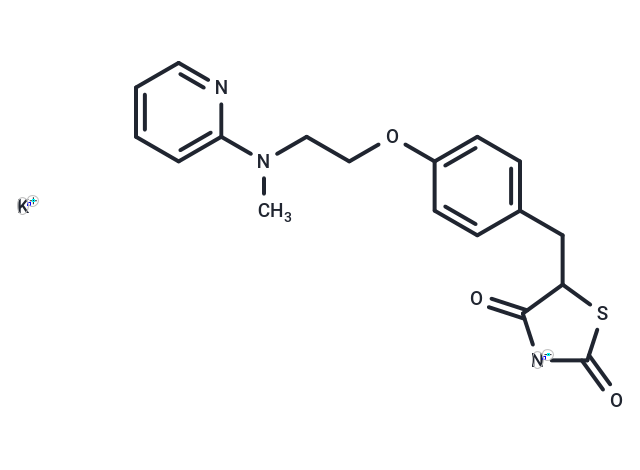
| Description | Rosiglitazone (BRL 49653) potassium, a potent and selective PPARγ agonist (EC 50: 60 nM, Kd: 40 nM) administered orally, also acts as an activator of TRPC5 (EC 50: 30 μM) and an inhibitor of TRPM3. Widely used in research, it has shown promise in investigating obesity, diabetes, senescence, and ovarian cancer [1] [2] [4] [7]. |
| Targets & IC50 | TRPC5:30 μM (EC50), PPARγ:60 nM (EC50), PPARγ:40 nM (Kd) |
| In vitro | Rosiglitazone potassium, across various concentrations and incubation periods, exhibits diverse biological activities. At concentrations ranging from 0.1-10 μM over 72 hours, it promotes the differentiation of pluripotent C3H10T1/2 stem cells into adipocytes. When used at 1 μM for 24 hours, it activates PPARγ, leading to the binding of this receptor to the NF-α1 promoter and the subsequent activation of gene transcription in neurons. Additionally, this concentration and incubation time frame protect Neuro2A cells and hippocampal neurons from oxidative stress by up-regulating BCL-2 expression in an NF-α1-dependent manner. At a range of 0.01-100 μM for 15 minutes, it inhibits TRPM3 channels, demonstrating IC 50 values of 9.5 μM and 4.6 μM against nifedipine- and PregS-evoked activities, respectively. Furthermore, concentrations between 0.5-50 μM over seven days have been shown to inhibit ovarian cancer cell proliferation, while a specific dosage of 5 μM for the same duration counters Olaparib-induced cellular senescence alterations and encourages apoptosis in A2780 and SKOV3 cells. This effect on cell proliferation and apoptosis is supported by Cell Proliferation Assay results, which show a time and concentration-dependent inhibition of cell proliferation in A2780 and SKOV3 cells. Western Blot Analysis further corroborates these findings, indicating increased levels of NF-α1 and BCL-2 proteins in hippocampal neurons treated with 1 μM of rosiglitazone potassium for 24 hours. |
| In vivo | Rosiglitazone potassium, when administered orally at 5 mg/kg daily for 8 weeks, was observed to reduce serum glucose levels in diabetic rats. This same compound, when given through intraperitoneal injection at 3 mg/kg/day, effectively mitigated airway inflammation in male Wistar rats by inhibiting M1 macrophage polarization through the activation of PPARγ and RXRα, a process induced by cigarette smoke exposure. Additionally, a dosage of 10 mg/kg administered intraperitoneally every two days demonstrated a significant inhibition of subcutaneous ovarian cancer growth in A2780 and SKOV3 mouse subcutaneous xenograft models. Detailed evaluations indicated that, in streptozotocin (STZ)-induced diabetic rats, the oral administration led to decreased IL-6, TNF-α, and VCAM-1 levels, along with reduced lipid peroxidation and NOx levels, while also increasing aortic GSH and SOD levels. Similarly, in male Wistar rats, the compound, when injected intraperitoneally twice a day for six days a week over 12 consecutive weeks, not only ameliorated emphysema symptoms and improved pulmonary function but also reduced the total cells, neutrophils, and cytokines (TNF-α and IL-1β) elevated by cigarette smoke. This treatment effectively inhibited cigarette smoke-induced M1 macrophage polarization and decreased the M1/M2 ratio. |
| Molecular Weight | 395.52 |
| Formula | C18H18KN3O3S |
| Cas No. | 316371-84-3 |
| Smiles | [K+].CN(CCOc1ccc(CC2SC(=O)[N-]C2=O)cc1)c1ccccn1 |
| Storage | Powder: -20°C for 3 years | In solvent: -80°C for 1 year Shipping with blue ice/Shipping at ambient temperature. |
 For example, if the intended dosage is 10 mg/kg for animals weighing 20 g , with a dosing volume of 100 μL per animal, and a total of 10 animals are to be administered, using a formulation of
  10% DMSO+ 40% PEG300+ 5% Tween 80+ 45% Saline/PBS/ddH2O , the resulting working solution concentration would be 2 mg/mL.
Dissolve 2 mg of the compound in 100 μL DMSO to obtain a stock solution at a concentration of 20 mg/mL . If the required concentration exceeds the compound's known solubility, please contact us for technical support before proceeding.
1) Add 100 μL of the DMSO stock solution to 400 µL PEG300 and mix thoroughly until the solution becomes clear.
2) Add 50 µL Tween 80 and mix well until fully clarified.
3) Add 450 µL Saline,PBS or ddH2O and mix thoroughly until a homogeneous solution is obtained.
| Size | Quantity | Unit Price | Amount | Operation |
|---|
 Feedback
 Hello! How can I help you today?
Copyright © 2015-2026 TargetMol Chemicals Inc. All Rights Reserved.
