


Shopping Cart
Remove All Your shopping cart is currently empty

Synonyms: RG7167, CH4987655
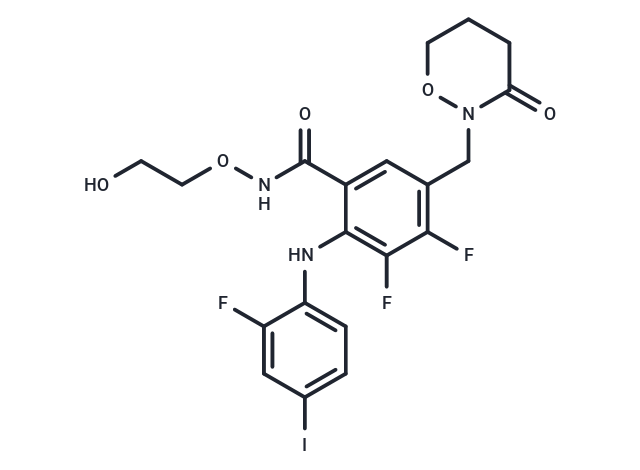

| Pack Size | Price | USA Stock | Global Stock | Quantity |
|---|---|---|---|---|
| 1 mg | $59 | In Stock | In Stock | |
| 2 mg | $85 | In Stock | In Stock | |
| 5 mg | $145 | In Stock | In Stock | |
| 10 mg | $233 | In Stock | In Stock | |
| 25 mg | $397 | In Stock | In Stock | |
| 50 mg | $619 | - | In Stock | |
| 1 mL x 10 mM (in DMSO) | $179 | In Stock | In Stock |
| Description | RO4987655 (RG7167) is an orally active and highly selective MEK inhibitor (IC50: 5.2 nM for MEK1/MEK2). |
| Targets & IC50 | MEK1:5.2 nM (cell free), MEK2:5.2 nM (cell free) |
| In vitro | CH4987655 (RO4987655) potently inhibits mitogen-activated protein kinase signaling pathway activation and tumor cell growth, with an in vitro IC50 of 5.2 nmol/L for inhibition of MEK1/2 [1]. In NCI-H2122 cells, RO4987655 at doses ranging from 0.1 to 1.0 μM suppressed pERK1/2 already at 2 h after the start of treatment. RO4987655 inhibited proliferation of NCI-H2122 cells in a dose-dependent manner with an IC50 value of 0.0065 μM [2]. |
| In vivo | In the dose-ranging study, treatment with RO4987655 5.0 mg/kg led to dramatic decrease in FDG uptake on day 1. The daily RO4987655, 2.5 mg/kg treatment were followed by PET examinations on days 1, 3, and 9 of the drug administration. The maximum decrease was observed on day 1, followed by a slight rebound on day 3. The effect plateaued thereafter to day 9 of treatment [2]. Doses of 0.5, 1, 2, 3, and 4 mg were safe and well-tolerated. A total of 26 adverse events (n = 15) were reported: 21 mild, 5 moderate, and none severe. Moderate adverse events were experienced by one subject at 1 mg (autonomic nervous system imbalance) and three subjects at 4 mg (diarrhea, abdominal pain, autonomic nervous system, and acne) [3]. |
| Synonyms | RG7167, CH4987655 |
| Cell Research | Cells were treated with various concentrations of RO4987655 for 72 h in 96-well plates and viable cells were quantified with Cell Counting Kit-8. For Western blotting, cells were treated with RO4987655 for indicated periods and lysed with cell lysis buffer containing a protease inhibitor cocktail, phosphatase inhibitor cocktails 2 and 3, and 1 mM PMSF. For detection of protein bands, the following were used as primary antibodies: pEGFR, EGFR, pMKK4, MKK4, pAKT, AKT, pERK, ERK, pMEK1/2, MEK, Cyclin D1, and actin. All protein bands were visualized with secondary antibodies labeled with HRP and ECL system by using ImageQuant LAS 4000 [2]. |
| Animal Research | A time interval of 20 to 24 h was used between daily RO4987655 administration and completion of PET imaging for each tumor-bearing mouse and for each PET imaging time point (day 0, 1, 3 and 9). Mice were fasted for 6 to 8 h prior to start of the imaging session. [18F] FDG (7 to 8 MBq per mouse, maximum volume of 200 μL) was administered to awake, warmed (37°C) mice by a bolus injection via the tail vein. Forty to sixty minutes after the tracer injection, the mice were administered with isoflurane, controlled by an E-Z anesthesia vaporizer. The mice were placed on a heated pad (37°C) on the camera bed, with most of the body volume in the field of view (7.68 cm). Emission data were collected for 20 min in list mode with a microPET Focus 120 scanner. Maximum standardized uptake values (SUVmax) of [18F] FDG uptake in the tumor were calculated and normalized to the administered activity (MBq/body weight, g). The drug effect on tumor metabolism was estimated as%SUVmax change to day 0 (baseline) [2]. |
| Molecular Weight | 565.28 |
| Formula | C20H19F3IN3O5 |
| Cas No. | 874101-00-5 |
| Smiles | OCCONC(=O)c1cc(CN2OCCCC2=O)c(F)c(F)c1Nc1ccc(I)cc1F |
| Relative Density. | 1.740 g/cm3 (Predicted) |
| Storage | Powder: -20°C for 3 years | In solvent: -80°C for 1 year Shipping with blue ice/Shipping at ambient temperature. | ||||||||||||||||||||||||||||||
| Solubility Information | DMSO: 35 mg/mL (61.92 mM), Sonication is recommended. | ||||||||||||||||||||||||||||||
| In Vivo Formulation | 10% DMSO+40% PEG300+5% Tween 80+45% Saline: 2 mg/mL (3.54 mM), Sonication is recommended. Please add the solvents sequentially, clarifying the solution as much as possible before adding the next one. Dissolve by heating and/or sonication if necessary. Working solution is recommended to be prepared and used immediately. The formulation provided above is for reference purposes only. In vivo formulations may vary and should be modified based on specific experimental conditions. | ||||||||||||||||||||||||||||||
Solution Preparation Table | |||||||||||||||||||||||||||||||
DMSO
Note : The dilution table applies only to solid products. For liquid products, please calculate the stock solution based on the stated concentration and/or density. | |||||||||||||||||||||||||||||||
 For example, if the intended dosage is 10 mg/kg for animals weighing 20 g , with a dosing volume of 100 μL per animal, and a total of 10 animals are to be administered, using a formulation of
  10% DMSO+ 40% PEG300+ 5% Tween 80+ 45% Saline/PBS/ddH2O , the resulting working solution concentration would be 2 mg/mL.
Dissolve 2 mg of the compound in 100 μL DMSO to obtain a stock solution at a concentration of 20 mg/mL . If the required concentration exceeds the compound's known solubility, please contact us for technical support before proceeding.
1) Add 100 μL of the DMSO stock solution to 400 µL PEG300 and mix thoroughly until the solution becomes clear.
2) Add 50 µL Tween 80 and mix well until fully clarified.
3) Add 450 µL Saline,PBS or ddH2O and mix thoroughly until a homogeneous solution is obtained.
| Size | Quantity | Unit Price | Amount | Operation |
|---|
 Feedback
 Hello! How can I help you today?
Copyright © 2015-2026 TargetMol Chemicals Inc. All Rights Reserved.
