


Shopping Cart
Remove All Your shopping cart is currently empty


Synonyms:
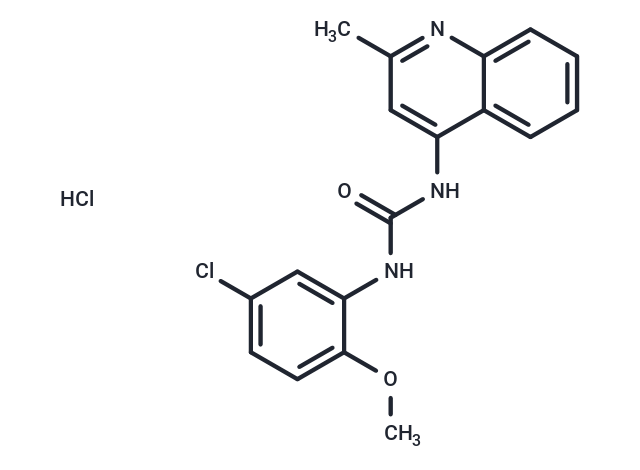
| Pack Size | Price | USA Stock | Global Stock | Quantity |
|---|---|---|---|---|
| 5 mg | $30 | In Stock | In Stock | |
| 10 mg | $40 | In Stock | In Stock | |
| 25 mg | $71 | In Stock | In Stock | |
| 50 mg | $127 | In Stock | In Stock | |
| 100 mg | $211 | In Stock | In Stock | |
| 200 mg | $307 | In Stock | - | |
| 1 mL x 10 mM (in DMSO) | $40 | In Stock | In Stock |
| Description | PQ401 inhibits autophosphorylation of IGF-1R domain with IC50 of <1 μM. |
| Targets & IC50 | IGF-1R:<1 μM |
| In vitro | PQ 401 is an IGF-1R inhibitor and inhibits autophosphorylation of the IGF-IR kinase domain at concentrations <100 nM, with an IC50 <1 μM. PQ 401 significantly reduced proliferation of MCF-7 cells with IC50 of 8 μM. PQ 401 also inhibits growth of MCNeuA cells with IC50 of 15 μM. PQ 401 inhibits the IGF-I-mediated antiapoptotic pathway in MCF-7 cells. PQ 401 increases caspase-mediated apoptotic activity in MCF-7 cells. |
| In vivo | PQ 401 (50 mg/Kg, 100 mg/Kg) significantly inhibits MCNeuA tumor growth in a dose-dependent manner. |
| Kinase Assay | IGF-IR Peptide Autophosphorylation:One microgram of constitutively active IGF-IR kinase domain peptide isincubated +/? varying concentrations of PQ 401 in 2% DMSO in 40 mM Tris (pH 7.4), 80 μMEGTA, 0.25% 2-mercaptoethanol, 80 μM Na3VO4, 10 mM MgCl2, and 2 mM MnCl2 for 20 minutes. ATP is then added at a final concentration of 20 μM. Autophosphorylation of the kinase domain peptide isallowed to occur for 20 minutes at 22℃. The reaction isstopped by the addition of SDS-reducing buffer and the samples are run on SDS-PAGE. Following transfer to nitrocellulose membrane, peptide autophosphorylation isdetermined by Western blotting employing an antibody against phosphotyrosine (PY20). |
| Cell Research | Cell lines: MCF-7,MCNeuA. Concentrations: ~50 μM. Incubation Time: 3 days. Method: The inhibitory effects of diaryl urea on breast cancer cell growth are determined using a CyQuant cell proliferation assay kit.MCF-7 or MCNeuA cells are plated in 96-well plates (5×10³ per well) in phenol red-free DMEM supplemented with 10% FCS.One plate isprepared for each harvest day.Cells are allowed to adhere overnight and are then treated with various concentrations of diaryl urea or DMSO as a vehicle control.Microplate cultures are harvested on days 0,1,2,and 3 by inverting the microplate onto paper towels with gentle blotting to remove growth medium without disrupting adherent cells.Each plate iskept at ?80 ℃ until the end of the experiment (day 3) when all of the plates are thawed and assayed together.After thawing,200 μL of CyQuant GR solution are added to each well and the plates are incubated in the dark for 2 to 5 minutes.Fluorescence ismeasured with a SpectraMax Gemini XS fluorescence microplate reader with 480-nm excitation and 520-nm emission.Proliferation index iscalculated as the percent of nucleotide content versus control cells at day 0. |
| Animal Research | Animal Models: FVB/N-TgN(MMTVneu)202 mouse injected with MCNeuA cells. Formulation: 8% polysorbate 80 and ethanol. Dosages: 50 or 100 mg/kg. Administration: i.p. |
| Molecular Weight | 378.25 |
| Formula | C18H17Cl2N3O2 |
| Smiles | Cl.COc1ccc(Cl)cc1NC(=O)Nc1cc(C)nc2ccccc12 |
| Relative Density. | no data available |
| Storage | Powder: -20°C for 3 years | In solvent: -80°C for 1 year Shipping with blue ice/Shipping at ambient temperature. | |||||||||||||||||||||||||||||||||||
| Solubility Information | DMSO: 45 mg/mL (118.97 mM), Sonication is recommended.  | |||||||||||||||||||||||||||||||||||
Solution Preparation Table | ||||||||||||||||||||||||||||||||||||
DMSO
Note : The dilution table applies only to solid products. For liquid products, please calculate the stock solution based on the stated concentration and/or density. | ||||||||||||||||||||||||||||||||||||
 For example, if the intended dosage is 10 mg/kg for animals weighing 20 g , with a dosing volume of 100 μL per animal, and a total of 10 animals are to be administered, using a formulation of
  10% DMSO+ 40% PEG300+ 5% Tween 80+ 45% Saline/PBS/ddH2O , the resulting working solution concentration would be 2 mg/mL.
Dissolve 2 mg of the compound in 100 μL DMSO to obtain a stock solution at a concentration of 20 mg/mL . If the required concentration exceeds the compound's known solubility, please contact us for technical support before proceeding.
1) Add 100 μL of the DMSO stock solution to 400 µL PEG300 and mix thoroughly until the solution becomes clear.
2) Add 50 µL Tween 80 and mix well until fully clarified.
3) Add 450 µL Saline,PBS or ddH2O and mix thoroughly until a homogeneous solution is obtained.
| Size | Quantity | Unit Price | Amount | Operation |
|---|
 Feedback
 Hello! How can I help you today?
Copyright © 2015-2026 TargetMol Chemicals Inc. All Rights Reserved.
