


Shopping Cart
Remove All Your shopping cart is currently empty


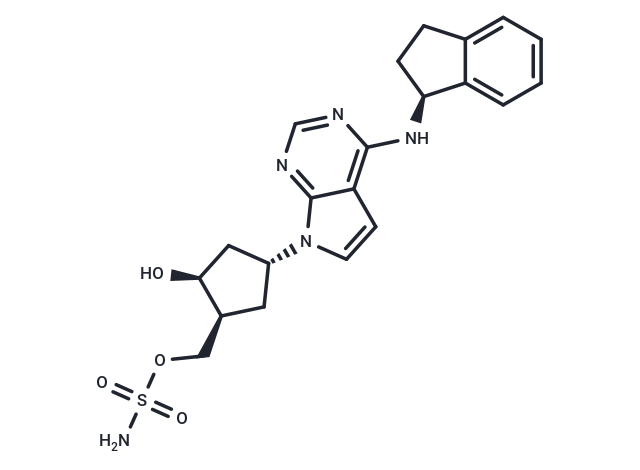
Synonyms: MLN4924
| Pack Size | Price | USA Stock | Global Stock | Quantity |
|---|---|---|---|---|
| 1 mg | $48 | In Stock | In Stock | |
| 2 mg | $64 | In Stock | In Stock | |
| 5 mg | $97 | In Stock | In Stock | |
| 10 mg | $147 | In Stock | In Stock | |
| 25 mg | $272 | In Stock | In Stock | |
| 50 mg | $446 | In Stock | In Stock | |
| 100 mg | $755 | In Stock | In Stock | |
| 1 mL x 10 mM (in DMSO) | $95 | In Stock | In Stock |
| Description | Pevonedistat (MLN4924) is a potent and selective NEDD8 activating enzyme (NAE) inhibitor (IC50=4.7 nM) with therapeutic potential for myelodysplastic syndromes (MDS) and antitumor activity. |
| Targets & IC50 | Neuroblastoma:136-400 nM, EKVX cells:0.3 μM, DU-145 cells:201 nM, HGC-27 cells:1.25 μM, CAPAN-1 cells:101 nM, HuTu80 cells:42.6 nM, HepG2 cells:0.3 μM, HT29 cells:484 nM, BEAS-2B cells:1.22 μM, Huh7 cells:0.3 μM, GES1 cells:13.45 μM, A549 cells:0.63 μM, NAE:4.7 nM, Caco-2 cells:4.4 μM, HCT116 cells:33.89 nM |
| In vitro | METHODS: Nine neuroblastoma cell lines were treated with Pevonedistat (12-1000 nM) for 72 h. Cell viability was measured by MTT. RESULTS: All neuroblastoma cell lines tested were sensitive to Pevonedistat with IC50 values ranging from 136-400 nM. [1] METHODS: Human colorectal cancer cells HCT-116 were treated with Pevonedistat (0.001-3 μM) for 24 h, and the expression levels of target proteins were detected by Western Blot. RESULTS: Pevonedistat treatment resulted in a dose-dependent decrease in Ubc12-NEDD8 thioester and NEDD8-cullin couplings, leading to an increase in the abundance of known CRL substrates CDT1, p27 and NRF2. [2] |
| In vivo | METHODS: To detect anti-tumor activity in vivo, Pevonedistat (30-60 mg/kg in 10% cyclodextrin) was injected subcutaneously into BALB/c mice harboring the human colorectal cancer tumor HCT-116 either once or twice daily for twenty days. RESULTS: Pevonedistat inhibited the growth of HCT-116 xenograft tumors. [2] METHODS: To assay in vivo antitumor activity, Pevonedistat (60 mg/kg, intraperitoneal injection, once daily), venetoclax (50 mg/kg, oral administration, once daily), and azacitidine (8 mg/kg, intravenously three times every seven days) were administered to NSGS mice harboring the AML tumor OCI-AML2-Red- Fluc for fourteen days. RESULTS: Pevonedistat/venetoclax/azacitidine triple therapy induced durable responses in a systemic xenograft model of acute myeloid leukemia. [3] |
| Synonyms | MLN4924 |
| Kinase Assay | Bcl-2 Binding affinity calculation: A predicted binding affinity for Obatoclax binding to BCL-2 is calculated using the SIE scoring function. [4] As a control in determining the reliability of the calculation, predicted binding affinities Ki) are calculated for a set of 12 small molecules with experimentally measured binding affinities to BCL-2. |
| Cell Research | MLN4924 is dissolved in DMSO and stored, and then diluted with appropriate medium before use[1]. HCT-116 cells grown in 6-well cell-culture dishes are treated with 0.1% DMSO (control) or 0.3 μM MLN4924 for 24 h. Whole cell extracts are prepared and analysed by immunoblotting. For analysis of the E2-UBL thioester levels, lysates are fractionated by non-reducing SDS-PAGE and immunoblotted with polyclonal antibodies to Ubc12, Ubc9 and Ubc10. For analysis of other proteins, lysates are fractionated by reducing SDS-PAGE and probed with primary antibodies as follows: mouse monoclonal antibodies to CDT1, p27, geminin, ubiquitin, securin/PTTG and p53 or rabbit polyclonal antibodies to NRF2, Cyclin B1 and GADD34[1]. |
| Molecular Weight | 443.52 |
| Formula | C21H25N5O4S |
| Cas No. | 905579-51-3 |
| Smiles | N(C1=C2C(N(C=C2)[C@@H]3C[C@@H](COS(N)(=O)=O)[C@@H](O)C3)=NC=N1)[C@@H]4C=5C(CC4)=CC=CC5 |
| Relative Density. | 1.62g/cm3 |
| Storage | Store at low temperature,Keep away from moisture Powder: -20°C for 3 years | In solvent: -80°C for 1 year Shipping with blue ice/Shipping at ambient temperature. | |||||||||||||||||||||||||||||||||||
| Solubility Information | DMSO: 62.5 mg/mL (140.92 mM), Sonication is recommended.  | |||||||||||||||||||||||||||||||||||
| In Vivo Formulation | 10% DMSO+40% PEG300+5% Tween 80+45% Saline: 2 mg/mL (4.51 mM), Sonication is recommended. Please add the solvents sequentially, clarifying the solution as much as possible before adding the next one. Dissolve by heating and/or sonication if necessary. Working solution is recommended to be prepared and used immediately. The formulation provided above is for reference purposes only. In vivo formulations may vary and should be modified based on specific experimental conditions. | |||||||||||||||||||||||||||||||||||
Solution Preparation Table | ||||||||||||||||||||||||||||||||||||
DMSO
Note : The dilution table applies only to solid products. For liquid products, please calculate the stock solution based on the stated concentration and/or density. | ||||||||||||||||||||||||||||||||||||
 For example, if the intended dosage is 10 mg/kg for animals weighing 20 g , with a dosing volume of 100 μL per animal, and a total of 10 animals are to be administered, using a formulation of
  10% DMSO+ 40% PEG300+ 5% Tween 80+ 45% Saline/PBS/ddH2O , the resulting working solution concentration would be 2 mg/mL.
Dissolve 2 mg of the compound in 100 μL DMSO to obtain a stock solution at a concentration of 20 mg/mL . If the required concentration exceeds the compound's known solubility, please contact us for technical support before proceeding.
1) Add 100 μL of the DMSO stock solution to 400 µL PEG300 and mix thoroughly until the solution becomes clear.
2) Add 50 µL Tween 80 and mix well until fully clarified.
3) Add 450 µL Saline,PBS or ddH2O and mix thoroughly until a homogeneous solution is obtained.
| Size | Quantity | Unit Price | Amount | Operation |
|---|
 Feedback
 Hello! How can I help you today?
Copyright © 2015-2026 TargetMol Chemicals Inc. All Rights Reserved.
