


Shopping Cart
Remove All Your shopping cart is currently empty


Synonyms: ML323
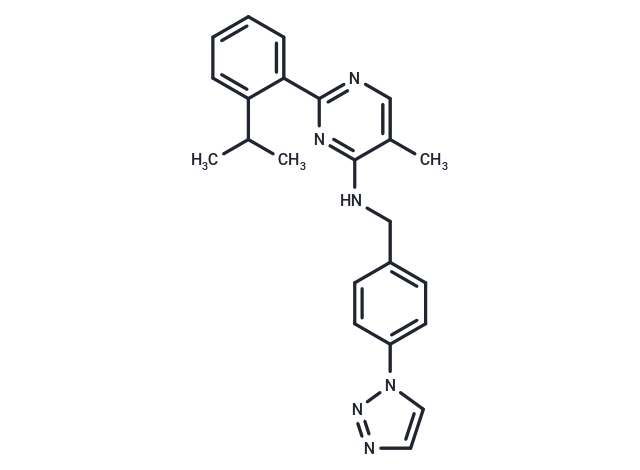

| Pack Size | Price | USA Stock | Global Stock | Quantity |
|---|---|---|---|---|
| 2 mg | $34 | In Stock | In Stock | |
| 5 mg | $53 | In Stock | In Stock | |
| 10 mg | $80 | In Stock | In Stock | |
| 25 mg | $129 | In Stock | In Stock | |
| 50 mg | $169 | In Stock | In Stock | |
| 1 mL x 10 mM (in DMSO) | $59 | In Stock | In Stock |
| Description | ML323 is a reversible and effective USP1-UAF1 inhibitor in a Ub-Rho assay (IC50: 76 nM) and in orthogonal gel-based assays using K63-linked diubiquitin (di-Ub) (IC50: 174 nM 820 nM)and monoubiquitinated PCNA (Ub-PCNA) (IC50: 820 nM) as substrates, respectively. |
| Targets & IC50 | USP1/UAF1:76 nM |
| In vivo | In H596 cells and U2OS osteosarcoma cells, ML323 targets two primary DNA damage response pathways (TLS and FA), enhancing the cytotoxicity of cisplatin. By inhibiting the USP1–UAF1 activity in H596 cells, ML323 suppresses the deubiquitination of PCNA and ANCD2. |
| Synonyms | ML323 |
| Kinase Assay | High-throughput screening: For HTS, USP1-UAF1 activity is monitored using ubiquitin-rhodamine 110 as a substrate, where hydrolysis of the amide bond between the C-terminal glycine of ubiquitin and rhodamine results in an increase in fluorescence. The assay is miniaturized to a 4 μL volume in a 1,536-well format and is used to screen approximately 402,701 compounds in quantitative HTS mode, with each compound tested over a range of four to five concentrations. The assay shows robust performance with an average Z'factor of 0.8 throughout the screen. |
| Cell Research | For the colony-forming assay, cells are seeded at a density of 300–500 cells per well in six-well plates and grown overnight. Cells are then treated with ML323 alone, cisplatin alone or a combination of cisplatin and ML323 (1:1 or 1:4) at the indicated concentrations. Cells treated with an equal volume of DMSO and saline are used as control. After 48 h of treatment, fresh growth medium is added, and cells are incubated for an additional 5-10 d to allow for colony formation. For UV combination treatment, the cells are treated with ML323 at the indicated concentrations or an equal volume of DMSO. After 48 h, the medium is removed, and cells are irradiated at 254 nm at the indicated dosage. Fresh growth medium is added, and the cells are incubated for an additional 5-10 d to allow for colony formation. The cells without UV irradiation but treated with ML323 or an equal volume of DMSO are used as controls and designated as 100%. After the formation of the colonies, cells are fixed with methanol and stained with 0.5% crystal violet. Colonies consisting of >50 cells are scored. The number of colonies is determined from triplicate plates. The dose-response curves are generated using GraphPad Prism and analyzed by using CalcuSyn to calculate the combination index, which is determined for the fraction of cells affected after the addition of fixed ratios of cisplatin and the USP1-UAF1 inhibitor. (Only for Reference) |
| Molecular Weight | 384.48 |
| Formula | C23H24N6 |
| Cas No. | 1572414-83-5 |
| Smiles | CC(C)c1ccccc1-c1ncc(C)c(NCc2ccc(cc2)-n2ccnn2)n1 |
| Relative Density. | 1.20 g/cm3 (Predicted) |
| Storage | Store at low temperature Powder: -20°C for 3 years | In solvent: -80°C for 1 year Shipping with blue ice/Shipping at ambient temperature. | |||||||||||||||||||||||||||||||||||
| Solubility Information | Ethanol: 38.5 mg/mL (100.14 mM), Sonication is recommended. DMSO: 72.5 mg/mL (188.57 mM), Sonication is recommended.  | |||||||||||||||||||||||||||||||||||
| In Vivo Formulation | 10% DMSO+40% PEG300+5% Tween 80+45% Saline: 2 mg/mL (5.2 mM), Sonication is recommended. Please add the solvents sequentially, clarifying the solution as much as possible before adding the next one. Dissolve by heating and/or sonication if necessary. Working solution is recommended to be prepared and used immediately. The formulation provided above is for reference purposes only. In vivo formulations may vary and should be modified based on specific experimental conditions. | |||||||||||||||||||||||||||||||||||
Solution Preparation Table | ||||||||||||||||||||||||||||||||||||
Ethanol/DMSO
Note : The dilution table applies only to solid products. For liquid products, please calculate the stock solution based on the stated concentration and/or density. | ||||||||||||||||||||||||||||||||||||
 For example, if the intended dosage is 10 mg/kg for animals weighing 20 g , with a dosing volume of 100 μL per animal, and a total of 10 animals are to be administered, using a formulation of
  10% DMSO+ 40% PEG300+ 5% Tween 80+ 45% Saline/PBS/ddH2O , the resulting working solution concentration would be 2 mg/mL.
Dissolve 2 mg of the compound in 100 μL DMSO to obtain a stock solution at a concentration of 20 mg/mL . If the required concentration exceeds the compound's known solubility, please contact us for technical support before proceeding.
1) Add 100 μL of the DMSO stock solution to 400 µL PEG300 and mix thoroughly until the solution becomes clear.
2) Add 50 µL Tween 80 and mix well until fully clarified.
3) Add 450 µL Saline,PBS or ddH2O and mix thoroughly until a homogeneous solution is obtained.
| Size | Quantity | Unit Price | Amount | Operation |
|---|
 Feedback
 Hello! How can I help you today?
Copyright © 2015-2026 TargetMol Chemicals Inc. All Rights Reserved.
