


Shopping Cart
Remove All Your shopping cart is currently empty

Synonyms: VLT045, Spermatheridine
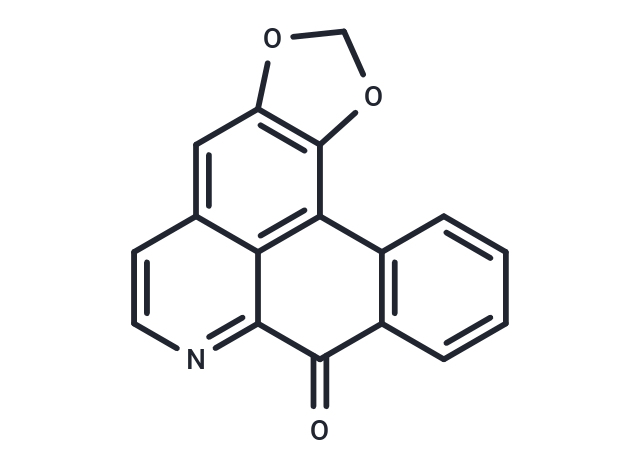
| Pack Size | Price | USA Stock | Global Stock | Quantity |
|---|---|---|---|---|
| 1 mg | $429 | - | In Stock | |
| 5 mg | $2,049 | Inquiry | Inquiry |
| Description | Liriodenine is a natural alkaloid that induces apoptosis in various cancer cells by targeting caspase-3 and caspase-9, and exhibits antimicrobial, antifungal, antitumour, antiviral, and antiplatelet aggregation activities. |
| Targets & IC50 | HEK293 cells:8.07μM, KB cells:9.60 μM, A549 cells:9.20 μM, MLKL (HT-29 cells):11.02 μM, HT29 cells:11.02 μM |
| In vitro | Methods: Liriodenine (0.16-20 μg/mL, 48 hours) was used to treat human oral epidermoid carcinoma (KB), human colon cancer (Col-2 and HT-29), human breast cancer (MCF-7), human lung cancer (Lu-1 and A549), rat glioma (ASK), and noncancerous human embryonic kidney cells (HEK-293), and cytotoxicity was determined using the sulforhodamine B assay. Results: Liriodenine showed IC50 values of 9.60 μM, 11.02 μM, 10.62 μM, 9.20 μM and 8.07 μM for KB, HT-29, MCF-7, A549, ASK, and HEK-293 cells, respectively. [2] |
| In vivo | Methods: Liriodenine (0.01, 0.1 mg/kg, intravenous) was administered to rats to determine whether the effective antiarrhythmic dose of 0.01 mg/kg liriodenine has an effect on left ventricular (LV)-arterial coupling in Wistar rats. Results: Liriodenine at a dose of 0.01 mg/kg did not cause significant changes in basal heart rate (HR), cardiac output (CO), LV end-systolic pressure (Pes), Ea, Ees, and Q load, whereas liriodenine at a dose of 0.1 mg/kg caused a significant decrease in HR by 2.0%, a significant increase in CO by 5.8%, but no significant change in Pes. In addition, administration of 0.1 mg/kg liriodenine to rats significantly decreased Ees by 8.5% and Ea by 10.6%, but did not change Q load. [3] |
| Synonyms | VLT045, Spermatheridine |
| Molecular Weight | 275.26 |
| Formula | C17H9NO3 |
| Cas No. | 475-75-2 |
| Smiles | O=C1C2=NC=CC3=CC=4OCOC4C(C=5C=CC=CC15)=C32 |
| Relative Density. | 1.501g/cm3 |
| Storage | Keep away from moisture Powder: -20°C for 3 years | In solvent: -80°C for 1 year Shipping with blue ice/Shipping at ambient temperature. |
 For example, if the intended dosage is 10 mg/kg for animals weighing 20 g , with a dosing volume of 100 μL per animal, and a total of 10 animals are to be administered, using a formulation of
  10% DMSO+ 40% PEG300+ 5% Tween 80+ 45% Saline/PBS/ddH2O , the resulting working solution concentration would be 2 mg/mL.
Dissolve 2 mg of the compound in 100 μL DMSO to obtain a stock solution at a concentration of 20 mg/mL . If the required concentration exceeds the compound's known solubility, please contact us for technical support before proceeding.
1) Add 100 μL of the DMSO stock solution to 400 µL PEG300 and mix thoroughly until the solution becomes clear.
2) Add 50 µL Tween 80 and mix well until fully clarified.
3) Add 450 µL Saline,PBS or ddH2O and mix thoroughly until a homogeneous solution is obtained.
| Size | Quantity | Unit Price | Amount | Operation |
|---|
 Feedback
 Hello! How can I help you today?
Copyright © 2015-2026 TargetMol Chemicals Inc. All Rights Reserved.
