


Shopping Cart
Remove All Your shopping cart is currently empty

Synonyms: BGB-283, Beigene-283
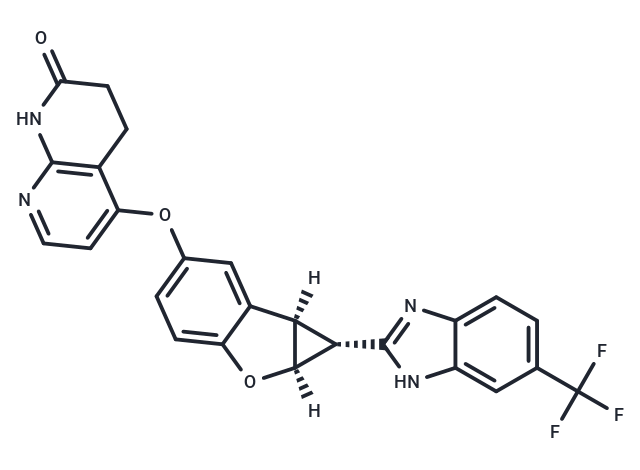
| Pack Size | Price | USA Stock | Global Stock | Quantity |
|---|---|---|---|---|
| 1 mg | $30 | In Stock | In Stock | |
| 5 mg | $63 | In Stock | In Stock | |
| 10 mg | $98 | In Stock | In Stock | |
| 25 mg | $199 | In Stock | In Stock | |
| 50 mg | Preferential | In Stock | In Stock | |
| 100 mg | Preferential | - | In Stock | |
| 1 mL x 10 mM (in DMSO) | $91 | In Stock | In Stock |
| Description | Lifirafenib (Beigene-283) is a potent inhibitor of RAF family kinases and EGFR in biochemical assays with IC50 of 23, 29 and 495 nM for the recombinant BRAFV600E kinase domain, EGFR and EGFR T790M/L858R mutant respectively. |
| Targets & IC50 | EGFR (L858R/T790M):495 nM (IC50), EGFR:29 nM, B-Raf (V600E):23 nM |
| In vitro | Lifirafenib potently inhibits BRAFV600E-activated ERK phosphorylation and cell proliferation. It demonstrates selective cytotoxicity and preferentially inhibits proliferation of cancer cells harboring BRAFV600E and EGFR mutation/amplification.Lifirafenib effectively inhibits the reactivation of EGFR and EGFR-mediated cell proliferation,in BRAFV600E colorectal cancer cell lines. It demonstrates selective cytotoxicity to cell lines harboring BRAFV600E or EGFR mutations. In A431 cells, Lifirafenib inhibits the EGF-induced EGFR autophosphorylation on Tyr1068 in a dose-dependent manner. In WiDr colorectal cancer cells, Lifirafenib inhibits the feedback activation of EGFR signaling and achieves sustained inhibition of pERK[1] |
| In vivo | The treatment of Lifirafenib leads to tumor growth inhibition accompanied by partial and complete tumor regressions in both cell line-derived and primary human colorectal tumor xenografts bearing BRAFV600E mutation in a dose-dependent manner. Lifirafenib has high efficacy in BRAF(V600E) colorectal cancer xenograft models, including Colo205, HT29, and two primary tumor xenografts harboring BRAFV600E mutation. In addition, Lifirafenib shows compelling efficacy in a WiDr xenograft model where EGFR reactivation is shown to be induced upon BRAF inhibition. Lifirafenib induces tumor regression in HCC827 but not in A431 xenograft. Lifirafenib inhibits phosphorylation of both EGFR and ERK1/2 and displays potent antitumor activity in WiDr tumor xenografts. Lifirafenib does not induce EGFR feedback activation as reported for vemurafenib. Lifirafenib potently inhibits DUSP6 expression, ERK and MEK phosphorylation in vivo when dosed repeatedly. There is no detectable difference on AKT phosphorylation[1]. |
| Synonyms | BGB-283, Beigene-283 |
| Molecular Weight | 478.42 |
| Formula | C25H17F3N4O3 |
| Cas No. | 1446090-79-4 |
| Smiles | [H][C@]12Oc3ccc(Oc4ccnc5NC(=O)CCc45)cc3[C@@]1([H])[C@@H]2c1nc2ccc(cc2[nH]1)C(F)(F)F |
| Relative Density. | 1.72 g/cm3 (Predicted) |
| Storage | Store at low temperature Powder: -20°C for 3 years | In solvent: -80°C for 1 year Shipping with blue ice/Shipping at ambient temperature. | ||||||||||||||||||||||||||||||
| Solubility Information | DMSO: 33.3 mg/mL (69.6 mM), Sonication is recommended.  | ||||||||||||||||||||||||||||||
| In Vivo Formulation | 10% DMSO+40% PEG300+5% Tween 80+45% Saline: 3.33 mg/mL (6.96 mM), Solution. 10% DMSO+90% Saline: < 3.33 mg/mL (6.96 mM), Lower concentrations may be soluble, but exact solubility limit is unknown. Please add the solvents sequentially, clarifying the solution as much as possible before adding the next one. Dissolve by heating and/or sonication if necessary. Working solution is recommended to be prepared and used immediately. The formulation provided above is for reference purposes only. In vivo formulations may vary and should be modified based on specific experimental conditions. | ||||||||||||||||||||||||||||||
Solution Preparation Table | |||||||||||||||||||||||||||||||
DMSO
Note : The dilution table applies only to solid products. For liquid products, please calculate the stock solution based on the stated concentration and/or density. | |||||||||||||||||||||||||||||||
 For example, if the intended dosage is 10 mg/kg for animals weighing 20 g , with a dosing volume of 100 μL per animal, and a total of 10 animals are to be administered, using a formulation of
  10% DMSO+ 40% PEG300+ 5% Tween 80+ 45% Saline/PBS/ddH2O , the resulting working solution concentration would be 2 mg/mL.
Dissolve 2 mg of the compound in 100 μL DMSO to obtain a stock solution at a concentration of 20 mg/mL . If the required concentration exceeds the compound's known solubility, please contact us for technical support before proceeding.
1) Add 100 μL of the DMSO stock solution to 400 µL PEG300 and mix thoroughly until the solution becomes clear.
2) Add 50 µL Tween 80 and mix well until fully clarified.
3) Add 450 µL Saline,PBS or ddH2O and mix thoroughly until a homogeneous solution is obtained.
| Size | Quantity | Unit Price | Amount | Operation |
|---|
 Feedback
 Hello! How can I help you today?
Copyright © 2015-2026 TargetMol Chemicals Inc. All Rights Reserved.
