Shopping Cart
Remove All
  • TargetMol
    Your shopping cart is currently empty

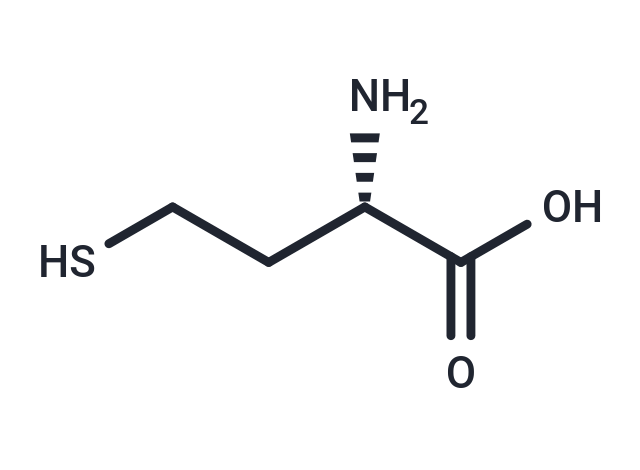
L-Homocysteine

Copy Product Info
😃Good
Catalog No. T19392Cas No. 6027-13-0

L-Homocysteine is a biological thiol involved in various diseases and pathological conditions. It is a marker for atherosclerosis and can exacerbate intestinal inflammation in inflammatory bowel disease (IBD) by promoting the expression of 5-LOX and COX-2, making it suitable for inducing vascular endothelial inflammation models.

L-Homocysteine

L-Homocysteine

Copy Product Info
😃Good
Purity: 99.91%
Catalog No. T19392Cas No. 6027-13-0
L-Homocysteine is a biological thiol involved in various diseases and pathological conditions. It is a marker for atherosclerosis and can exacerbate intestinal inflammation in inflammatory bowel disease (IBD) by promoting the expression of 5-LOX and COX-2, making it suitable for inducing vascular endothelial inflammation models.
Pack SizePriceUSA WarehouseGlobal WarehouseQuantity
10 mg$30In StockIn Stock
25 mg$46In StockIn Stock
50 mg$66In StockIn Stock
100 mg$96In StockIn Stock
200 mg$139-In Stock
Add to Cart
Add to Quotation
In Stock Estimated shipping dateUSA Warehouse[1-2 days] Global Warehouse[5-7 days]
All TargetMol products are for research purposes only and cannot be used for human consumption. We do not provide products or services to individuals. Please comply with the intended use and do not use TargetMol products for any other purpose.
Questions
TargetMol
View More

Batch Information

Select Batch
Purity:99.91%
Appearance:Solid
Color:White
Contact us for more batch information

Resource Download

Product Introduction

Bioactivity
Description
L-Homocysteine is a biological thiol involved in various diseases and pathological conditions. It is a marker for atherosclerosis and can exacerbate intestinal inflammation in inflammatory bowel disease (IBD) by promoting the expression of 5-LOX and COX-2, making it suitable for inducing vascular endothelial inflammation models.
In vitro
L-Homocysteine (100 mM, 24h) promoted the expression of cathepsin V in HUVECs and induced vascular inflammation. [2]
In vivo
L-Homocysteine induced cathepsin V expression in endothelial cells in a mouse model of hyperhomocysteinemia induced by a high methionine diet. [2]
Disease Modeling Protocol
Congenital heart disease model
  • Modeling Mechanism:

    L-Homocysteine enhances the classical Wnt/β-catenin signaling pathway, inhibits the expression of key genes for heart development (Hex, Isl1), and interferes with the differentiation and proliferation of cells in the first and second cardiac fields. At the same time, it damages placental function, leading to intrauterine growth retardation in the embryo, and ultimately causing congenital heart disease such as valvular defects, myocardial hypertrophy, and outflow tract abnormalities.

  • Related Products:

    L-Homocysteine (T19392)

  • Modeling Method:

    Experimental Subject:① Mice, C57BL/6, (Embryos), Intervention at embryonic day 6.75 (E6.75); ② Chicken embryo, White Leghorn, Hamburger-Hamilton (HH) stage 3+/4-5

    Dosage and Administration Route:① Mice: 75 μM L-Homocysteine, 100 μL, intraperitoneal injection (maternal mice, single dose at E6.75); ② Chicken embryo: 50 μM L-Homocysteine, Agarose-Albumin medium incubation (HH stage 3+/4-5, duration 8-24 hours)

    Dosing Frequency and Duration Model:Single dose

  • Validation:

    Mouse Model: Clinical Functions: Echocardiography showed valvular regurgitation (mainly tricuspid and semilunar valves) in 66.1% of embryos, elevated myocardial performance index (MPI), and increased atrial contraction velocity (A wave); Histology: Myocardial hypertrophy, ventricular wall thickening, abnormal tricuspid valve leaflets, and pulmonary valve stenosis with post-stenotic dilatation; Developmental Indicators: Significantly reduced embryonic crown-rump length, body weight, and placental weight, with an absorption rate of 45.7%; Chicken Embryo Model: Phenotypic Characteristics: Cardiac abnormalities (cardiac bifida, left loop, abnormal heart position, etc.) were observed in 78% of embryos, and Hex and Isl1 gene expression was significantly downregulated.

*Precautions: The female mouse was euthanized after an ultrasound examination.

*References:Han M,et,al. Folate rescues lithium-, homocysteine- and Wnt3A-induced vertebrate cardiac anomalies. Dis Model Mech. 2009 Sep-Oct;2(9-10):467-78.

Chemical Properties
Molecular Weight135.19
FormulaC4H9NO2S
Cas No.6027-13-0
Smiles[C@H](CCS)(C(O)=O)N
Relative Density.1.31g/cm3
Storage & Solubility Information
Storagestore at low temperature | Powder: -20°C for 3 years | In solvent: -80°C for 1 year | Shipping with blue ice/Shipping at ambient temperature.
Solubility Information
H2O: 33.3 mg/mL (246.32 mM), Sonication is recommended.

DMSO: < 0.1 mg/mL (insoluble)
Solution Preparation Table
H2O
1mg5mg10mg50mg
1 mM7.3970 mL36.9850 mL73.9700 mL369.8498 mL
5 mM1.4794 mL7.3970 mL14.7940 mL73.9700 mL
10 mM0.7397 mL3.6985 mL7.3970 mL36.9850 mL
20 mM0.3698 mL1.8492 mL3.6985 mL18.4925 mL
50 mM0.1479 mL0.7397 mL1.4794 mL7.3970 mL
100 mM0.0740 mL0.3698 mL0.7397 mL3.6985 mL

Calculator

  • Molarity Calculator
  • Dilution Calculator
  • Reconstitution Calculator
  • Molecular Weight Calculator

In Vivo Formulation Calculator (Clear solution)

Please enter your animal experiment information in the following box and click Calculate to obtain the stock solution preparation method and in vivo formula preparation method:
TargetMol | Animal experiments For example, if the intended dosage is 10 mg/kg for animals weighing 20 g , with a dosing volume of 100 μL per animal, TargetMol | Animal experiments and a total of 10 animals are to be administered, using a formulation of TargetMol | reagent 10% DMSO+ 40% PEG300+ 5% Tween 80+ 45% Saline/PBS/ddH2O , the resulting working solution concentration would be 2 mg/mL.

Stock Solution Preparation:

Dissolve 2 mg of the compound in 100 μL DMSOTargetMol | reagent to obtain a stock solution at a concentration of 20 mg/mL . If the required concentration exceeds the compound's known solubility, please contact us for technical support before proceeding.

Preparation of the In Vivo Formulation:

1) Add 100 μL of the DMSOTargetMol | reagent stock solution to 400 μL PEG300TargetMol | reagent and mix thoroughly until the solution becomes clear.

2) Add 50 μL Tween 80 and mix well until fully clarified.

3) Add 450 μL Saline,PBS or ddH2OTargetMol | reagent and mix thoroughly until a homogeneous solution is obtained.

This example is provided solely to demonstrate the use of the In Vivo Formulation Calculator and does not constitute a recommended formulation for any specific compound. Please select an appropriate dissolution and formulation strategy based on your experimental model and route of administration.
All co-solvents required for this protocol, includingDMSO, PEG300/PEG400, Tween 80, SBE-β-CD, and Corn oil, are available for purchase on the TargetMol website.
1 Enter information below:
mg/kg
g
μL
2 Enter the in vivo formulation:
% DMSO
%
% Tween 80
% Saline/PBS/ddH2O

Dose Conversion

You can also refer to dose conversion for different animals. More Dose Conversion

Tech Support

Please see Inhibitor Handling Instructions for more frequently ask questions. Topics include: how to prepare stock solutions, how to store products, and cautions on cell-based assays & animal experiments, etc

Keywords

Related Tags: buy L-Homocysteine | purchase L-Homocysteine | L-Homocysteine cost | order L-Homocysteine | L-Homocysteine chemical structure | L-Homocysteine in vivo | L-Homocysteine in vitro | L-Homocysteine formula | L-Homocysteine molecular weight