


Shopping Cart
Remove All Your shopping cart is currently empty

Synonyms:
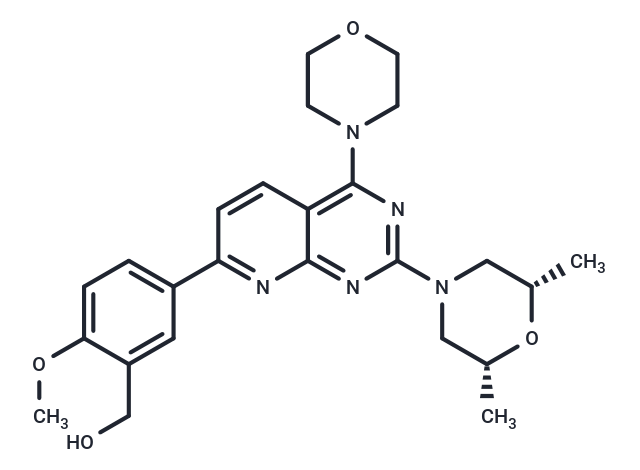

| Pack Size | Price | USA Stock | Global Stock | Quantity |
|---|---|---|---|---|
| 5 mg | $52 | In Stock | In Stock | |
| 10 mg | $72 | In Stock | In Stock | |
| 25 mg | $132 | In Stock | In Stock | |
| 50 mg | $233 | In Stock | In Stock | |
| 100 mg | $432 | In Stock | In Stock | |
| 500 mg | $982 | - | In Stock | |
| 1 mL x 10 mM (in DMSO) | $53 | In Stock | In Stock |
| Description | KU-0063794 is a potent and highly specific dual inhibitor of mTORC1 and mTORC2. |
| Targets & IC50 | mTORC2:10 nM, mTORC1:10 nM |
| In vivo | KU-0063794, unlike Rapamycin, inhibits SGK1 activity and Ser422 phosphorylation in a dose-dependent manner, as well as the phosphorylation of its physiological substrate NDGR1, to the same extent as it does S6K1 and Akt. However, KU-0063794 does not inhibit the phosphorylation and activation of ERK or RSK induced by phorbol ester. Compared to Rapamycin, KU-0063794 demonstrates significantly greater potency in inducing complete dephosphorylation of 4E-BP1 at Thr37, Thr46, and Ser65. It also inhibits the growth of both wild-type and mLST8-deficient MEFs cells, and induces a more pronounced G1 phase cell cycle arrest than Rapamycin. KU-0063794 shows higher specificity towards mTOR compared to the mTOR inhibitor PP242, as it does not affect PI3K or any other of the 76 kinases tested. In HEK-293 cells, 30 nM KU-0063794 is sufficient to rapidly abolish S6K1 activity by blocking phosphorylation at the hydrophobic motif (Thr389) and subsequent phosphorylation at the T-loop residue (Thr229). At concentrations of 100-300 nM, KU-0063794 also completely inhibits amino acid-induced phosphorylation of S6K1 and S6 protein. Similarly, KU-0063794 inhibits the phosphorylation of mTORC1 at Ser2448 and mTORC2 at Ser2481 in a dose- and time-dependent manner. |
| Kinase Assay | mTOR complexes kinase assays: HEK-293 cells are freshly lysed in Hepes lysis buffer. Lysate (1-4 mg) is pre-cleared by incubating with 5-20 μL of Protein G-Sepharose conjugated to pre-immune IgG. The lysate extracts are then incubated with 5-20 μL of Protein G-Sepharose conjugated to 5-20 μg of either anti-Rictor or anti-Raptor antibody, or pre-immune IgG. All antibodies are covalently conjugated to Protein G-Sepharose. Immunoprecipitations are carried out for 1 hour at 4 °C on a vibrating platform. The immunoprecipitates are washed four times with Hepes lysis buffer, followed by two washes with Hepes kinase buffer. For Raptor immunoprecipitates used for phosphorylating S6K1, for the initial two wash steps the buffer includes 0.5 M NaCl to ensure optimal kinase activity. GST-Akt1 is isolated from serum-deprived HEK-293 cells incubated with PI-103 (1 μM for 1 hour). GST-S6K1 is purified from serum-deprived HEK-293 cells incubated with rapamycin (0.1 μM for 1 hour). mTOR reactions are initiated by adding 0.1 mM ATP and 10 mM MgCl2 in the presence of various concentrations of KU-0063794 and GST-Akt1 (0.5 μg) or GST-S6K1 (0.5 μg). Reaction are carried out for 30 minutes at 30 °C on a vibrating platform and stopped by addition of SDS sample buffer. Reaction mixtures are then filtered through a 0.22-μm-poresize Spin-X filter and samples are subjected to electrophoresis and immunoblot analysis with the indicated antibodies. |
| Cell Research | Cells are treated with KU-0063794 for 24, 48, and 72 hours, and the medium is changed every 24 hours with freshly dissolved KU-0063794. For the measurement of cell growth, cells are washed once with PBS, and fixed in 4% (v/v) paraformaldehyde in PBS for 15 minutes. After washing once with water, the cells are stained with 0.1% Crystal Violet in 10% ethanol for 20 minutes and washed three times with water. Crystal Violet is extracted from cells with 0.5 mL of 10% (v/v) ethanoic (acetic) acid for 20 minutes. The eluate is then diluted 1:10 in water and absorbance at 590 nm is quantified. For the assessment of cell cycle distribution, cells are harvested by trypsinization, washed once in PBS, and re-suspended in ice-cold aq. 70% (v/v) ethanol. Cells are washed twice in PBS plus 1% (w/v) BSA and stained for 20 minutes in PBS plus 0.1% (v/v) Triton X-100 containing 50 g/mL propidium iodide and 50 g/mL RNase A. The DNA content of cells is determined using a FACSCalibur flow cytometer and CellQuest software. Red fluorescence (585 nm) is acquired on a linear scale, and pulse width analysis is used to exclude doublets. Cell-cycle distribution is determined using FlowJo software.(Only for Reference) |
| Molecular Weight | 465.54 |
| Formula | C25H31N5O4 |
| Cas No. | 938440-64-3 |
| Smiles | COc1ccc(cc1CO)-c1ccc2c(nc(nc2n1)N1C[C@H](C)O[C@H](C)C1)N1CCOCC1 |
| Relative Density. | 1.248g/cm3 |
| Storage | Powder: -20°C for 3 years | In solvent: -80°C for 1 year Shipping with blue ice/Shipping at ambient temperature. | ||||||||||||||||||||
| Solubility Information | DMSO: 8.06 mg/mL (17.31 mM), Sonication is recommended.  | ||||||||||||||||||||
| In Vivo Formulation | 10% DMSO+40% PEG300+5% Tween 80+45% Saline: 1 mg/mL (2.15 mM), Sonication is recommended. Please add the solvents sequentially, clarifying the solution as much as possible before adding the next one. Dissolve by heating and/or sonication if necessary. Working solution is recommended to be prepared and used immediately. The formulation provided above is for reference purposes only. In vivo formulations may vary and should be modified based on specific experimental conditions. | ||||||||||||||||||||
Solution Preparation Table | |||||||||||||||||||||
DMSO
Note : The dilution table applies only to solid products. For liquid products, please calculate the stock solution based on the stated concentration and/or density. | |||||||||||||||||||||
 For example, if the intended dosage is 10 mg/kg for animals weighing 20 g , with a dosing volume of 100 μL per animal, and a total of 10 animals are to be administered, using a formulation of
  10% DMSO+ 40% PEG300+ 5% Tween 80+ 45% Saline/PBS/ddH2O , the resulting working solution concentration would be 2 mg/mL.
Dissolve 2 mg of the compound in 100 μL DMSO to obtain a stock solution at a concentration of 20 mg/mL . If the required concentration exceeds the compound's known solubility, please contact us for technical support before proceeding.
1) Add 100 μL of the DMSO stock solution to 400 µL PEG300 and mix thoroughly until the solution becomes clear.
2) Add 50 µL Tween 80 and mix well until fully clarified.
3) Add 450 µL Saline,PBS or ddH2O and mix thoroughly until a homogeneous solution is obtained.
| Size | Quantity | Unit Price | Amount | Operation |
|---|
 Feedback
 Hello! How can I help you today?
Copyright © 2015-2026 TargetMol Chemicals Inc. All Rights Reserved.
