


Shopping Cart
Remove All Your shopping cart is currently empty


Synonyms:
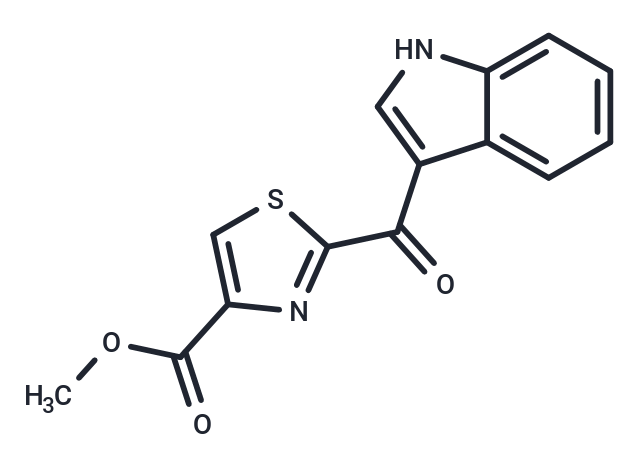

| Pack Size | Price | USA Stock | Global Stock | Quantity |
|---|---|---|---|---|
| 2 mg | $34 | In Stock | In Stock | |
| 5 mg | $55 | In Stock | In Stock | |
| 10 mg | $97 | In Stock | In Stock | |
| 25 mg | $178 | In Stock | In Stock | |
| 50 mg | $313 | In Stock | In Stock | |
| 100 mg | $497 | In Stock | In Stock | |
| 1 mL x 10 mM (in DMSO) | $62 | In Stock | In Stock |
| Description | ITE is a potent endogenous agonist of the aryl hydrocarbon receptor (AhR) (Ki: 3 nM) with immunosuppressive activity. |
| Targets & IC50 | AhR:3 nM (Ki) |
| In vitro | ITE dose- and time-dependently inhibited proliferation of HPAECs with a maximum inhibition of 83% at 20 μM after 6 days of treatment. ITE rapidly decreased AhR protein levels, while it increased mRNA levels of cytochrome P450 (CYP), family 1, member A1 (CYP1A1) and B1 (CYP1B1), indicating activation of the AhR/CYP1A1 and AhR/CYP1B1 pathways in HPAECs. The AhR siRNA significantly suppressed AhR protein expression, whereas it did not significantly alter ITE-inhibited growth of HPAECs[1]. |
| In vivo | ITE diminishes colitis pathology through induction of Tregs; reduces inflammatory cytokines, inflammation score, and macrophage frequency; and induces DCs resulting in amelioration of colitis. Therefore, nontoxic endogenous ITE promotes the induction of Tregs and may be useful for the treatment of IBD[2]. |
| Cell Research | Immunohistochemistry was performed to localize AhR expression in human lung tissues. The crystal violet method and MTT assay were used to determine ITE's effects on growth of HPAECs. The AhR activation in HPAECs was confirmed using Western blotting and RT-qPCR. The role of AhR in ITE-affected proliferation of HPAECs was assessed using siRNA knockdown method followed by the crystal violet method[1] |
| Animal Research | At the start of DSS induction, mice received 100 μl by intraperitoneal injection of vehicle and ITE (10 mg/kg body wt) twice a week on each Monday and Thursday until week 6 at the end point of the experiment. During a pilot study, we used several (5, 10, 20, 40, and 80 mg/kg body wt) doses of ITE and noticed that the 10-mg/kg dose was the lowest dose giving maximum protection. Therefore, Used this dose in entire study. At the experimental end point blood was collected by tail-vein bleedings and serum was obtained following centrifugation. For comparison, a similar treatment was also given to normal BL/6 mice to see the effect of ITE alone[2]. |
| Molecular Weight | 286.31 |
| Formula | C14H10N2O3S |
| Cas No. | 448906-42-1 |
| Smiles | COC(=O)c1csc(n1)C(=O)c1c[nH]c2ccccc12 |
| Relative Density. | 1.427g/cm3 |
| Storage | Powder: -20°C for 3 years | In solvent: -80°C for 1 year Shipping with blue ice/Shipping at ambient temperature. | |||||||||||||||||||||||||||||||||||
| Solubility Information | DMSO: 62.5 mg/mL (218.29 mM), Sonication is recommended.  | |||||||||||||||||||||||||||||||||||
| In Vivo Formulation | 10% DMSO+90% Saline: < 6.25 mg/mL (21.83 mM), Lower concentrations may be soluble, but exact solubility limit is unknown. 10% DMSO+40% PEG300+5% Tween 80+45% Saline: 6.25 mg/mL (21.83 mM), Suspension. Please add the solvents sequentially, clarifying the solution as much as possible before adding the next one. Dissolve by heating and/or sonication if necessary. Working solution is recommended to be prepared and used immediately. The formulation provided above is for reference purposes only. In vivo formulations may vary and should be modified based on specific experimental conditions. | |||||||||||||||||||||||||||||||||||
Solution Preparation Table | ||||||||||||||||||||||||||||||||||||
DMSO
Note : The dilution table applies only to solid products. For liquid products, please calculate the stock solution based on the stated concentration and/or density. | ||||||||||||||||||||||||||||||||||||
 For example, if the intended dosage is 10 mg/kg for animals weighing 20 g , with a dosing volume of 100 μL per animal, and a total of 10 animals are to be administered, using a formulation of
  10% DMSO+ 40% PEG300+ 5% Tween 80+ 45% Saline/PBS/ddH2O , the resulting working solution concentration would be 2 mg/mL.
Dissolve 2 mg of the compound in 100 μL DMSO to obtain a stock solution at a concentration of 20 mg/mL . If the required concentration exceeds the compound's known solubility, please contact us for technical support before proceeding.
1) Add 100 μL of the DMSO stock solution to 400 µL PEG300 and mix thoroughly until the solution becomes clear.
2) Add 50 µL Tween 80 and mix well until fully clarified.
3) Add 450 µL Saline,PBS or ddH2O and mix thoroughly until a homogeneous solution is obtained.
| Size | Quantity | Unit Price | Amount | Operation |
|---|
 Feedback
 Hello! How can I help you today?
Copyright © 2015-2026 TargetMol Chemicals Inc. All Rights Reserved.
