


Shopping Cart
Remove All Your shopping cart is currently empty

Synonyms: Ro 5503781, RG7388
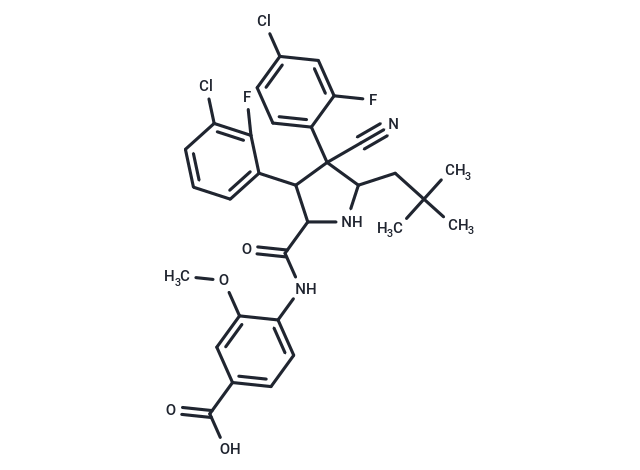
| Pack Size | Price | USA Stock | Global Stock | Quantity |
|---|---|---|---|---|
| 2 mg | $34 | In Stock | In Stock | |
| 5 mg | $55 | In Stock | In Stock | |
| 10 mg | $97 | In Stock | In Stock | |
| 25 mg | $162 | In Stock | In Stock | |
| 50 mg | $238 | In Stock | In Stock | |
| 100 mg | $396 | In Stock | In Stock | |
| 500 mg | $929 | - | In Stock | |
| 1 mL x 10 mM (in DMSO) | $76 | In Stock | In Stock |
| Description | Idasanutlin (Ro 5503781) is a potent, highly selective small-molecule MDM2 inhibitor with an IC₅₀ value of 6 nM. Idasanutlin exerts its antitumor effects primarily by restoring the function of the p53 signaling pathway. Idasanutlin can be used in cancer treatment research. |
| Targets & IC50 | MDM2:6 nM |
| In vitro | Methods: MOLT-3 control and TP53 KO cells were treated with Idasanutlin at a concentration gradient (0.01–10 μM) for 72 hours. Cell viability was assessed using the CellTiter-Glo assay. Results: Idasanutlin exhibited dose-dependent inhibition in TP53 wild-type MOLT-3 cells but was ineffective in TP53 knockout cells, confirming p53-dependent activity. [1] |
| In vivo | Methods: Various T-ALL PDX cell lines (DFCI12, DFCI15, DFAT28537, CBAT27299) were intravenously injected or implanted into NSG mice to establish systemic leukemia models. Tumor burden was monitored by flow cytometry analysis of human CD45⁺ cells. Once tumor establishment was confirmed, mice were randomly assigned to receive oral administration of Idasanutlin (40 mg/kg, administered for 5 consecutive days followed by a 2-day rest period) or Navitoclax (100 mg/kg, once daily) for 14 days. Results: Idasanutlin significantly inhibited leukemia progression and significantly prolonged survival in all four PDX models. [1] Methods: Human GBM10 cells were stereotaxically implanted into the brains of Rag2-null immunodeficient rats to establish an orthotopic tumor model. After tumor maturation (49 days post-implantation), multimodal imaging was performed, followed by oral administration of Idasanutlin (40 mg/kg, administered as 5 consecutive days of dosing followed by 2 days of rest) for a total of 14 days, and intraperitoneal injection of temozolomide (50 mg/m², once daily) for a total of 5 days, to assess overall survival. Results: Compared with the monotherapy group or the control group, the overall survival of rats in the Idasanutlin + temozolomide combination therapy group was significantly prolonged. [2] |
| Synonyms | Ro 5503781, RG7388 |
| Kinase Assay | Biochemical Binding Affinity – HTRF Assay: The p53-MDM2 HTRF assay is performed in buffer containing 50 mM Tris-HCl, pH 7.4, 100 mM NaCl, 1 mM DTT, 0.02 or 0.2 mg/ml BSA. Small-molecule inhibitors are stored in aliquots as 10 mM stock solutions in DMSO at 4°C in 96-deep-well plates. It is thawed and mixed immediately prior to testing. The compound is incubated with GST-MDM2 and a biotinylated p53 peptide for one hour at 37°C. Phycolink goat anti-GST (Type 1) allophycocyanin and Eu-8044-streptavidin are then added and followed by one hour incubation at room temperature. Plates are read using the Envision fluorescence reader. IC50 values are determined from inter-plate duplicate or triplicate sets of data. Data are analyzed by XLfit4 (Microsoft) using a 4 Parameter Logistic Model (Sigmoidal Dose-Response Model) and the equation Y= (A+ ((B-A)/ (1+ ((C/x)^D)))), where A and B are enzyme activity in the absence or presence of infinite inhibitor compound, respectively, C is the IC50 and D is the Hill coefficient. |
| Cell Research | Cell proliferation is evaluated by the tetrazolium dye assay. The concentration at which 50% inhibition (IC50) or 90% inhibition (IC90) of cell proliferation is determined from the linear regression of a plot of the logarithm of the concentration versus percent inhibition. (Only for Reference) |
| Molecular Weight | 616.48 |
| Formula | C31H29Cl2F2N3O4 |
| Cas No. | 1229705-06-9 |
| Smiles | COc1cc(ccc1NC(=O)C1NC(CC(C)(C)C)C(C#N)(C1c1cccc(Cl)c1F)c1ccc(Cl)cc1F)C(O)=O |
| Relative Density. | 1.40 g/cm3 (Predicted) |
| Storage | Powder: -20°C for 3 years | In solvent: -80°C for 1 year Shipping with blue ice/Shipping at ambient temperature. | ||||||||||||||||||||||||||||||||||||||||
| Solubility Information | H2O: < 1 mg/mL (insoluble or slightly soluble) DMSO: 65 mg/mL (105.44 mM), Sonication is recommended.  Ethanol: 8 mg/mL (12.98 mM), Heating is recommended. | ||||||||||||||||||||||||||||||||||||||||
| In Vivo Formulation | 20% Cremophor EL: 5 mg/mL (8.11 mM), Suspension. Please add the solvents sequentially, clarifying the solution as much as possible before adding the next one. Dissolve by heating and/or sonication if necessary. Working solution is recommended to be prepared and used immediately. The formulation provided above is for reference purposes only. In vivo formulations may vary and should be modified based on specific experimental conditions. | ||||||||||||||||||||||||||||||||||||||||
Solution Preparation Table | |||||||||||||||||||||||||||||||||||||||||
Ethanol/DMSO
DMSO
Note : The dilution table applies only to solid products. For liquid products, please calculate the stock solution based on the stated concentration and/or density. | |||||||||||||||||||||||||||||||||||||||||
 For example, if the intended dosage is 10 mg/kg for animals weighing 20 g , with a dosing volume of 100 μL per animal, and a total of 10 animals are to be administered, using a formulation of
  10% DMSO+ 40% PEG300+ 5% Tween 80+ 45% Saline/PBS/ddH2O , the resulting working solution concentration would be 2 mg/mL.
Dissolve 2 mg of the compound in 100 μL DMSO to obtain a stock solution at a concentration of 20 mg/mL . If the required concentration exceeds the compound's known solubility, please contact us for technical support before proceeding.
1) Add 100 μL of the DMSO stock solution to 400 µL PEG300 and mix thoroughly until the solution becomes clear.
2) Add 50 µL Tween 80 and mix well until fully clarified.
3) Add 450 µL Saline,PBS or ddH2O and mix thoroughly until a homogeneous solution is obtained.
| Size | Quantity | Unit Price | Amount | Operation |
|---|
 Feedback
 Hello! How can I help you today?
Copyright © 2015-2026 TargetMol Chemicals Inc. All Rights Reserved.
