


Shopping Cart
Remove All Your shopping cart is currently empty


Synonyms: Hydroxyzine 2HCl
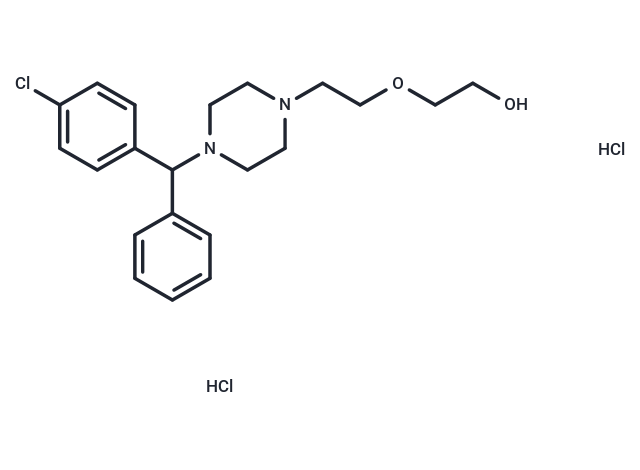
| Pack Size | Price | USA Stock | Global Stock | Quantity |
|---|---|---|---|---|
| 200 mg | $29 | In Stock | In Stock | |
| 500 mg | $35 | In Stock | In Stock | |
| 1 g | $48 | In Stock | In Stock | |
| 1 mL x 10 mM (in DMSO) | $39 | In Stock | In Stock |
| Description | Hydroxyzine dihydrochloride (Hydroxyzine 2HCl) is a histamine H1 receptor antagonist that is effective in the treatment of chronic urticaria, dermatitis, and histamine-mediated pruritus. Unlike its major metabolite CETIRIZINE, it does cause drowsiness. It is also effective as an antiemetic, for relief of anxiety and tension, and as a sedative. |
| Targets & IC50 | H1 receptor:10 nM-19 nM |
| In vitro | In a tail-flick test, intraperitoneal injection of 12.5 mg/kg Hydroxyzine reduced the analgesic effect of morphine in rats; however, an injection of 50 mg/kg Hydroxyzine enhanced the effect of morphine. Furthermore, 500 μM Hydroxyzine significantly decreased the steady-state concentration of etoposide by half, achieving a concentration of 0.055 μM/mL in Sprague-Dawley rats. |
| In vivo | At a concentration of 0.1 mM, Hydroxyzine inhibits 50% of Experimental Autoimmune Encephalomyelitis (EAE) exacerbation in Lewis rats and suppresses 70% of mast cell degranulation. In bladder slices pre-treated with Hydroxyzine, a 60-minute incubation results in a 34% inhibition of 5-hydroxytryptamine release induced by 10 μM carbachol, with 1 μM Hydroxyzine causing a 25% inhibition and 0.1 μM suppressing it by 17%. Additionally, 500 μM Hydroxyzine significantly enhances the transport of digoxin to the serosal side in isolated everted jejunum sacs and notably reduces the efflux of approximately 2.4 μg/mL digoxin in the jejunum and ileum. |
| Synonyms | Hydroxyzine 2HCl |
| Molecular Weight | 447.83 |
| Formula | C21H27ClN2O2·2HCl |
| Cas No. | 2192-20-3 |
| Smiles | C1CN(CCN1CCOCCO)C(c1ccccc1)c1ccc(cc1)Cl.Cl.Cl |
| Relative Density. | 1.182 g/cm3 |
| Storage | Powder: -20°C for 3 years | In solvent: -80°C for 1 year Shipping with blue ice/Shipping at ambient temperature. | |||||||||||||||||||||||||||||||||||
| Solubility Information | H2O: 201 mM, Sonication is recommended. DMSO: 55 mg/mL (122.81 mM), Sonication is recommended.  | |||||||||||||||||||||||||||||||||||
Solution Preparation Table | ||||||||||||||||||||||||||||||||||||
DMSO/H2O
Note : The dilution table applies only to solid products. For liquid products, please calculate the stock solution based on the stated concentration and/or density. | ||||||||||||||||||||||||||||||||||||
 For example, if the intended dosage is 10 mg/kg for animals weighing 20 g , with a dosing volume of 100 μL per animal, and a total of 10 animals are to be administered, using a formulation of
  10% DMSO+ 40% PEG300+ 5% Tween 80+ 45% Saline/PBS/ddH2O , the resulting working solution concentration would be 2 mg/mL.
Dissolve 2 mg of the compound in 100 μL DMSO to obtain a stock solution at a concentration of 20 mg/mL . If the required concentration exceeds the compound's known solubility, please contact us for technical support before proceeding.
1) Add 100 μL of the DMSO stock solution to 400 µL PEG300 and mix thoroughly until the solution becomes clear.
2) Add 50 µL Tween 80 and mix well until fully clarified.
3) Add 450 µL Saline,PBS or ddH2O and mix thoroughly until a homogeneous solution is obtained.
| Size | Quantity | Unit Price | Amount | Operation |
|---|
 Feedback
 Hello! How can I help you today?
Copyright © 2015-2026 TargetMol Chemicals Inc. All Rights Reserved.
