


Shopping Cart
Remove All Your shopping cart is currently empty

Synonyms: Hexachlorofen
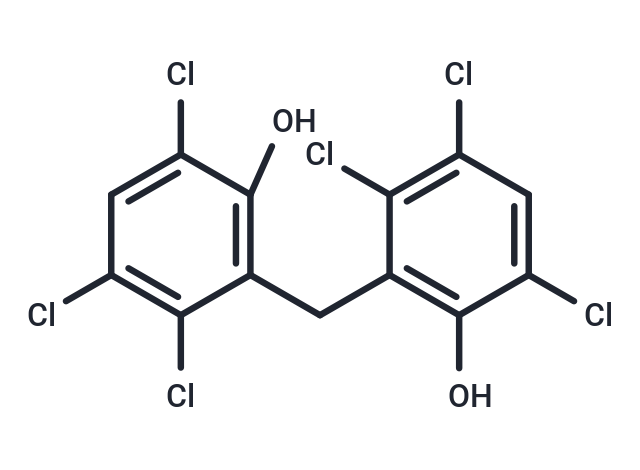
| Pack Size | Price | USA Stock | Global Stock | Quantity |
|---|---|---|---|---|
| 100 mg | $34 | - | In Stock | |
| 200 mg | $40 | - | In Stock |
| Description | Hexachlorophene is an agonist of the KCNQ1/KCNE1 potassium ion channel with an EC50 value of 4.61 μM. Hexachlorophene is also an inhibitor of the Wnt/β-catenin signaling pathway. |
| Targets & IC50 | SARS-CoV:5 μM, KCNQ1/KCNE1:4.61 μM (EC50) |
| In vitro | Hexachlorophene increases KCNQ1/KCNE1 current amplitude within the concentration range of approximately 0.1 - 10 μM, with an EC₅₀ value of 4.61 μM, and shortens action potential duration [1]. At a concentration of 10 μM, Hexachlorophene can rescue the loss-of-function of LQT mutants caused by impaired gating or reduced PIP₂ binding affinity in CHO cells [1]. Within the concentration range of 0 - 50 μg/mL (with approximately 30 minutes of treatment), Hexachlorophene exhibits antibacterial activity against Micrococcus sp., Staphylococcus aureus, Staphylococcus epidermidis, and Streptococcus, with IC₅₀ values of 0.83 μg/mL, 1.5 μg/mL, 1.75 μg/mL, and 1.3 μg/mL, respectively [2]. At a concentration of 20 μM and after 15 hours of treatment, Hexachlorophene inhibits the Wnt/β-catenin signaling pathway in HEK293 and HCT116 cells through Siah-1-mediated β-catenin degradation [3]. Within the concentration range of 0 - 10 μM and after 48 hours of treatment, Hexachlorophene inhibits the growth of HCT116 cells [3]. Hexachlorophene is a competitive inhibitor of the SARS-CoV 3CL protease, with an IC₅₀ value of 5 μM, and forms hydrogen bonds with SARS-CoV 3CL, with an estimated Ki value of 4 μM [4]. |
| In vivo | One day before mice were exposed to Schistosoma mansoni cercariae (Puerto Rico strain, WRAIR source), their tails were treated with a 1.25% w/v Hexachlorophene solution via tail immersion (5 minutes). This treatment exhibited inhibitory activity against schistosome infection in mice [6]. Hexachlorophene possesses acute and subacute toxicity, with a median lethal dose (LD₅₀) range of 21.8–40.0 mg/kg for intraperitoneal injection and 57.6–87.0 mg/kg for oral administration [5]. |
| Synonyms | Hexachlorofen |
| Molecular Weight | 406.9 |
| Formula | C13H6Cl6O2 |
| Cas No. | 70-30-4 |
| Smiles | ClC=1C=C(Cl)C(O)=C(C1Cl)CC=2C(Cl)=C(Cl)C=C(Cl)C2O |
| Storage | Store at low temperature Powder: -20°C for 3 years | In solvent: -80°C for 1 year Shipping with blue ice/Shipping at ambient temperature. |
| Solubility Information | DMSO: ≥ 80 mg/mL, Sonication is recommended. H2O: < 1mg/mL (insoluble) |
| In Vivo Formulation | 10% DMSO+40% PEG300+5% Tween-80+45% Saline: 3.3 mg/mL (8.11 mM), Sonication is recommended. Please add the solvents sequentially, clarifying the solution as much as possible before adding the next one. Dissolve by heating and/or sonication if necessary. Working solution is recommended to be prepared and used immediately. The formulation provided above is for reference purposes only. In vivo formulations may vary and should be modified based on specific experimental conditions. |
 For example, if the intended dosage is 10 mg/kg for animals weighing 20 g , with a dosing volume of 100 μL per animal, and a total of 10 animals are to be administered, using a formulation of
  10% DMSO+ 40% PEG300+ 5% Tween 80+ 45% Saline/PBS/ddH2O , the resulting working solution concentration would be 2 mg/mL.
Dissolve 2 mg of the compound in 100 μL DMSO to obtain a stock solution at a concentration of 20 mg/mL . If the required concentration exceeds the compound's known solubility, please contact us for technical support before proceeding.
1) Add 100 μL of the DMSO stock solution to 400 µL PEG300 and mix thoroughly until the solution becomes clear.
2) Add 50 µL Tween 80 and mix well until fully clarified.
3) Add 450 µL Saline,PBS or ddH2O and mix thoroughly until a homogeneous solution is obtained.
| Size | Quantity | Unit Price | Amount | Operation |
|---|
 Feedback
 Hello! How can I help you today?
Copyright © 2015-2026 TargetMol Chemicals Inc. All Rights Reserved.
