


Shopping Cart
Remove All Your shopping cart is currently empty


Synonyms: NSC 71795 (hydrochloride), Ellipticine HCl
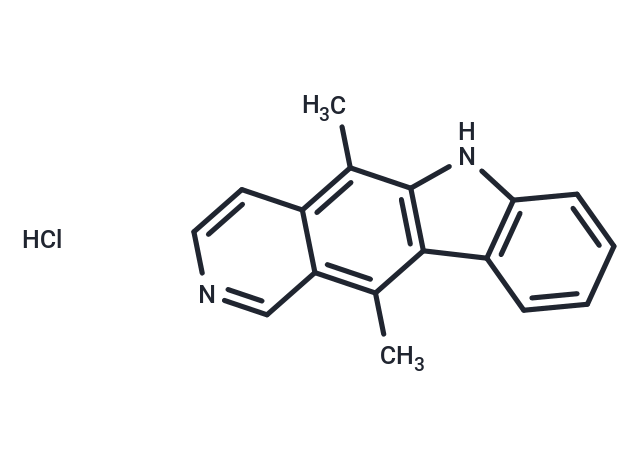
| Pack Size | Price | USA Stock | Global Stock | Quantity |
|---|---|---|---|---|
| 5 mg | $40 | In Stock | In Stock | |
| 10 mg | $60 | In Stock | In Stock | |
| 25 mg | $123 | In Stock | In Stock | |
| 50 mg | $213 | In Stock | In Stock | |
| 1 mL x 10 mM (in DMSO) | $44 | In Stock | In Stock |
| Description | Ellipticine hydrochloride (NSC-71795 (hydrochloride)) is a potent antineoplastic agent; inhibits DNA topoisomerase II activities. |
| In vitro | Ellipticine is a potent antineoplastic agent exhibiting the multimodal mechanism of its action. The mechanisms of ellipticine antitumor, mutagenic and cytotoxic activities are suggested to be intercalation into DNA and inhibition of DNA topoisomerase II activity. Another mode of ellipticine action is the formation of covalent DNA adducts mediated by its oxidation with cytochromes P450 (CYP) and peroxidases[1]. Ellipticine can also act as an inhibitor or inducer of biotransformation enzymes, thereby modulating its own metabolism leading to its genotoxic and pharmacological effects. Treatment of cells with ellipticine results in inhibition of cell growth and proliferation. This effect is associated with formation of two covalent ellipticine-derived DNA adducts[2]. |
| In vivo | Ellipticine treatment results in ellipticine-derived DNA adduct generation in several healthy organs (liver, kidney, lung, spleen, breast, heart and brain) and in DNA of mammary adenocarcinoma. The levels of ellipticine-derived DNA adducts generated in these adenocarcinomas are almost 2-fold higher than in normal healthy mammary tissue. The induced expression of cytochrome b5?protein in liver of rats treated with ellipticine suggests that cytochrome b5?may modulate the CYP-mediated bioactivation and detoxification of ellipticine[3]. |
| Synonyms | NSC 71795 (hydrochloride), Ellipticine HCl |
| Cell Research | The cytotoxicity of ellipticine is determined by MTT test. Ellipticine is dissolved in DMSO (1 mM) and diluted in culture medium to final concentrations of 0, 0.1, 1, 5 or 10 μM. Cells in exponential growth are seeded at 1×10⁴ per well in a 96-well microplate. After incubation the MTT solution is added, the microplates are incubated for 4 hours and cells lysed in 50% N,N-dimethylformamide containing 20% of sodium dodecyl sulfate (SDS), pH 4.5. The absorbance at 570 nm is measured. The mean absorbance of medium controls is subtracted as a background. The viability of control cells is taken as 100% and the values of treated cells are calculated as a percentage of control. The IC50 values are calculated using linear regression of the dose-log response curves[2] . |
| Molecular Weight | 282.76 |
| Formula | C17H15ClN2 |
| Cas No. | 5081-48-1 |
| Smiles | Cl.Cc1c2[nH]c3ccccc3c2c(C)c2cnccc12 |
| Relative Density. | no data available |
| Storage | Store at low temperature,Store under nitrogen Powder: -20°C for 3 years | In solvent: -80°C for 1 year Shipping with blue ice/Shipping at ambient temperature. | ||||||||||||||||||||
| Solubility Information | DMSO: 5.33 mg/mL (18.85 mM), Sonication is recommended.  | ||||||||||||||||||||
| In Vivo Formulation | 10% DMSO+90% Saline: 0.53 mg/mL (1.87 mM), Suspension. Please add the solvents sequentially, clarifying the solution as much as possible before adding the next one. Dissolve by heating and/or sonication if necessary. Working solution is recommended to be prepared and used immediately. The formulation provided above is for reference purposes only. In vivo formulations may vary and should be modified based on specific experimental conditions. | ||||||||||||||||||||
Solution Preparation Table | |||||||||||||||||||||
DMSO
Note : The dilution table applies only to solid products. For liquid products, please calculate the stock solution based on the stated concentration and/or density. | |||||||||||||||||||||
 For example, if the intended dosage is 10 mg/kg for animals weighing 20 g , with a dosing volume of 100 μL per animal, and a total of 10 animals are to be administered, using a formulation of
  10% DMSO+ 40% PEG300+ 5% Tween 80+ 45% Saline/PBS/ddH2O , the resulting working solution concentration would be 2 mg/mL.
Dissolve 2 mg of the compound in 100 μL DMSO to obtain a stock solution at a concentration of 20 mg/mL . If the required concentration exceeds the compound's known solubility, please contact us for technical support before proceeding.
1) Add 100 μL of the DMSO stock solution to 400 µL PEG300 and mix thoroughly until the solution becomes clear.
2) Add 50 µL Tween 80 and mix well until fully clarified.
3) Add 450 µL Saline,PBS or ddH2O and mix thoroughly until a homogeneous solution is obtained.
| Size | Quantity | Unit Price | Amount | Operation |
|---|
 Feedback
 Hello! How can I help you today?
Copyright © 2015-2026 TargetMol Chemicals Inc. All Rights Reserved.
