


Shopping Cart
Remove All Your shopping cart is currently empty


Synonyms:

| Pack Size | Price | USA Stock | Global Stock | Quantity |
|---|---|---|---|---|
| 1 mg | $43 | In Stock | In Stock | |
| 2 mg | $61 | In Stock | In Stock | |
| 5 mg | $98 | In Stock | In Stock | |
| 10 mg | $148 | In Stock | In Stock | |
| 25 mg | $252 | In Stock | In Stock | |
| 50 mg | $375 | In Stock | In Stock | |
| 100 mg | $553 | In Stock | In Stock | |
| 1 mL x 10 mM (in DMSO) | $112 | In Stock | In Stock |
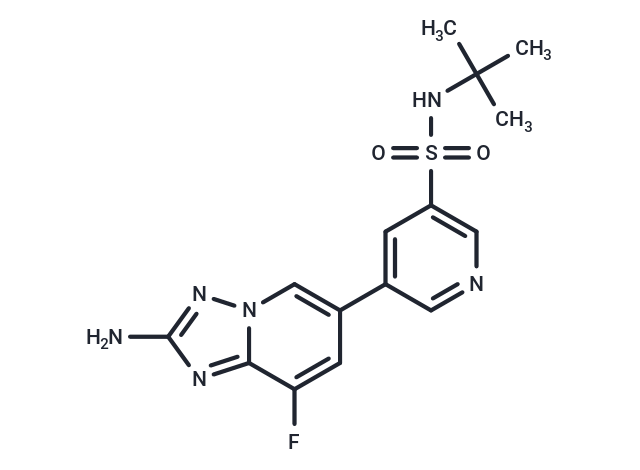
| Description | CZC24832 is a selective inhibitor of PI 3-kinase γ. |
| Targets & IC50 | PI3Kγ:27 nM, PI3Kβ:1.1 μM, PI3Kδ:8.194 μM |
| In vitro | In a therapeutic model of collagen-induced arthritis (CIA), mice administered 10 mg/kg of CZC24832 orally twice daily exhibited significant reductions in both bone and cartilage destruction and overall clinical parameters. Additionally, in an IL-8-dependent air-pouch model, CZC24832 demonstrated a dose-dependent decrease in granulocyte recruitment, consistent with the level of inhibition observed in mice lacking PI3Kγ. |
| In vivo | In the BT system, treatment with CZC24832 significantly inhibits IL-17A (IC50 = 1.5 μM) as well as B-cell activation markers, such as IL-6 and IgG. Moreover, in T-cell systems, such as in human umbilical vein endothelial cells, the production of IL17A is strongly suppressed, indicating that PI3Kγ kinase activity plays a broad role in the functionality of TH17 cells. Accordingly, CZC24832 inhibits the differentiation of TH17 cells. A high-throughput screening of 154 lipid and protein kinases, alongside 922 other proteins, identified only PI3Kβ and PIP4K2C as off-target proteins within a 100-fold selectivity window. |
| Kinase Assay | AZD4547 kinase activity: The ability of AZD4547 to inhibit the human recombinant kinase activities of FGFR1-3 is tested using ATP concentrations at, or just below, the respective Km. |
| Molecular Weight | 364.4 |
| Formula | C15H17FN6O2S |
| Cas No. | 1159824-67-5 |
| Smiles | CC(C)(C)NS(=O)(=O)c1cncc(c1)-c1cc(F)c2nc(N)nn2c1 |
| Relative Density. | 1.51 g/cm3 |
| Storage | Powder: -20°C for 3 years | In solvent: -80°C for 1 year Shipping with blue ice/Shipping at ambient temperature. | ||||||||||||||||||||||||||||||
| Solubility Information | DMSO: 36.4 mg/mL (99.89 mM), Sonication is recommended. | ||||||||||||||||||||||||||||||
| In Vivo Formulation | 10% DMSO+90% Corn Oil: 2 mg/mL (5.49 mM), Sonication is recommended. Please add the solvents sequentially, clarifying the solution as much as possible before adding the next one. Dissolve by heating and/or sonication if necessary. Working solution is recommended to be prepared and used immediately. The formulation provided above is for reference purposes only. In vivo formulations may vary and should be modified based on specific experimental conditions. | ||||||||||||||||||||||||||||||
Solution Preparation Table | |||||||||||||||||||||||||||||||
DMSO
Note : The dilution table applies only to solid products. For liquid products, please calculate the stock solution based on the stated concentration and/or density. | |||||||||||||||||||||||||||||||
 For example, if the intended dosage is 10 mg/kg for animals weighing 20 g , with a dosing volume of 100 μL per animal, and a total of 10 animals are to be administered, using a formulation of
  10% DMSO+ 40% PEG300+ 5% Tween 80+ 45% Saline/PBS/ddH2O , the resulting working solution concentration would be 2 mg/mL.
Dissolve 2 mg of the compound in 100 μL DMSO to obtain a stock solution at a concentration of 20 mg/mL . If the required concentration exceeds the compound's known solubility, please contact us for technical support before proceeding.
1) Add 100 μL of the DMSO stock solution to 400 µL PEG300 and mix thoroughly until the solution becomes clear.
2) Add 50 µL Tween 80 and mix well until fully clarified.
3) Add 450 µL Saline,PBS or ddH2O and mix thoroughly until a homogeneous solution is obtained.
| Size | Quantity | Unit Price | Amount | Operation |
|---|
 Feedback
 Hello! How can I help you today?
Copyright © 2015-2026 TargetMol Chemicals Inc. All Rights Reserved.
