


Shopping Cart
Remove All Your shopping cart is currently empty

Synonyms:
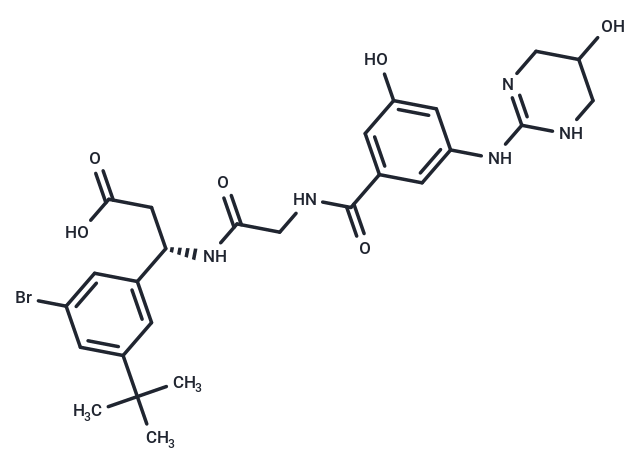

| Pack Size | Price | USA Stock | Global Stock | Quantity |
|---|---|---|---|---|
| 1 mg | $34 | In Stock | In Stock | |
| 2 mg | $48 | In Stock | In Stock | |
| 5 mg | $80 | In Stock | In Stock | |
| 10 mg | $128 | In Stock | In Stock | |
| 25 mg | $233 | In Stock | In Stock | |
| 50 mg | $389 | - | In Stock | |
| 100 mg | $579 | - | In Stock | |
| 1 mL x 10 mM (in DMSO) | $97 | In Stock | In Stock |
| Description | CWHM-12 is a potent inhibitor of αV integrins, with IC50 values of 0.2, 0.8, 1.5, and 1.8 nM for αvβ8, αvβ3, αvβ6, and αvβ1, respectively. |
| Targets & IC50 | αvβ6 integrin:1.5 nM, αvβ5 integrin:61 nM, αvβ1 integrin:1.8 nM, αvβ8 integrin:0.2 nM, αvβ3 integrin:0.8 nM |
| In vitro | CWHM-12 also less potently inhibits αvβ5 (IC50: 61 nM) and αIIbβ3/α2β1/α10β1 (IC50>5000 nM). CWHM-12 demonstrates high potency against all of the five possible β subunit binding partners (αvβ1, αvβ3, αvβ5, αvβ6, and αvβ8) in in vitro ligand-binding assays, with somewhat less potency against αvβ5 than against the other αv integrins. |
| In vivo | Mice are treated with CCl4 for 3 weeks to establish fibrotic disease and then treated with CWHM-12 or vehicle for the final 3 weeks of CCl4. CWHM-12 significantly reduces liver fibrosis even after the fibrotic disease has been established. Digital image quantitation demonstrates significantly reduced p-SMAD3 signaling in the livers of CWHM-12 treated mice compared to controls, demonstrating that the protection from CCl4-induced hepatic fibrosis observed in CWHM-12 treated mice is due at least in part to a reduction in TGF-β activation by αv integrins. Besides, the administration of CWHM-12 significantly inhibited the progression of pulmonary fibrosis. |
| Kinase Assay | Functions of integrins αvβ1, αvβ8, α2β1, and α10β1 are measured using cell-free receptor-ligand interaction assays using purified recombinant human integrins. Ligands used are human fibronectin for αvβ1, human LAP for αvβ8, bovine collagen II for α2β1, and murine laminin I for α10β1. 96-well plates are coated with the predetermined optimal concentration of ligand overnight, washed 3X with TBS+++ (25 mM Tris pH7.4, 137 mM NaCl, 2.7 mM KCl, 1 mM MgCl2, 1 mM MnCl2, 1mM CaCl2), and blocked with TBS+++/1%BSA. Purified integrin is diluted in TBS+++/0.1%BSA with or without compounds (e.g., CWHM-12), and the solution added to empty wells of the washed ligand-coated plate according to a standard template, with each sample repeated in triplicate. After incubation for 2 hr at room temperature, the plate is washed 3X with TBS+++. Biotin-labeled antibody against the αv subunit (αvβ1, αvβ8 assays) or β1 subunit (α2β1, α10β1 assays) is applied for 1 hr. The plate is washed 3X with TBS/0.1%BSA. Streptavidin-conjugated horseradish peroxidase is added to the wells, and the plate incubated for 20 min at room temperature. Following a 3X TBS+++ wash, bound integrin is detected using streptavidin-conjugated horseradish peroxidase and TMB substrate with absorbance measured at 650 nm. For assay of αIIbβ3 (IIbIIIa) function, plates are coated with the purified human integrin overnight, washed 3X with TBS+++, and blocked with TBS+++/1%BSA. Alexa Fluor647-labeled purified human fibrinogen is diluted in TBS+++/0.1%BSA with or without compounds, and the solutions are added to the integrin-coated plate. After 2 hr incubation, the plate is washed 3X with TBS+++, and the bound ligand is detected by absorbance measured at 640/668nm. For all assays, concentration-response curves are constructed by non-linear regression analysis and IC50 values are calculated using GraphPad Prism software. |
| Cell Research | The stably transfected human 293 cells over-expressing human αvβ3 or αvβ5 are pre-incubated in HBSS buffer containing 200 μM MnCl2 for 30 min at 37°C with 3-fold dilutions of compound (e.g., CWHM-12). Each sample is then added to triplicate wells of a 96-well plate which has been coated overnight at 4°C with a predetermined optimal concentration of purified vitronectin, washed, blocked by 1 hr incubation with BSA, and washed again. Cells are allowed to attach for 30 min at 37°C, and non-adherent cells are removed by washing. Remaining attached cells are measured by endogenous alkaline phosphatase activity using para-nitrophenyl phosphate and reading absorbance signal at 405 nM. The same procedure is used to measure adhesion of αvβ6-expressing human HT-29 cells to purified human latency-associated peptide, and α5β1-expressing human K562 cells to human plasma fibronectin. In all cell-based assays, binding by the expected integrin is verified by the testing activity of corresponding isotype-matched positive (function-blocking) and negative control antibodies. |
| Animal Research | The mTmG (Td tomato/EGFP) and Ai14 (Rosa-CAG-LSL-tdTomato-WPRE) mice are used and crossed with Pdgfrb-Cre mice. Wild type C57/BL6 mice, Itgavflox/flox mice, and itgb8flox/flox mice are used. Mice used for all experiments are 8-12 weeks old and are housed under specific pathogen-free conditions. For all studies, CWHM-12 and CWHM-96 are solubilized in 50% DMSO (in sterile water) and dosed to 100 mg/kg/day. Drug or vehicle (50% DMSO) is delivered by implantable ALZET osmotic minipumps. For CCl4-induced fibrosis, pumps are inserted subcutaneously either before the first dose of CCl4 (prophylactic) or after 3 weeks of treatment (therapeutic) and livers are harvested after 6 weeks. For Bleomycin-induced fibrosis pumps are inserted 14 days after treatment with Bleomycin or saline and lungs are harvested at 28 days. |
| Molecular Weight | 590.47 |
| Formula | C26H32BrN5O6 |
| Cas No. | 1564286-55-0 |
| Smiles | CC(C)(C)c1cc(Br)cc(c1)[C@H](CC(O)=O)NC(=O)CNC(=O)c1cc(O)cc(NC2=NCC(O)CN2)c1 |
| Relative Density. | 1.52 g/cm3 (Predicted) |
| Storage | Powder: -20°C for 3 years | In solvent: -80°C for 1 year Shipping with blue ice/Shipping at ambient temperature. | |||||||||||||||||||||||||||||||||||
| Solubility Information | DMSO: 150 mg/mL (254.03 mM), Sonication is recommended.  | |||||||||||||||||||||||||||||||||||
| In Vivo Formulation | 10% DMSO+40% PEG300+5% Tween 80+45% Saline: 10 mg/mL (16.94 mM), Solution. 10% DMSO+90% Saline: < 10 mg/mL (16.94 mM), Lower concentrations may be soluble, but exact solubility limit is unknown. Please add the solvents sequentially, clarifying the solution as much as possible before adding the next one. Dissolve by heating and/or sonication if necessary. Working solution is recommended to be prepared and used immediately. The formulation provided above is for reference purposes only. In vivo formulations may vary and should be modified based on specific experimental conditions. | |||||||||||||||||||||||||||||||||||
Solution Preparation Table | ||||||||||||||||||||||||||||||||||||
DMSO
Note : The dilution table applies only to solid products. For liquid products, please calculate the stock solution based on the stated concentration and/or density. | ||||||||||||||||||||||||||||||||||||
 For example, if the intended dosage is 10 mg/kg for animals weighing 20 g , with a dosing volume of 100 μL per animal, and a total of 10 animals are to be administered, using a formulation of
  10% DMSO+ 40% PEG300+ 5% Tween 80+ 45% Saline/PBS/ddH2O , the resulting working solution concentration would be 2 mg/mL.
Dissolve 2 mg of the compound in 100 μL DMSO to obtain a stock solution at a concentration of 20 mg/mL . If the required concentration exceeds the compound's known solubility, please contact us for technical support before proceeding.
1) Add 100 μL of the DMSO stock solution to 400 µL PEG300 and mix thoroughly until the solution becomes clear.
2) Add 50 µL Tween 80 and mix well until fully clarified.
3) Add 450 µL Saline,PBS or ddH2O and mix thoroughly until a homogeneous solution is obtained.
| Size | Quantity | Unit Price | Amount | Operation |
|---|
 Feedback
 Hello! How can I help you today?
Copyright © 2015-2026 TargetMol Chemicals Inc. All Rights Reserved.
