


Shopping Cart
Remove All Your shopping cart is currently empty


Synonyms:
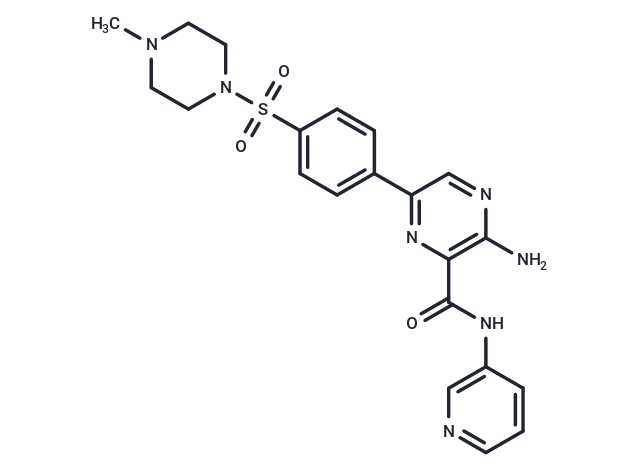

| Pack Size | Price | USA Stock | Global Stock | Quantity |
|---|---|---|---|---|
| 1 mg | $30 | In Stock | In Stock | |
| 5 mg | $68 | In Stock | In Stock | |
| 10 mg | $103 | In Stock | In Stock | |
| 25 mg | $189 | In Stock | In Stock | |
| 50 mg | $297 | In Stock | In Stock | |
| 100 mg | $413 | In Stock | In Stock | |
| 1 mL x 10 mM (in DMSO) | $82 | In Stock | In Stock |
| Description | AZD2858 is a selective GSK-3 inhibitor, inhibiting tau phosphorylation at the S396 site and activating Wnt signaling pathway. |
| Targets & IC50 | GSK-3α:0.9 nM, CDK1-CyclinB:1246 nM, Haspin:366 nM, CDK2-CyclinA:810 nM, TLK2:1381 nM, GSK-3:68 nM, GSK-3β:5 nM, PKD2:2462 nM, CDK5-p25:356 nM, Aurora A:4966 nM, CDK2-CyclinE:3310 nM, DYRK2:491 nM, PIM3:1269 nM, CDK5-p35:387 nM |
| In vitro | After three weeks of treatment with 30 μM/kg AZD2858, rats exhibited increases in bone callus mineral density (28% at 2 weeks, 38% at 3 weeks) and mineral content (81% at two weeks, 93% at three weeks). Treatment with AZD2858 for 28 days resulted in time-dependent changes in serum markers of bone turnover, along with an increase in bone density. Within 7 days of AZD2858 treatment, the bone formation marker P1NP increased, and the resorption marker TRAcP-5b decreased, indicating enhanced bone metabolism and reduced absorption in rats. Oral administration of AZD2858 for two weeks led to a dose-dependent increase in bone density compared to the control group, with the greatest efficacy observed at a daily dose of 20 mg/kg (total BMC: 172% of the control group). AZD2858 treatment expedited bone fracture healing, with the presence of a bony callus and no significant cartilage components. |
| In vivo | AZD2858 induces β-catenin stabilization in human and rat mesenchymal stem cells, activating osteoblasts and osteogenic mineralization in vitro. Treatment with AZD2858 (1 μM, 12 hours) on primary isolated human osteoblast-like cells results in a three-fold increase in β-catenin levels. |
| Kinase Assay | Tau phosphorylation assay: NIH-3T3 cells expressing 4-repeat Tau are used to assess functional activity of AZD2858 in vitro. The cells are grown in DMEM media and 2 mM L-glut, and 10% HiFCS, and plated at a concentration of 6×10⁵ cells/well in 6-well plates. In each experiment, AZD2858 is dosed in triplicates at a concentration of 1, 10, 100, 500, 1000, 2000 and 10,000 nM. Cells are treated for 4 h prior to cell lysis using 100 μL ice cold lysis buffer (0.5% NP-40, 10 mM Tris, pH 7.2, 150 mM NaCl, 2 mM EDTA). A suspension is made with addition of protease and phosphatase inhibitors: 50 mM NaF, 0.2 mM NaVO4 and Cocktail Protease inhibitors. The solution is then snap frozen at ? 80 °C for at least 1 h, before thawing on ice and lysate clarification by centrifugation, followed by Western blot according to standard protocols. After blocking, the blots are exposed to the primary antibody, Phospho-Ser396-tau (1:1000) over night, washed and incubated with the secondary antibody (donkey anti-rabbit, 1:5000), followed by a final wash. For re-probing, the primary antibody Tau5 (1:200) and the secondary horseradish peroxidase linked antibody (sheep anti-mouse, 1:10000) are used. All blots are developed using ECL Western blot detection reagents, Kodak X-ray films, quantified using densitometric analysis, and the ratio of S396 tau to total tau (tau5) is calculated. |
| Cell Research | Human adipose derived stem cells and rat MSCs (isolated from bone marrow of Sprague Dawley rats at less than 8 weeks after gestation) are cultured in a basal media of DMEM containing 5% FBS and 2 mM GlutaMax. Cells are seeded in basal media into 96-well plates (3–5000 cells/well) for 18 h before treatment with AZD2858 (0.3 nM to 20 mM). After 24 h, β-catenin stabilisation is measured.(Only for Reference) |
| Molecular Weight | 453.52 |
| Formula | C21H23N7O3S |
| Cas No. | 486424-20-8 |
| Smiles | C(NC=1C=CC=NC1)(=O)C=2N=C(C=NC2N)C3=CC=C(S(=O)(=O)N4CCN(C)CC4)C=C3 |
| Relative Density. | 1.408 g/cm3 (Predicted) |
| Storage | Powder: -20°C for 3 years | In solvent: -80°C for 1 year Shipping with blue ice/Shipping at ambient temperature. | ||||||||||||||||||||
| Solubility Information | Ethanol: < 1 mg/mL (insoluble or slightly soluble) DMSO: 7.9 mg/mL (17.42 mM), Sonication is recommended.  | ||||||||||||||||||||
| In Vivo Formulation | 10% DMSO+90% Saline: 0.79 mg/mL (1.74 mM), Suspension. Please add the solvents sequentially, clarifying the solution as much as possible before adding the next one. Dissolve by heating and/or sonication if necessary. Working solution is recommended to be prepared and used immediately. The formulation provided above is for reference purposes only. In vivo formulations may vary and should be modified based on specific experimental conditions. | ||||||||||||||||||||
Solution Preparation Table | |||||||||||||||||||||
DMSO
Note : The dilution table applies only to solid products. For liquid products, please calculate the stock solution based on the stated concentration and/or density. | |||||||||||||||||||||
 For example, if the intended dosage is 10 mg/kg for animals weighing 20 g , with a dosing volume of 100 μL per animal, and a total of 10 animals are to be administered, using a formulation of
  10% DMSO+ 40% PEG300+ 5% Tween 80+ 45% Saline/PBS/ddH2O , the resulting working solution concentration would be 2 mg/mL.
Dissolve 2 mg of the compound in 100 μL DMSO to obtain a stock solution at a concentration of 20 mg/mL . If the required concentration exceeds the compound's known solubility, please contact us for technical support before proceeding.
1) Add 100 μL of the DMSO stock solution to 400 µL PEG300 and mix thoroughly until the solution becomes clear.
2) Add 50 µL Tween 80 and mix well until fully clarified.
3) Add 450 µL Saline,PBS or ddH2O and mix thoroughly until a homogeneous solution is obtained.
| Size | Quantity | Unit Price | Amount | Operation |
|---|
 Feedback
 Hello! How can I help you today?
Copyright © 2015-2026 TargetMol Chemicals Inc. All Rights Reserved.
