


Shopping Cart
Remove All Your shopping cart is currently empty


Synonyms: MK-869, MK-0869, L-754030, Aprepitant`
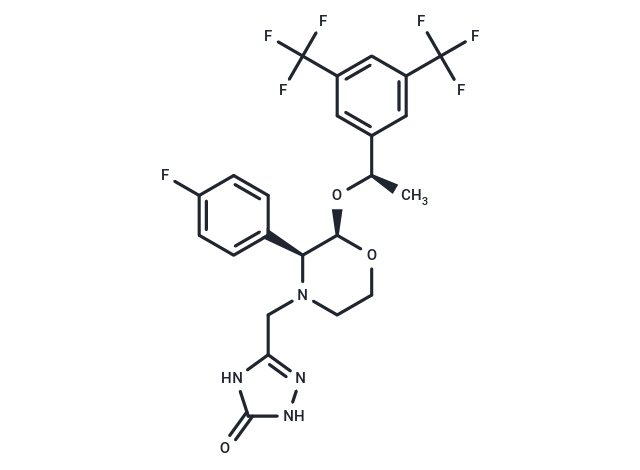
| Pack Size | Price | USA Stock | Global Stock | Quantity |
|---|---|---|---|---|
| 5 mg | $48 | In Stock | In Stock | |
| 10 mg | $58 | In Stock | In Stock | |
| 50 mg | $81 | In Stock | In Stock | |
| 100 mg | $98 | In Stock | In Stock | |
| 200 mg | $117 | In Stock | In Stock | |
| 500 mg | $148 | In Stock | In Stock | |
| 1 mL x 10 mM (in DMSO) | $58 | In Stock | In Stock |
| Description | Aprepitant is a Substance P/Neurokinin-1 Receptor Antagonist. The mechanism of action of aprepitant is as a Neurokinin 1 Antagonist, and Cytochrome P450 3A4 Inhibitor, and Cytochrome P450 2C9 Inducer, and Cytochrome P450 3A4 Inducer. |
| Targets & IC50 | NK1R:0.1 nM |
| In vitro | Aprepitant plays a crucial role in the transmission of pain impulses from peripheral receptors to the central nervous system (CNS), engaging in various behavioral, neurochemical, and cardiovascular responses to stress. It can cross the blood-brain barrier and bind to NK-1 receptors in the brain. Aprepitant inhibits cytotoxicity induced by chemotherapy, such as acute and delayed vomiting caused by cisplatin (blocking Substance P). When administered at a dose of 3 mg/kg, either intravenously (i.v.) or orally (p.o.), Aprepitant effectively suppresses vomiting induced by cisplatin (10 mg/kg, i.v.). It enhances antiemetic effects when combined with dexamethasone (20 mg/kg, i.v.) or the 5-HT3 receptor antagonist ondansetron (0.1 mg/kg, i.v.) at a dosage of 0.1 mg/kg, i.v. In the acute delayed vomiting model in ferrets, nausea and vomiting responses were recorded for 72 hours following cisplatin administration (5 mg/kg, intraperitoneally [i.p.]). Pre-treatment with Aprepitant (4-16 mg/kg, p.o.) dose dependently inhibits vomiting induced by cisplatin. Complete inhibition of nausea and vomiting symptoms was achieved with Aprepitant (2-4 mg/kg/day, p.o.) in all administered ferrets. An acute phase of vomiting developed 24 hours after cisplatin injection, with Aprepitant administration (4 mg/kg, p.o.) at 24 and 48 hours post-injection suppressing 75% of nausea and vomiting symptoms in ferrets. |
| In vivo | Aprepitant exhibits a high degree of selectivity for human NK1 receptors, being 3000 times more selective than for human NK3 receptors, and 50,000 times more than for human NK2 receptors. It shows no activity in assays for monoamine uptake sites (NE, 5–HT, DA) using human and animal tissues (IC50 > 3 μM), nor in assays for human monoamine oxidase A and B, and human serotonin receptors 5–HT1A, 5–HT2A, 5–HT2c, 5–HT3, 5–HT5, 5–HT6, and 5–HT7 (IC50 > 3 μM). Aprepitant acts by binding to and antagonizing the substance P (SP) on both central nervous system (CNS) and peripheral NK-1 receptors. In CHO or COS cells, aprepitant displaces 50% of SP binding on hNK1 receptors at a concentration of 0.1 nM. Radio-ligand binding assays using primitive animal tissue have shown that aprepitant inhibits the binding of [3H]SP to natural NK1 receptors in rat submandibular glands; upon screening with PANLABS panels, aprepitant did not demonstrate significant interaction with any other primitive animal G-protein coupled receptors or ion channels. |
| Synonyms | MK-869, MK-0869, L-754030, Aprepitant` |
| Cell Research | Aprepitant is dissolved in DMSO. The inhibitory effect of aprepitant on metabolic activity of Nalm-6 cells is assessed by uptake of thiazolyl blue tetrazolium bromide (MTT) by viable cells. Cells are plated onto 96-well plates at a density of 5000 cells/well. After treatment with aprepitant at 5, 10, 15, 20 and 30 μM for 24, 36 and 48 h, the cells are further incubated with 100 μL of MTT (0.5 mg/mL) at 37°C for 3 h. Untreated cells are defined as the control group. Following solubilization of precipitated formazan with 100 μL of DMSO, the optical densitometry is measured with an ELISA reader at a wavelength of 578 nm. |
| Molecular Weight | 534.43 |
| Formula | C23H21F7N4O3 |
| Cas No. | 170729-80-3 |
| Smiles | C(N1[C@H]([C@@H](O[C@H](C)C2=CC(C(F)(F)F)=CC(C(F)(F)F)=C2)OCC1)C3=CC=C(F)C=C3)C4=NNC(=O)N4 |
| Relative Density. | 1.51 g/cm3 (Predicted) |
| Storage | Powder: -20°C for 3 years | In solvent: -80°C for 1 year Shipping with blue ice/Shipping at ambient temperature. | ||||||||||||||||||||||||||||||||||||||||
| Solubility Information | Ethanol: 12 mg/mL (22.45 mM), Sonication is recommended. DMSO: 104 mg/mL (194.6 mM), Sonication is recommended.  | ||||||||||||||||||||||||||||||||||||||||
| In Vivo Formulation | 10% DMSO+90% Saline: < 10 mg/mL (18.71 mM), Lower concentrations may be soluble, but exact solubility limit is unknown. 10% DMSO+40% PEG300+5% Tween 80+45% Saline: 10 mg/mL (18.71 mM), Solution. Please add the solvents sequentially, clarifying the solution as much as possible before adding the next one. Dissolve by heating and/or sonication if necessary. Working solution is recommended to be prepared and used immediately. The formulation provided above is for reference purposes only. In vivo formulations may vary and should be modified based on specific experimental conditions. | ||||||||||||||||||||||||||||||||||||||||
Solution Preparation Table | |||||||||||||||||||||||||||||||||||||||||
Ethanol/DMSO
DMSO
Note : The dilution table applies only to solid products. For liquid products, please calculate the stock solution based on the stated concentration and/or density. | |||||||||||||||||||||||||||||||||||||||||
 For example, if the intended dosage is 10 mg/kg for animals weighing 20 g , with a dosing volume of 100 μL per animal, and a total of 10 animals are to be administered, using a formulation of
  10% DMSO+ 40% PEG300+ 5% Tween 80+ 45% Saline/PBS/ddH2O , the resulting working solution concentration would be 2 mg/mL.
Dissolve 2 mg of the compound in 100 μL DMSO to obtain a stock solution at a concentration of 20 mg/mL . If the required concentration exceeds the compound's known solubility, please contact us for technical support before proceeding.
1) Add 100 μL of the DMSO stock solution to 400 µL PEG300 and mix thoroughly until the solution becomes clear.
2) Add 50 µL Tween 80 and mix well until fully clarified.
3) Add 450 µL Saline,PBS or ddH2O and mix thoroughly until a homogeneous solution is obtained.
| Size | Quantity | Unit Price | Amount | Operation |
|---|
 Feedback
 Hello! How can I help you today?
Copyright © 2015-2026 TargetMol Chemicals Inc. All Rights Reserved.
