


Shopping Cart
Remove All Your shopping cart is currently empty

Synonyms:
| Pack Size | Price | USA Stock | Global Stock | Quantity |
|---|---|---|---|---|
| 1 mg | $77 | In Stock | In Stock | |
| 2 mg | $111 | - | In Stock | |
| 5 mg | $140 | In Stock | In Stock | |
| 10 mg | Preferential | - | In Stock | |
| 50 mg | Preferential | - | In Stock | |
| 1 mL x 10 mM (in DMSO) | $140 | - | In Stock |
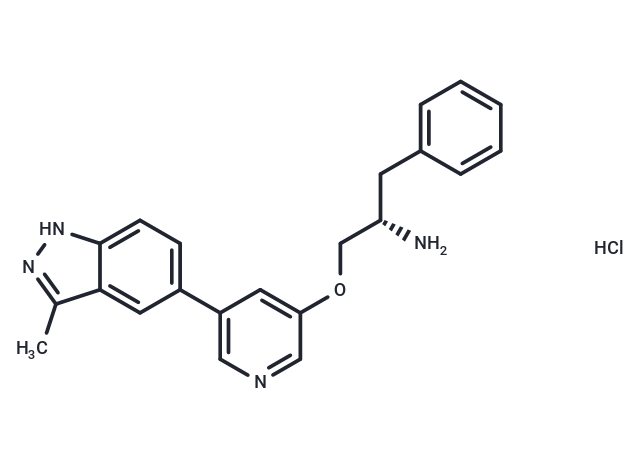
| Description | A-674563 is an orally available, ATP-competitive, and reversible inhibitor of Akt (Ki: 11 nM for Akt1) [1]. It exhibits inhibitory activity against PKA and Cdk2 (IC50: 16/46 nM) but is 10- to >1, 800-fold selective for Akt1 versus additional kinases in the CMGC, CAMK, and TK families [1]. |
| Targets & IC50 | ERK2:260 nM (Ki), PKCδ:360 nM (Ki), PKA:16 nM (Ki), CDK2:46 nM (Ki), Akt1:11 nM (Ki), GSK-3β:110 nM (Ki) |
| In vitro | A-674563 reduces phosphorylation of Akt downstream targets in cells and slows proliferation of tumor cells in vitro (EC50: 0.4 μM) [1]. A563 (0-10 μM) markedly decreases GSK3 and MDM2 phosphorylation in STS cells. A563 shows inhibitory effect on all STS cell lines, with IC50 values at 48 hours ranging from 0.22 μM to 0.35 μM. A563 induces G2 cell cycle arrest and apoptosis in STS cells. A563 (1 μM/12 hr) upregulates the expression of GADD45A independent of p53[2]. A-674563 (10-1000 nM) is anti-proliferative and cytotoxic in cultured human melanoma cells, induces melanoma cell apoptotic death, inhibited by caspase inhibitors, and inhibits melanoma cells via Akt-dependent and -independent mechanisms[3]. A-674563 is cytotoxic and anti-proliferative when added to U937 and AmL progenitor cells activate caspase-3/9 and apoptosis in U937 and AmL progenitor cells and manipulate other signalings in AmL cells whiling blocking Akt[4]. |
| In vivo | In the PC-3 prostate cancer xenograft model, A-674563 (40 mg/kg/d, p.o.) has no marked monotherapy activity, but the efficacy of the combination therapy (A-674563+paclitaxel) is significantly improved. In an oral glucose tolerance test, A-674563 (20, 100 mg/kg) can increase plasma insulin[1]. A563 (20 mg/kg/bid; p.o.) exhibits slow tumor growth and a significant difference in tumor volume without significant weight loss of mice. A563-treated tumors express increased levels of GADD45α and decreased levels of PCNA (a nuclear marker for proliferation). Additionally, TUNEL assay staining levels (marker for apoptosis) increase in the A563-treated specimens[2]. A-674563 (25, 100 mg/kg, lavage daily) effectively inhibits A375 xenograft growth in mice[3]. A-674563 (15, 40 mg/kg) injection inhibits U937 xenograft in vivo growth and improves mice survival[4]. |
| Cell Research | The cells on 96-well plates are gently washed with 200 μL of PBS. Alamar Blue reagent is diluted 1:10 in normal growth media. The diluted Alamar Blue reagent (100 μL) is added to each well on the 96-well plates and incubated until the reaction is complete. The analysis is done using a fmax Fluorescence Microplate Reader, set at the excitation wavelength of 544 nm and the emission wavelength of 595 nm. Data are analyzed using SOFTmax PRO software. |
| Animal Research | A-674563 is formulated in 5% dextrose.Immunocompromised male SCID mice are at 6 to 8 weeks of age. The 1×10⁶ 3T3-Akt1 or 2×10⁶ MiaPaCa-2 and PC-3 cells in 50% Matrigel are inoculated s.c. into the flank. For early treatment studies, mice are randomly assigned to treatment groups and therapy is initiated the day after inoculation. Ten animals are assigned to each group, including controls. For established tumor studies, tumors are allowed to reach a designated size and mice are assigned to treatment groups of equal tumor size (n=10 mice per group). Tumor size is evaluated by twice-weekly measurements with digital calipers. Tumor volume is estimated using the formula: V=L×W2/2. A-443654 is given s.c. in a vehicle of 0.2% HPMC. A-674563 is given orally in a vehicle of 5% dextrose. Gemcitabine and paclitaxel are added to the assay. |
| Molecular Weight | 394.9 |
| Formula | C22H23ClN4O |
| Cas No. | 2070009-66-2 |
| Smiles | CC=1C=2C(=CC=C(C2)C=3C=C(OC[C@H](CC4=CC=CC=C4)N)C=NC3)NN1.Cl |
| Storage | Powder: -20°C for 3 years | In solvent: -80°C for 1 year Shipping with blue ice/Shipping at ambient temperature. |
| Solubility Information | DMSO: >30 mg/mL, Sonication is recommended. |
 For example, if the intended dosage is 10 mg/kg for animals weighing 20 g , with a dosing volume of 100 μL per animal, and a total of 10 animals are to be administered, using a formulation of
  10% DMSO+ 40% PEG300+ 5% Tween 80+ 45% Saline/PBS/ddH2O , the resulting working solution concentration would be 2 mg/mL.
Dissolve 2 mg of the compound in 100 μL DMSO to obtain a stock solution at a concentration of 20 mg/mL . If the required concentration exceeds the compound's known solubility, please contact us for technical support before proceeding.
1) Add 100 μL of the DMSO stock solution to 400 µL PEG300 and mix thoroughly until the solution becomes clear.
2) Add 50 µL Tween 80 and mix well until fully clarified.
3) Add 450 µL Saline,PBS or ddH2O and mix thoroughly until a homogeneous solution is obtained.
| Size | Quantity | Unit Price | Amount | Operation |
|---|
 Feedback
 Hello! How can I help you today?
Copyright © 2015-2026 TargetMol Chemicals Inc. All Rights Reserved.
