


Shopping Cart
Remove All Your shopping cart is currently empty


Synonyms: SHP099 free base, SHP-099, SHP 099
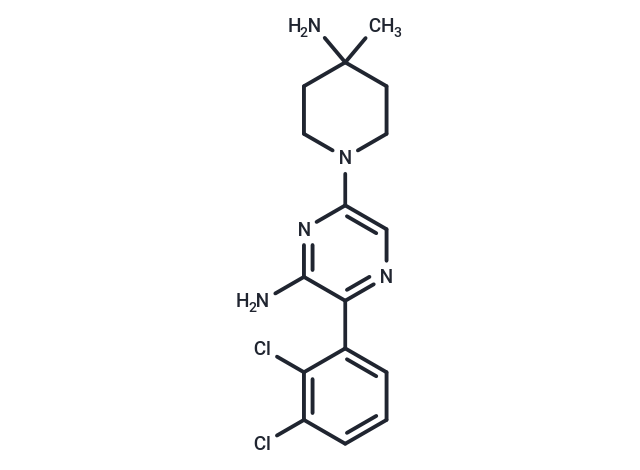
| Pack Size | Price | USA Stock | Global Stock | Quantity |
|---|---|---|---|---|
| 1 mg | $31 | In Stock | In Stock | |
| 2 mg | $44 | In Stock | In Stock | |
| 5 mg | $72 | In Stock | In Stock | |
| 10 mg | $101 | In Stock | In Stock | |
| 25 mg | $177 | In Stock | In Stock | |
| 50 mg | $237 | In Stock | In Stock | |
| 100 mg | $431 | In Stock | In Stock | |
| 1 mL x 10 mM (in DMSO) | $55 | In Stock | In Stock |

| Description | SHP099 is an oral, highly selective, allosteric SHP2 (PTPN11) inhibitor with an IC₅₀ of 70 nM. SHP099 inhibits tumor cell proliferation and survival by stabilizing the autoinhibitory conformation of SHP2 and blocking RAS-ERK signaling. SHP099 inhibits the growth of cancer cells, such as MV4-11 and TF-1 cells (IC₅₀ = 0.32 and 1.73 μM). SHP099 can be used in tumor research. |
| Targets & IC50 | SHP2 (E69K):0.416 μM, BaF3 cells:19.86 μM, Capan-2 cells:15.67 μM, SHP2:0.07 μM, pERK:0.250 μM, BXPC-3 cells:72.86 μM, SHP2 (D61Y):1.241 μM, SHP2A72V:1.968 μM, MV-4-11 cells:0.32 μM, TF-1 cell:1.73 μM, SHP2E76K:2.896 μM, 4T1 cells:119.3 μM, ASPC1 cells:64.04 μM |
| In vitro | Methods: RAW264.7 mouse macrophage cells were induced to differentiate into osteoclasts using RANKL (100 ng/mL). In some experiments, IL-6 (100 ng/mL) was added concurrently to simulate the post-injury inflammatory environment. Subsequently, 15 μM SHP099 was added and co-treated with the stimulant. The culture medium was changed every 2 days for a total duration of 5-6 days. Results: IL-6 enhanced RANKL-induced osteoclast differentiation and upregulated p-SHP2/p-TAK1 expression. SHP099 significantly reduced osteoclast numbers and downregulated mRNA and protein levels of osteoclast markers and proinflammatory cytokines. [1] Methods: Kmt2d KO LUSC cells were treated with SHP099 (1 μM) and/or afatinib (0.02 μM) for 7 days, followed by crystal violet staining to detect colony formation. Results: SHP099 significantly inhibited colony formation. [2] |
| In vivo | Methods: Bilateral proximal tibial drilling injuries were performed on 3-4-week-old C57BL/6J mice. The control group underwent no surgery. Intra-articular injection of SHP099 (30 mg/kg) was administered into the right knee as a single postoperative dose. Animals were euthanized for tissue collection 10 days post-surgery. Results: SHP099 treatment significantly suppressed tibial growth plate injury-induced gene upregulation, indicating its efficacy in inhibiting local osteoclastogenesis and inflammatory responses. [1] Methods: Kmt2d KO or Pten KO LUSC cells were injected via tail vein into B6-Albino mice. Tumor growth was monitored by MRI. When tumor volume reached 100–200 mm³, mice were randomly assigned to receive daily SHP099 (75 mg/kg) once daily, 5 days/week. Results: SHP099 monotherapy significantly inhibited tumor growth.[2] |
| Synonyms | SHP099 free base, SHP-099, SHP 099 |
| Molecular Weight | 352.26 |
| Formula | C16H19Cl2N5 |
| Cas No. | 1801747-42-1 |
| Smiles | CC1(N)CCN(CC1)c1cnc(c(N)n1)-c1cccc(Cl)c1Cl |
| Relative Density. | 1.326 g/cm3 (Predicted) |
| Storage | Store at low temperature Powder: -20°C for 3 years | In solvent: -80°C for 1 year Shipping with blue ice/Shipping at ambient temperature. | |||||||||||||||||||||||||
| Solubility Information | DMSO: 15.8 mg/mL (44.85 mM), Sonication is recommended.  | |||||||||||||||||||||||||
| In Vivo Formulation | 10% DMSO+40% PEG300+5% Tween 80+45% Saline: 1 mg/mL (2.84 mM), Sonication is recommended. Please add the solvents sequentially, clarifying the solution as much as possible before adding the next one. Dissolve by heating and/or sonication if necessary. Working solution is recommended to be prepared and used immediately. The formulation provided above is for reference purposes only. In vivo formulations may vary and should be modified based on specific experimental conditions. | |||||||||||||||||||||||||
Solution Preparation Table | ||||||||||||||||||||||||||
DMSO
Note : The dilution table applies only to solid products. For liquid products, please calculate the stock solution based on the stated concentration and/or density. | ||||||||||||||||||||||||||
 For example, if the intended dosage is 10 mg/kg for animals weighing 20 g , with a dosing volume of 100 μL per animal, and a total of 10 animals are to be administered, using a formulation of
  10% DMSO+ 40% PEG300+ 5% Tween 80+ 45% Saline/PBS/ddH2O , the resulting working solution concentration would be 2 mg/mL.
Dissolve 2 mg of the compound in 100 μL DMSO to obtain a stock solution at a concentration of 20 mg/mL . If the required concentration exceeds the compound's known solubility, please contact us for technical support before proceeding.
1) Add 100 μL of the DMSO stock solution to 400 µL PEG300 and mix thoroughly until the solution becomes clear.
2) Add 50 µL Tween 80 and mix well until fully clarified.
3) Add 450 µL Saline,PBS or ddH2O and mix thoroughly until a homogeneous solution is obtained.
| Size | Quantity | Unit Price | Amount | Operation |
|---|
 Feedback
 Hello! How can I help you today?
Copyright © 2015-2026 TargetMol Chemicals Inc. All Rights Reserved.
