


Shopping Cart
Remove All Your shopping cart is currently empty

Synonyms: DPBF
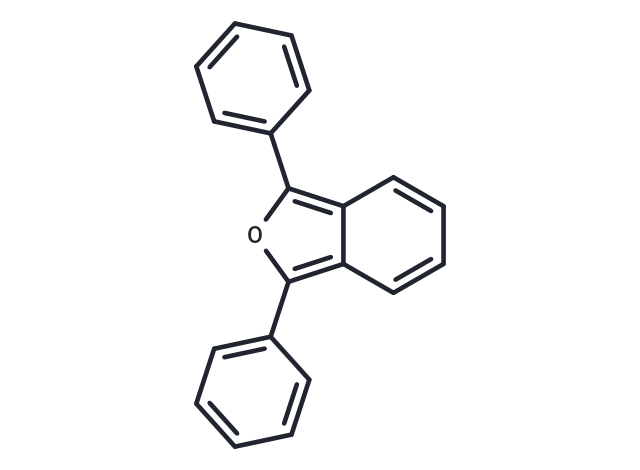
| Pack Size | Price | USA Stock | Global Stock | Quantity |
|---|---|---|---|---|
| 500 mg | $30 | - | In Stock | |
| 1 g | $40 | - | In Stock |
| Description | 1,3-Diphenylisobenzofuran (DPBF) is a fluorescent probe. It possesses a highly specific reactivity towards singlet oxygen forming an endoperoxide which decomposes to give 1,2-dibenzoylbenzene. 1,3-Diphenylisobenzofuran can detect the generation of reactive oxygen species (ROS). |
| Synonyms | DPBF |
| Cell Research | I. Cell fluorescence labeling a. Solution preparation: 1. Mother solution preparation: Prepare 10 mM DPBF mother solution with DMSO, store it at -20℃ or -80℃ in the dark after aliquoting. 2. Working solution preparation: Dilute the mother solution with preheated serum-free cell culture medium or PBS to prepare 10-20μM DPBF working solution (select the appropriate working solution concentration according to experimental requirements, and prepare it for immediate use). b. Operation steps: 1. Cell staining: Suspended cells: Collect cells by centrifugation, add PBS and wash twice, 5 minutes each time. Adherent cells: Discard the culture medium and add trypsin to digest the cells. After centrifugation and discarding the supernatant, add PBS and wash twice, 5 minutes each time. If you do not do flow cytometry experiments, adherent cells do not need to be digested. 2. Add DPBF working solution: Add 1mL DPBF working solution and incubate at room temperature for 30 minutes. 3. Centrifugal washing: 400g, 4℃ centrifuge for 3-4 minutes, discard the supernatant. Add PBS to wash the cells twice, 5 minutes each time. 4. Resuspension detection: After resuspending the cells with 1mL serum-free medium or PBS, detect under a fluorescence microscope or flow cytometer. 2. Superoxide anion detection a. Operation steps: 1. Dissolve the nanozyme and DPBF in PBS solution and prepare them to the required concentration. 2. Reaction system construction: Mix the prepared nanozyme and DPBF solution, place them in an appropriate reaction container, and incubate for 5 minutes. 3. Result detection: Use instruments such as UV-visible spectrophotometer or fluorescence spectrometer to measure the absorbance or fluorescence intensity changes of the solution before and after the reaction (excitation wavelength 410 nm, emission wavelength 455 nm) to evaluate the generation of superoxide anions. The above information is based on published literature. Experimental procedures should be appropriately modified to meet specific research demands. |
| Molecular Weight | 270.32 |
| Formula | C20H14O |
| Cas No. | 5471-63-6 |
| Smiles | c1ccc(cc1)-c1oc(-c2ccccc2)c2ccccc12 |
| Relative Density. | 1.141 g/cm3 |
| Storage | Keep away from direct sunlight,Store under nitrogen,Store at low temperature Powder: -20°C for 3 years | In solvent: -80°C for 1 year Shipping with blue ice/Shipping at ambient temperature. | |||||||||||||||||||||||||
| Solubility Information | DMSO: 6.94 mg/mL (25.67 mM), Sonication is recommended.  | |||||||||||||||||||||||||
| In Vivo Formulation | 10% DMSO+90% Saline: 0.69 mg/mL (2.55 mM), Solution. Please add the solvents sequentially, clarifying the solution as much as possible before adding the next one. Dissolve by heating and/or sonication if necessary. Working solution is recommended to be prepared and used immediately. The formulation provided above is for reference purposes only. In vivo formulations may vary and should be modified based on specific experimental conditions. | |||||||||||||||||||||||||
Solution Preparation Table | ||||||||||||||||||||||||||
DMSO
Note : The dilution table applies only to solid products. For liquid products, please calculate the stock solution based on the stated concentration and/or density. | ||||||||||||||||||||||||||
 For example, if the intended dosage is 10 mg/kg for animals weighing 20 g , with a dosing volume of 100 μL per animal, and a total of 10 animals are to be administered, using a formulation of
  10% DMSO+ 40% PEG300+ 5% Tween 80+ 45% Saline/PBS/ddH2O , the resulting working solution concentration would be 2 mg/mL.
Dissolve 2 mg of the compound in 100 μL DMSO to obtain a stock solution at a concentration of 20 mg/mL . If the required concentration exceeds the compound's known solubility, please contact us for technical support before proceeding.
1) Add 100 μL of the DMSO stock solution to 400 µL PEG300 and mix thoroughly until the solution becomes clear.
2) Add 50 µL Tween 80 and mix well until fully clarified.
3) Add 450 µL Saline,PBS or ddH2O and mix thoroughly until a homogeneous solution is obtained.
| Size | Quantity | Unit Price | Amount | Operation |
|---|
 Feedback
 Hello! How can I help you today?
Copyright © 2015-2026 TargetMol Chemicals Inc. All Rights Reserved.
