


Shopping Cart
Remove All Your shopping cart is currently empty

Synonyms: β-Amyloid (1-42), human, Amyloid β-Peptide (1-42) human
| Pack Size | Price | USA Stock | Global Stock | Quantity |
|---|---|---|---|---|
| 200 µg | $98 | - | In Stock | |
| 500 µg | $163 | - | In Stock | |
| 1 mg | $243 | - | In Stock |
| Description | β-Amyloid (1-42), human, is a 42-amino acid peptide integral to the pathogenesis of Alzheimer disease. |
| In vitro | Amyloid β-Peptide (1-42) human is a 42-amino acid peptide which plays a key role in the pathogenesis of Alzheimer disease. Application of Amyloid β-Peptide (1-42) human (1 to 10 μM) in the bathing solution does not change delayed rectifier K+-current and leakage current, but enhances inactivation of Са2+-current and blocks Са2+-dependent К+-current[1]. At 2.5 μM concentration, Amyloid β-Peptide (1-42) human reduces viability of SH-SY5Y cells to 65%. Results show that Amyloid β-Peptide (1-42) human localizes in both the cytoplasm and nucleus of SH-SY5Y cells after 30 min of incubation and after 8 h. In the latter, large accumulations of Amyloid β-Peptide (1-42) human are seen in the cytoplasm and in the nucleus. Increased APP mRNA levels are also detected upon Amyloid β-Peptide (1-42) human treatment[2].
Preparation of Monomeric Aβ42 from Lyophilized Peptide [2] The following procedure is a recommended guideline and may require optimization based on the requirements of specific downstream applications. 1. Equilibrate lyophilized Aβ42 peptide to room temperature. Briefly centrifuge at 1,500 × g for 30 seconds to collect material at the bottom of the tube. 2. Add ice-cold hexafluoroisopropanol (HFIP) at a ratio of 100 µL per 0.5 mg Aβ42. Incubate the mixture on ice for 30 minutes to fully solubilize the peptide. Caution: HFIP is volatile and toxic. Perform all handling in a certified chemical fume hood with appropriate personal protective equipment. 3. Dispense the peptide/HFIP solution into 20 µL aliquots, allowing solvent to evaporate in a fume hood for 2-3 hours until a uniform peptide film is formed. Films may be stored at −20 °C or −80 °C. Note: If available, vacuum desiccation or nitrogen gas blowing is recommended. Preparation of Aβ42 Oligomers 1. Dissolve the peptide film in 10 µL of freshly prepared DMSO (Cat. No. T0341). Sonicate in a water-bath sonicator for 10 minutes at room temperature to facilitate monomerization. 2. Dilute the DMSO stock with 190 µL of 50 mM Tris-HCl buffer (pH 7.4) and mix gently by pipetting to avoid introducing air bubbles. 3. Centrifuge the solution at 20,000 × g for 20 minutes at 4 °C to remove insoluble aggregates. Carefully transfer the supernatant (monomer-enriched fraction) to a clean tube. 4. Incubate the collected supernatant at 4-8 °C for 24-48 hours to promote controlled oligomerization. Centrifuge again at 20,000 × g for 20 minutes at 4 °C to remove newly formed large aggregates. Use the final supernatant for experiments following dilution (typically 10-200 fold depending on assay requirements). Warning: Aβ42 oligomeric assemblies are unstable and prone to further aggregation. Fresh preparation is strongly recommended. For extended storage, peptides should remain in film form at −20 °C or −80 °C rather than in solution. 5. Quantify peptide concentration using a bicinchoninic acid (BCA) protein assay (Cat. No. C0050), following the manufacturer’s instructions. Note: The protocol is derived from published literature and is provided for reference only. TargetMol has not independently validated the method. |
| Synonyms | β-Amyloid (1-42), human, Amyloid β-Peptide (1-42) human |
| Molecular Weight | 4514.04 |
| Formula | C203H311N55O60S |
| Cas No. | 107761-42-2 |
| Smiles | CCC(C)C(NC(=O)C(NC(=O)C(C)NC(=O)CNC(=O)C(CCCCN)NC(=O)C(CC(N)=O)NC(=O)C(CO)NC(=O)CNC(=O)C(NC(=O)C(CC(O)=O)NC(=O)C(CCC(O)=O)NC(=O)C(C)NC(=O)C(Cc1ccccc1)NC(=O)C(Cc1ccccc1)NC(=O)C(NC(=O)C(CC(C)C)NC(=O)C(CCCCN)NC(=O)C(CCC(N)=O)NC(=O)C(Cc1c[nH]cn1)NC(=O)C(Cc1c[nH]cn1)NC(=O)C(NC(=O)C(CCC(O)=O)NC(=O)C(Cc1ccc(O)cc1)NC(=O)CNC(=O)C(CO)NC(=O)C(CC(O)=O)NC(=O)C(Cc1c[nH]cn1)NC(=O)C(CCCNC(N)=N)NC(=O)C(Cc1ccccc1)NC(=O)C(CCC(O)=O)NC(=O)C(C)NC(=O)C(N)CC(O)=O)C(C)C)C(C)C)C(C)C)C(C)CC)C(=O)NCC(=O)NC(CC(C)C)C(=O)NC(CCSC)C(=O)NC(C(C)C)C(=O)NCC(=O)NCC(=O)NC(C(C)C)C(=O)NC(C(C)C)C(=O)NC(C(C)CC)C(=O)NC(C)C(O)=O |
| Relative Density. | no data available |
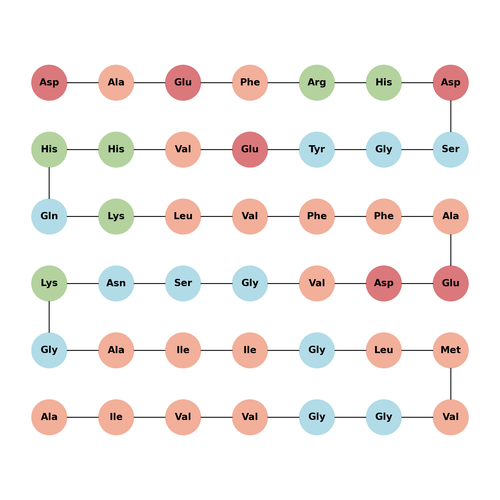
| Sequence | Asp-Ala-Glu-Phe-Arg-His-Asp-Ser-Gly-Tyr-Glu-Val-His-His-Gln-Lys-Leu-Val-Phe-Phe-Ala-Glu-Asp-Val-Gly-Ser-Asn-Lys-Gly-Ala-Ile-Ile-Gly-Leu-Met-Val-Gly-Gly-Val-Val-Ile-Ala |
| Sequence Short | DAEFRHDSGYEVHHQKLVFFAEDVGSNKGAIIGLMVGGVVIA |
| Storage | Keep away from moisture,Store at low temperature,Keep away from direct sunlight Powder: -20°C for 3 years Shipping with blue ice/Shipping at ambient temperature. | ||||||||||||||||||||
| Solubility Information | DMSO: 50 mg/mL (11.08 mM), Sonication is recommended. | ||||||||||||||||||||
Solution Preparation Table | |||||||||||||||||||||
DMSO
Note : The dilution table applies only to solid products. For liquid products, please calculate the stock solution based on the stated concentration and/or density. | |||||||||||||||||||||
 For example, if the intended dosage is 10 mg/kg for animals weighing 20 g , with a dosing volume of 100 μL per animal, and a total of 10 animals are to be administered, using a formulation of
  10% DMSO+ 40% PEG300+ 5% Tween 80+ 45% Saline/PBS/ddH2O , the resulting working solution concentration would be 2 mg/mL.
Dissolve 2 mg of the compound in 100 μL DMSO to obtain a stock solution at a concentration of 20 mg/mL . If the required concentration exceeds the compound's known solubility, please contact us for technical support before proceeding.
1) Add 100 μL of the DMSO stock solution to 400 µL PEG300 and mix thoroughly until the solution becomes clear.
2) Add 50 µL Tween 80 and mix well until fully clarified.
3) Add 450 µL Saline,PBS or ddH2O and mix thoroughly until a homogeneous solution is obtained.
| Size | Quantity | Unit Price | Amount | Operation |
|---|
 Feedback
 Hello! How can I help you today?
Copyright © 2015-2026 TargetMol Chemicals Inc. All Rights Reserved.
