


Shopping Cart
Remove All Your shopping cart is currently empty


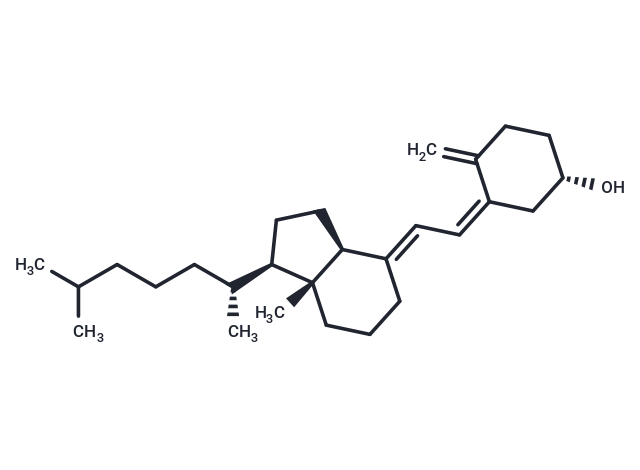
Synonyms: Colecalciferol, Cholecalciferol
| Pack Size | Price | USA Stock | Global Stock | Quantity |
|---|---|---|---|---|
| 1 g | $33 | In Stock | In Stock | |
| 1 mL x 10 mM (in DMSO) | $39 | In Stock | In Stock |

| Description | Vitamin D3 (cholecalciferol) is a naturally occurring form of vitamin D; once metabolically activated, it can induce cellular differentiation and cancer cell proliferation. Vitamin D3 can be used to establish kidney stone models and is also an important research target in the fields of immunology and oncology. |
| Targets & IC50 | H305F/H397Y mutant vitamin D receptor:300 nM(Kd) |
| In vitro | Methods: IK, RL95/2, and HEC1-A cells were treated with 2–10 μM vitamin D3 for 24, 48, or 72 hours, and cell viability was assessed using the MTT assay. Results: Vitamin D3 inhibited cell viability in a dose- and time-dependent manner, with the strongest inhibitory effect observed after 72 hours of treatment with 10 μM vitamin D3.[1] Methods: IK cells were treated with 10 μM vitamin D3 for 0–48 h. Intracellular 25(OH)D levels were measured using chemiluminescence, and VDR nuclear translocation was assessed by immunofluorescence and Western blot. Results: Vitamin D3 treatment for 48 h was required to detect 25(OH)D production, accompanied by VDR nuclear translocation.[1] |
| In vivo | Methods: Male ddY mice were divided into 4 groups (solvent control, Vitamin D3 alone, CCl₄ alone, Vitamin D3 + CCl₄). Mice were pretreated with Vitamin D3 (5 mg/kg) administered via gavage for 4 consecutive days, followed by intraperitoneal injection of CCl₄ (2 g/kg) on Day 0. A separate group received a direct injection of CaCl₂ (150 mg/kg) to validate the role of calcium. Results: Vitamin D3 alone significantly increased serum calcium levels to 13.0 mg/dL (normal: 7.77 mg/dL), with no evidence of liver or kidney damage or oxidative stress.[2] |
| Synonyms | Colecalciferol, Cholecalciferol |
| Disease Modeling Protocol | Kidney stone model
*Precautions: Calcium or vitamin D alone cannot form significant stones; they must be used in combination. |
| Molecular Weight | 384.64 |
| Formula | C27H44O |
| Cas No. | 67-97-0 |
| Smiles | CC(C)CCC[C@@H](C)[C@H]1CC[C@H]2\C(CCC[C@]12C)=C\C=C1\C[C@@H](O)CCC1=C |
| Relative Density. | 0.96 g/cm3 |
| Storage | Keep away from direct sunlight,The compound is unstable in solution. Please use soon Powder: -20°C for 3 years Shipping with blue ice/Shipping at ambient temperature. | |||||||||||||||||||||||||||||||||||
| Solubility Information | DMSO: 252.5 mg/mL (656.46 mM), Sonication is recommended. (The compound is unstable in solution, please use soon.)  | |||||||||||||||||||||||||||||||||||
| In Vivo Formulation | 10% DMSO+40% PEG300+5% Tween 80+45% Saline: 1 mg/mL (2.6 mM), Sonication is recommended. Please add the solvents sequentially, clarifying the solution as much as possible before adding the next one. Dissolve by heating and/or sonication if necessary. Working solution is recommended to be prepared and used immediately. The formulation provided above is for reference purposes only. In vivo formulations may vary and should be modified based on specific experimental conditions. | |||||||||||||||||||||||||||||||||||
Solution Preparation Table | ||||||||||||||||||||||||||||||||||||
DMSO
Note : The dilution table applies only to solid products. For liquid products, please calculate the stock solution based on the stated concentration and/or density. | ||||||||||||||||||||||||||||||||||||
 For example, if the intended dosage is 10 mg/kg for animals weighing 20 g , with a dosing volume of 100 μL per animal, and a total of 10 animals are to be administered, using a formulation of
  10% DMSO+ 40% PEG300+ 5% Tween 80+ 45% Saline/PBS/ddH2O , the resulting working solution concentration would be 2 mg/mL.
Dissolve 2 mg of the compound in 100 μL DMSO to obtain a stock solution at a concentration of 20 mg/mL . If the required concentration exceeds the compound's known solubility, please contact us for technical support before proceeding.
1) Add 100 μL of the DMSO stock solution to 400 µL PEG300 and mix thoroughly until the solution becomes clear.
2) Add 50 µL Tween 80 and mix well until fully clarified.
3) Add 450 µL Saline,PBS or ddH2O and mix thoroughly until a homogeneous solution is obtained.
| Size | Quantity | Unit Price | Amount | Operation |
|---|
 Feedback
 Hello! How can I help you today?
Copyright © 2015-2026 TargetMol Chemicals Inc. All Rights Reserved.
