Shopping Cart
Remove All
  • TargetMol
    Your shopping cart is currently empty

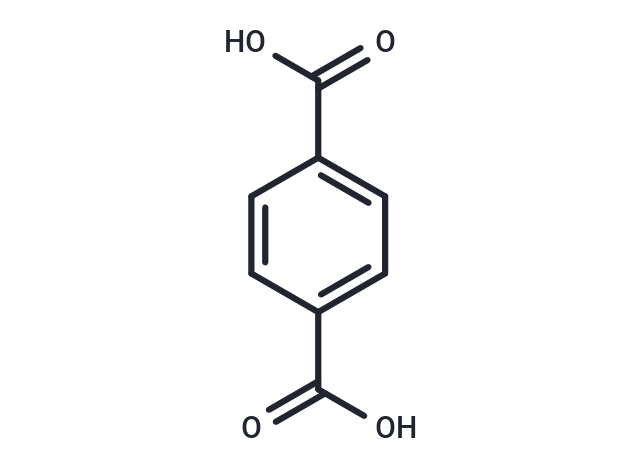
Terephthalic acid

Copy Product Info
😃Good
Catalog No. T8031Cas No. 100-21-0

Terephthalic acid is an isomer and a precursor of the polyester PET. It is used in the production of textiles and plastics, and can also be used to establish skin cancer models.

Terephthalic acid

Terephthalic acid

Copy Product Info
😃Good
Purity: 99.63%
Catalog No. T8031Cas No. 100-21-0
Terephthalic acid is an isomer and a precursor of the polyester PET. It is used in the production of textiles and plastics, and can also be used to establish skin cancer models.
Pack SizePriceUSA WarehouseGlobal WarehouseQuantity
5 g$31-In Stock
10 g$36-In Stock
25 g$44-In Stock
1 mL x 10 mM (in DMSO)$44In StockIn Stock
Add to Cart
Add to Quotation
In Stock Estimated shipping dateUSA Warehouse[1-2 days] Global Warehouse[5-7 days]
All TargetMol products are for research purposes only and cannot be used for human consumption. We do not provide products or services to individuals. Please comply with the intended use and do not use TargetMol products for any other purpose.
Questions
TargetMol
View More

Batch Information

Select Batch
Purity:99.63%
Appearance:Solid
Color:White
Contact us for more batch information

Resource Download

Product Introduction

Terephthalic acid AI Summary
Terephthalic acid exhibits a diverse range of bioactivities across several assays and tests. It shows significant specificity and potency in targeting cancer cells with p53 mutations (5.0 nM) and serves as an agonist of the Thyroid Stimulating Hormone Receptor, with a potency of 25118.9 nM. Furthermore, the compound acts as an antagonist to the Androgen Receptor signaling pathway (50118.7 nM) and the Retinoid-Related Orphan Receptor Gamma (ROR-gamma) signaling pathway (74978.0 nM). In addition to these activities, Terephthalic acid has demonstrated antihemorrhagic properties in ddY mice by inhibiting Protobothrops flavoviridis venom-induced hemorrhagic lesions with an IC50 value of 90.0 nM. This activity is compared to caffeic acid and benzoic acid, both having a ratio of IC50 values of 2.0 relative to this compound. The compound also possesses a pKa value of 3.49. Notably, Terephthalic acid shows potential in antiviral applications by demonstrating a 15.27% inhibition of SARS-CoV-2 3CL-Pro protease at a concentration of 20µM, which is crucial for the replication of the virus. Additionally, it inhibits SARS-CoV-2 induced cytotoxicity in VERO-6 cells at 10 µM after 48 hours exposure to 0.01 MOI of SARS-CoV-2 virus, with an inhibition rate of 0.03%, as determined by high content imaging..
Note: Summary generated by AI. Data source: ChEMBL
Bioactivity
Description
Terephthalic acid is an isomer and a precursor of the polyester PET. It is used in the production of textiles and plastics, and can also be used to establish skin cancer models.
Disease Modeling Protocol
Skin cancer model
  • Modeling Mechanism:

    Terephthalic acid (TPA), a classic skin tumor promoter, induces skin cancer through the following core mechanisms: ① Directly activates epidermal keratinocyte proliferation signals, disrupting the balance between epidermal proliferation and differentiation, promoting the expansion of abnormal cell clones, and providing a basis for carcinogenesis; ② Enhances skin barrier permeability, promoting the transdermal absorption and DNA damage effects of initiating carcinogens (such as DMBA); ③ Species/genetic background dependence: low doses (10 ng) can induce proliferation of porcine skin, porcine skin transplanted into nude mice, and nude mouse heterozygous (nu/+) skin, while nude mouse homozygous (nu/nu) skin requires high doses (100 ng) to respond, and its pro-cancer activity is related to recessive genetic traits; ④ Synergistic effect with the inflammatory microenvironment: high doses or combined stimulation induce the release of inflammatory factors, further accelerating the carcinogenesis process, ultimately leading to skin papilloma or squamous cell carcinoma.

  • Related Products:

    Terephthalic acid (T8031)

  • Modeling Method:

    Experimental Subject:

    Mice, Nude mice (homozygous nu/nu, heterozygous nu/+), pig skin-transplanted nude mouse model, 2–3 months old (acclimatised post-transplantation), pig skin donor being healthy domestic pig

    Dosage and Administration Route:

    ① Two-stage modelling:
    - Initiation phase: Topical application of carcinogenic initiator (e.g., 7,12-dimethylbenzo[a]anthracene, DMBA), 50 μg/site, dissolved in acetone, single application, followed by initiation of promotion phase after 2 weeks;
    - Promotion phase: Topical application of Terephthalic acid at low dose (10 ng/site for pig skin/homozygous nude mice) or high dose (100 ng/site for homozygous nude mice), dissolved in 50% dimethyl sulfoxide (DMSO)+50% acetone (D/A=1:1);
    ② Single-dose proliferation validation (pre-experimental modelling):
    - Topical application of Terephthalic acid, 10–100 ng/site, single application, with epidermal proliferation activity assessed after 18 hours;
    ③ Control treatment:
    - Blank control: application of equal volume solvent (D/A or acetone);
    - Transplant control: Pig skin grafted onto nude mice vs. autologous skin grafts administered concurrently;

    Dosing Frequency and Duration Model:

    Promotion phase: 1–2 times weekly for 16–20 weeks; Single-dose proliferation validation: single dose

  • Validation:

    1. Proliferation Indicators: - Labeling Index (LI): The LI of epidermal basal cells was significantly increased in the TPA treatment group (ΔLI was significant in the 10 ng TPA group of porcine skin, and the LI of the homozygous nude mouse 100 ng TPA group was more than 1.8 times that of the control group, p<0.005); - Epidermal Morphology: HE staining showed an increase in epidermal thickness of more than 30%, an extension of the proliferating cell layer, and disordered cell arrangement; 2. Tumor Characteristics: - Incidence: After two-stage modeling, the tumor incidence rate in heterozygous nude mice and porcine skin transplantation models was ≥60%, and in homozygous nude mice it reached 66% (32 weeks), mainly papillomas, with some progressing to squamous cell carcinoma; - Pathological Verification: HE staining showed tumor cell atypia, hyperkeratosis, and invasive features, and immunohistochemistry showed a significant increase in the positive rate of proliferation markers (such as Ki-67); 3. Species/Genetic Response: - Low-dose (10 ng) TPA It only induced proliferation of porcine skin, porcine skin grafts, and heterozygous nude mouse skin; homozygous nude mice showed no response; and high doses (100 ng) could exceed the threshold.

*Precautions:

*References:Krueger GG,et,al. Epidermal proliferation of nude mouse skin, pig skin, and pig skin grafts. Failure of nude mouse skin to respond to the tumor promoter 12-O-tetradecanoyl phorbol 13-acetate. J Exp Med. 1980 Nov 1;152(5):1329-39.

Chemical Properties
Molecular Weight166.13
FormulaC8H6O4
Cas No.100-21-0
SmilesC(O)(=O)C1=CC=C(C(O)=O)C=C1
Relative Density.1.58 g/cm3. Temperature:25 °C.
Storage & Solubility Information
StoragePowder: -20°C for 3 years | In solvent: -80°C for 1 year | Shipping with blue ice/Shipping at ambient temperature.
Solubility Information
DMSO: 4.62 mg/mL (27.81 mM), Sonication is recommended.
Solution Preparation Table
DMSO
1mg5mg10mg50mg
1 mM6.0194 mL30.0969 mL60.1938 mL300.9691 mL
5 mM1.2039 mL6.0194 mL12.0388 mL60.1938 mL
10 mM0.6019 mL3.0097 mL6.0194 mL30.0969 mL
20 mM0.3010 mL1.5048 mL3.0097 mL15.0485 mL

Calculator

  • Molarity Calculator
  • Dilution Calculator
  • Reconstitution Calculator
  • Molecular Weight Calculator

In Vivo Formulation Calculator (Clear solution)

Please enter your animal experiment information in the following box and click Calculate to obtain the stock solution preparation method and in vivo formula preparation method:
TargetMol | Animal experiments For example, if the intended dosage is 10 mg/kg for animals weighing 20 g , with a dosing volume of 100 μL per animal, TargetMol | Animal experiments and a total of 10 animals are to be administered, using a formulation of TargetMol | reagent 10% DMSO+ 40% PEG300+ 5% Tween 80+ 45% Saline/PBS/ddH2O , the resulting working solution concentration would be 2 mg/mL.

Stock Solution Preparation:

Dissolve 2 mg of the compound in 100 μL DMSOTargetMol | reagent to obtain a stock solution at a concentration of 20 mg/mL . If the required concentration exceeds the compound's known solubility, please contact us for technical support before proceeding.

Preparation of the In Vivo Formulation:

1) Add 100 μL of the DMSOTargetMol | reagent stock solution to 400 μL PEG300TargetMol | reagent and mix thoroughly until the solution becomes clear.

2) Add 50 μL Tween 80 and mix well until fully clarified.

3) Add 450 μL Saline,PBS or ddH2OTargetMol | reagent and mix thoroughly until a homogeneous solution is obtained.

This example is provided solely to demonstrate the use of the In Vivo Formulation Calculator and does not constitute a recommended formulation for any specific compound. Please select an appropriate dissolution and formulation strategy based on your experimental model and route of administration.
All co-solvents required for this protocol, includingDMSO, PEG300/PEG400, Tween 80, SBE-β-CD, and Corn oil, are available for purchase on the TargetMol website.
1 Enter information below:
mg/kg
g
μL
2 Enter the in vivo formulation:
% DMSO
%
% Tween 80
% Saline/PBS/ddH2O

Dose Conversion

You can also refer to dose conversion for different animals. More Dose Conversion

Tech Support

Please see Inhibitor Handling Instructions for more frequently ask questions. Topics include: how to prepare stock solutions, how to store products, and cautions on cell-based assays & animal experiments, etc

Keywords

Related Tags: buy Terephthalic acid | purchase Terephthalic acid | Terephthalic acid cost | order Terephthalic acid | Terephthalic acid chemical structure | Terephthalic acid formula | Terephthalic acid molecular weight