


Shopping Cart
Remove All Your shopping cart is currently empty

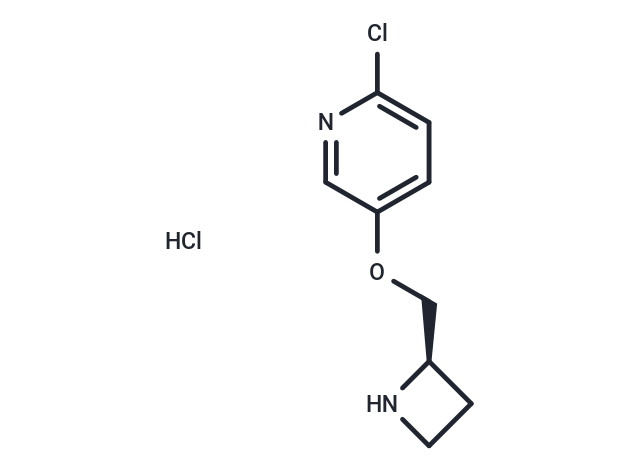
Synonyms: Ebanicline hydrochloride, ABT-594 hydrochloride
| Pack Size | Price | USA Stock | Global Stock | Quantity |
|---|---|---|---|---|
| 2 mg | $31 | In Stock | - | |
| 5 mg | $55 | In Stock | - | |
| 10 mg | $85 | In Stock | - | |
| 25 mg | $166 | In Stock | - | |
| 50 mg | $298 | Inquiry | Inquiry | |
| 100 mg | $435 | Inquiry | Inquiry |
| Description | Tebanicline hydrochloride (Ebanicline hydrochloride) , is an effective synthetic nicotinic (non-opioid) analgesic drug. |
| Targets & IC50 | nAChR:37 pM(ki) |
| In vitro | Tebanicline is a novel, potent cholinergic nAChR ligand with analgesic properties that shows preferential selectivity for neuronal nAChRs. It inhibits the binding of cytisine to α4β2 neuronal nAChRs with a Ki of 37 pM. Functionally, tebanicline is an agonist. At the transfected human α4β2 neuronal nAChR in K177 cells, with increased 86Rb+ efflux as a measure of cation efflux, ABT-594 has an EC50 value of 140 nM with an intrinsic activitycompared with (?)-nicotine of 130%; at the nAChR subtype expressed in IMR-32 cells, an EC50 of 340 nM; at the F11 dorsal root ganglion cell line, an EC50 of 1220 nM; and via direct measurement of ion currents, an EC50 value of 56,000 nM at the human α7 homo-oligimeric nAChR produced in oocytes[1] |
| In vivo | Tebanicline is a potent antinociceptive agent with full efficacy in models of acute and persistent pain and that these effects are mediated predominately by an action at central neuronal nAChRs[2]. Tebanicline produces significant antinociceptive effects in mice against both acute noxious thermal stimulation. ABT-594 is orally active, but 10-fold less potent by this route than after i.p. administration. The antinociceptive effect of ABT-594 is prevented, but not reversed, by the noncompetitive neuronal nicotinic acetylcholine receptor antagonist[3]. Tebanicline has antinociceptive effects in rat models of acute thermal, persistent chemical, and neuropathic pain. Direct injection of tebanicline into the nucleus raphe magnus (NRM) is antinociceptive in a thermal threshold test and destruction of serotonergic neurons in the NRM attenuates the effect of systemic tebanicline[4]. |
| Synonyms | Ebanicline hydrochloride, ABT-594 hydrochloride |
| Molecular Weight | 235.11 |
| Formula | C9H12Cl2N2O |
| Cas No. | 203564-54-9 |
| Smiles | Cl.Clc1ccc(OC[C@H]2CCN2)cn1 |
| Relative Density. | no data available |
| Storage | Pure form: -20°C for 3 years | In solvent: -80°C for 1 year Shipping with blue ice/Shipping at ambient temperature. | |||||||||||||||||||||||||||||||||||
| Solubility Information | DMSO: 50 mg/mL (212.67 mM), Sonication is recommended.  | |||||||||||||||||||||||||||||||||||
Solution Preparation Table | ||||||||||||||||||||||||||||||||||||
DMSO
Note : The dilution table applies only to solid products. For liquid products, please calculate the stock solution based on the stated concentration and/or density. | ||||||||||||||||||||||||||||||||||||
 For example, if the intended dosage is 10 mg/kg for animals weighing 20 g , with a dosing volume of 100 μL per animal, and a total of 10 animals are to be administered, using a formulation of
  10% DMSO+ 40% PEG300+ 5% Tween 80+ 45% Saline/PBS/ddH2O , the resulting working solution concentration would be 2 mg/mL.
Dissolve 2 mg of the compound in 100 μL DMSO to obtain a stock solution at a concentration of 20 mg/mL . If the required concentration exceeds the compound's known solubility, please contact us for technical support before proceeding.
1) Add 100 μL of the DMSO stock solution to 400 µL PEG300 and mix thoroughly until the solution becomes clear.
2) Add 50 µL Tween 80 and mix well until fully clarified.
3) Add 450 µL Saline,PBS or ddH2O and mix thoroughly until a homogeneous solution is obtained.
| Size | Quantity | Unit Price | Amount | Operation |
|---|
 Feedback
 Hello! How can I help you today?
Copyright © 2015-2026 TargetMol Chemicals Inc. All Rights Reserved.
