


Shopping Cart
Remove All Your shopping cart is currently empty


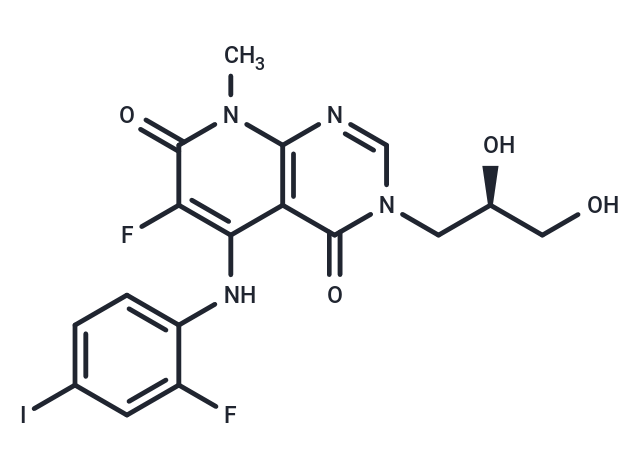
Synonyms: TAK733, TAK 733

| Pack Size | Price | USA Stock | Global Stock | Quantity |
|---|---|---|---|---|
| 1 mg | $51 | In Stock | In Stock | |
| 5 mg | $116 | In Stock | In Stock | |
| 10 mg | $197 | In Stock | In Stock | |
| 25 mg | $373 | In Stock | In Stock | |
| 50 mg | $553 | In Stock | In Stock | |
| 1 mL x 10 mM (in DMSO) | $135 | In Stock | In Stock |
| Description | TAK-733 is an orally bioavailable small-molecule inhibitor of MEK1 and MEK2 (MEK1/2) with potential antineoplastic activity. |
| Targets & IC50 | MEK1:3.2 nM |
| In vitro | TAK-733 is highly potent and selective MEK allosteric site inhibitor with IC50 of 3.2 nM. TAK-733 shows potent enzymatic and cell activity with an EC50 of 1.9 nM against ERK phosphorylation in cells. [1] |
| In vivo | TAK-733 demonstrates broad antitumor activity in mouse xenograft models of human cancer including models of melanoma, colorectal, NSCLC, pancreatic and breast cancer. TAK-733 is well tolerated with pharmacokinetics and pharmacodynamics that support once-daily oral dosing in humans. [1] TAK-733 shows maximally efficacious doses at once daily orally doses of 10 mg/kg. [2] |
| Synonyms | TAK733, TAK 733 |
| Kinase Assay | Fluorescence Polarization Based Assays for XIAP, cIAP1, and cIAP2 BIR3 Proteins: FL-AT-406 (the fluorescently tagged AT-406) is employed to develop a set of new FP assays for determination of the binding affinities of Smac mimetics to XIAP, cIAP-1, and cIAP-2 BIR3 proteins. The Kd value of FL-AT-406 to each IAP protein is determined by titration experiments using a fixed concentration of FL-AT-406 and different concentrations of the protein up to full saturation. Fluorescence polarization values are measured using an Infinite M-1000 plate reader in Microfluor 2 96-well, black, round-bottom plates. To each well, FL-AT-406 (2, 1, and 1 nM for experiments with XIAP BIR3, cIAP-1 BIR3, and cIAP-2 BIR3, respectively) and different concentrations of the protein are added to a final volume of 125 μL in the assay buffer (100 mM potassium phosphate, pH 7.5, 100 μg/mL bovine γ-globulin, 0.02% sodium azide, with 4% DMSO). Plates are mixed and incubated at room temperature for 2-3 hours with gentle shaking. The polarization values in millipolarization units (mP) are measured at an excitation wavelength of 485 nm and an emission wavelength of 530 nm. Equilibrium dissociation constants (Kd) are then calculated by fitting the sigmoidal dose-dependent FP increases as a function of protein concentrations using Graphpad Prism 5.0 software. In competitive binding experiments for XIAP3 BIR3, AT-406 is incubated with 20 nM XIAP BIR3 protein and 2 nM FL-AT-406 in the assay buffer (100 mM potassium phosphate, pH 7.5; 100 μg/mL bovine γ-globulin; 0.02% sodium azide). In competitive binding experiments for cIAP1 BIR3 protein, 3 nM protein and 1 nM FL-AT-406 are used. In competitive binding experiments for cIAP2 BIR3, 5 nM protein and 1 nM FL-AT-406 are used. For each competitive binding experiment, polarization values are measured after 2-3 hours of incubation using an Infinite M-1000 plate reader.The IC50 value, the inhibitor concentration at which 50% of the bound tracer is displaced, is determined from the plot using nonlinear least-squares analysis. Curve fitting is performed using the PRISM software. A Ki value for AT-406 is calculated. |
| Molecular Weight | 504.23 |
| Formula | C17H15F2IN4O4 |
| Cas No. | 1035555-63-5 |
| Smiles | Cn1c2ncn(C[C@@H](O)CO)c(=O)c2c(Nc2ccc(I)cc2F)c(F)c1=O |
| Relative Density. | 1.91 g/cm3 (Predicted) |
| Storage | Powder: -20°C for 3 years | In solvent: -80°C for 1 year Shipping with blue ice/Shipping at ambient temperature. | |||||||||||||||||||||||||||||||||||
| Solubility Information | H2O: <1 mg/mL Ethanol: <1 mg/mL DMSO: 150 mg/mL (297.48 mM), Sonication is recommended.  | |||||||||||||||||||||||||||||||||||
| In Vivo Formulation | 10% DMSO+90% Corn Oil: 3.3 mg/mL (6.54 mM), Sonication is recommended. 10% DMSO+90% Corn oil: < 10 mg/mL (19.83 mM), Lower concentrations may be soluble, but exact solubility limit is unknown. 10% DMSO+40% PEG300+5% Tween 80+45% Saline: < 10 mg/mL (19.83 mM), Lower concentrations may be soluble, but exact solubility limit is unknown. 10% DMSO+90% (20% SBE-β-CD in Saline): < 10 mg/mL (19.83 mM), Lower concentrations may be soluble, but exact solubility limit is unknown. 10% DMSO+90% Saline: < 10 mg/mL (19.83 mM), Lower concentrations may be soluble, but exact solubility limit is unknown. Please add the solvents sequentially, clarifying the solution as much as possible before adding the next one. Dissolve by heating and/or sonication if necessary. Working solution is recommended to be prepared and used immediately. The formulation provided above is for reference purposes only. In vivo formulations may vary and should be modified based on specific experimental conditions. | |||||||||||||||||||||||||||||||||||
Solution Preparation Table | ||||||||||||||||||||||||||||||||||||
DMSO
Note : The dilution table applies only to solid products. For liquid products, please calculate the stock solution based on the stated concentration and/or density. | ||||||||||||||||||||||||||||||||||||
 For example, if the intended dosage is 10 mg/kg for animals weighing 20 g , with a dosing volume of 100 μL per animal, and a total of 10 animals are to be administered, using a formulation of
  10% DMSO+ 40% PEG300+ 5% Tween 80+ 45% Saline/PBS/ddH2O , the resulting working solution concentration would be 2 mg/mL.
Dissolve 2 mg of the compound in 100 μL DMSO to obtain a stock solution at a concentration of 20 mg/mL . If the required concentration exceeds the compound's known solubility, please contact us for technical support before proceeding.
1) Add 100 μL of the DMSO stock solution to 400 µL PEG300 and mix thoroughly until the solution becomes clear.
2) Add 50 µL Tween 80 and mix well until fully clarified.
3) Add 450 µL Saline,PBS or ddH2O and mix thoroughly until a homogeneous solution is obtained.
| Size | Quantity | Unit Price | Amount | Operation |
|---|
 Feedback
 Hello! How can I help you today?
Copyright © 2015-2026 TargetMol Chemicals Inc. All Rights Reserved.
