


Shopping Cart
Remove All Your shopping cart is currently empty

Synonyms:
| Pack Size | Price | USA Stock | Global Stock | Quantity |
|---|---|---|---|---|
| 1 mg | $85 | In Stock | In Stock | |
| 5 mg | $248 | In Stock | In Stock | |
| 10 mg | $372 | In Stock | In Stock | |
| 25 mg | $626 | In Stock | In Stock | |
| 50 mg | $892 | In Stock | In Stock | |
| 100 mg | $1,220 | - | In Stock |
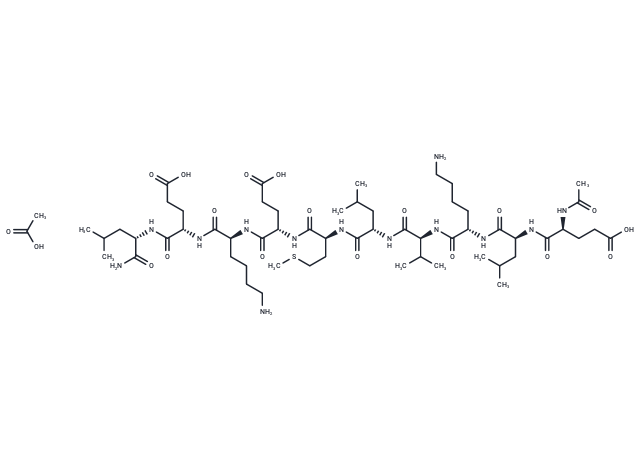
| Description | RAGE antagonist peptide acetate is an advanced antagonist of glycation end products (RAGE). RAGE antagonist peptide acetate possesses anti-tumor and anti-inflammatory activities. RAGE antagonist peptide acetate prevents RAGE from binding with several of its most important ligands, including HMGB-1, S100P, and S100A4. |
| In vitro | In cancer cells, RAGE antagonist peptide acetate reduces the ability of the ligands to stimulate RAGE activation of NFκB[2]. |
| In vivo | In mice bearing asthma, RAGE antagonist peptide acetate (RAP; 4 mg/kg; i.p.) blunts airway reactivity, airway inflammation and goblet cell metaplasia, and decreases release of Th2 cytokines. RAGE antagonist peptide acetate also reduces total, cytoplasmic and nuclear levels of β-catenin, enhanced β-catenin phosphorylation at Ser33/37/Thr41, which triggers ubiquitination, down-regulated expression of β-catenin targeted genes, and tends to keep β-catenin at the cytomembrane, shifting β-catenin from a signalling active pattern to an adhesive function[1]. RAGE antagonist peptide acetate reduces the growth and metastasis of pancreatic tumors and also inhibited glioma tumor growth. RAGE antagonist peptide acetate (100 μg) inhibits RAGE-mediated Basal NFκB Activity in PDAC cells in vivo[2]. |
| Molecular Weight | 1332.61 |
| Formula | C59H105N13O19S |
| Smiles | CC(O)=O.CSCC[C@@H](C(N[C@H](C(N[C@H](C(N[C@H](C(N[C@H](C(N)=O)CC(C)C)=O)CCC(O)=O)=O)CCCCN)=O)CCC(O)=O)=O)NC([C@@H](NC([C@H](C(C)C)NC([C@@H](NC([C@@H](NC([C@@H](NC(C)=O)CCC(O)=O)=O)CC(C)C)=O)CCCCN)=O)=O)CC(C)C)=O |
| Relative Density. | 1.31g/cm3 |
| Sequence | Glu-Leu-Lys-Val-Leu-Met-Glu-Lys-Glu-Leu |
| Sequence Short | ELKVLMEKEL |
| Storage | Keep away from moisture Powder: -20°C for 3 years | In solvent: -80°C for 1 year Shipping with blue ice/Shipping at ambient temperature. |
 For example, if the intended dosage is 10 mg/kg for animals weighing 20 g , with a dosing volume of 100 μL per animal, and a total of 10 animals are to be administered, using a formulation of
  10% DMSO+ 40% PEG300+ 5% Tween 80+ 45% Saline/PBS/ddH2O , the resulting working solution concentration would be 2 mg/mL.
Dissolve 2 mg of the compound in 100 μL DMSO to obtain a stock solution at a concentration of 20 mg/mL . If the required concentration exceeds the compound's known solubility, please contact us for technical support before proceeding.
1) Add 100 μL of the DMSO stock solution to 400 µL PEG300 and mix thoroughly until the solution becomes clear.
2) Add 50 µL Tween 80 and mix well until fully clarified.
3) Add 450 µL Saline,PBS or ddH2O and mix thoroughly until a homogeneous solution is obtained.
| Size | Quantity | Unit Price | Amount | Operation |
|---|
 Feedback
 Hello! How can I help you today?
Copyright © 2015-2026 TargetMol Chemicals Inc. All Rights Reserved.
