Shopping Cart
Remove All
  • TargetMol
    Your shopping cart is currently empty

Nitrofurazone (Synonyms: Nitrofural, NFZ, Furacilin)

Catalog No. T0897 Copy Product Info
Purity: 99.87%
🥰Excellent
Nitrofurazone (Nitrofural; Furacilin) is an orally active nitroaromatic broad-spectrum antibiotic with activity against both Gram-positive and Gram-negative bacteria. It is commonly used for establishing breast cancer models.

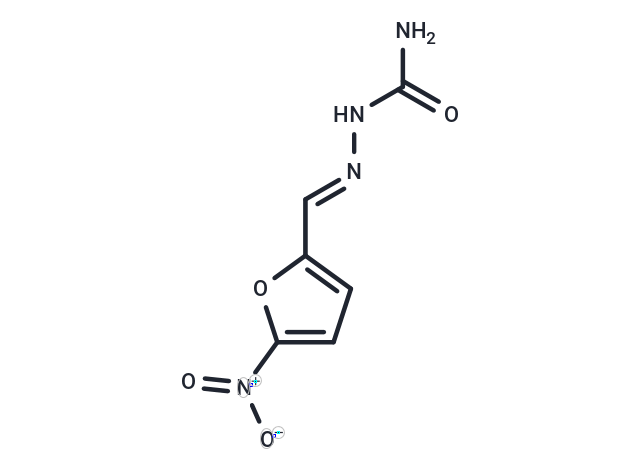
Nitrofurazone

Copy Product Info
🥰Excellent
Catalog No. T0897
Synonyms Nitrofural, NFZ, Furacilin

Nitrofurazone (Nitrofural; Furacilin) is an orally active nitroaromatic broad-spectrum antibiotic with activity against both Gram-positive and Gram-negative bacteria. It is commonly used for establishing breast cancer models.

Nitrofurazone
Cas No. 59-87-0
Pack SizePriceUSA StockGlobal StockQuantity
1 g$30In StockIn Stock
5 g$68-In Stock
10 g$98-In Stock
1 mL x 10 mM (in DMSO)$30In StockIn Stock
For In stock only · Estimated delivery: USA Stock (1-2 days) Global Stock (5-7 days)
Add to Cart
Add to Quotation
For research use only—not for human use. No sales to individuals. Use as intended only.
Questions
TargetMol
View More

Batch Information

Select Batch
Purity:99.87%
Appearance:Solid
Color:White
Contact us for more batch information

Resource Download

Product Introduction

Nitrofurazone AI Summary
Nitrofurazone exhibits bioactivity as an inhibitor of Plasmodium falciparum (DD2) proliferation, with an inhibitory potency of 21117.7 nM as determined by the qHTS profiling assay from the MIPE4 collection. This indicates that the compound may possess potential anti-malarial properties..
Note: Summary generated by AI. Data source: ChEMBL
Bioactivity
Description
Nitrofurazone (Nitrofural; Furacilin) is an orally active nitroaromatic broad-spectrum antibiotic with activity against both Gram-positive and Gram-negative bacteria. It is commonly used for establishing breast cancer models.
Disease Modeling Protocol
Breast tumor model
  • Modeling Mechanism:

    Nitrofurazone, a nitro-containing furan compound, induces breast tumors through the following mechanisms: ① The nitro group is activated by nitro reductase metabolism in vivo, generating a genotoxic active intermediate that binds to breast epithelial cell DNA, causing base damage and gene mutations; ② In vitro experiments have confirmed that it can induce Salmonella gene mutations, sister chromatid exchange in Chinese hamster ovary cells, and chromosomal aberrations. In vivo, it initiates malignant transformation of breast epithelial cells by interfering with the balance of cell proliferation and repair; ③ The nitro group in the molecular structure is a key carcinogenic group. Nitro-free structural analogs cannot induce breast tumors, and ultimately mainly form breast fibroadenomas, some of which can progress to adenocarcinoma.

  • Related Products:

    Nitrofurazone (T0897)

  • Modeling Method:

    Experimental Subject:

    Rats, F344/N rats, Female, 6–7 weeks old (pre-pubertal)

    Dosage and Administration Route:

    ① Core modelling: Nitrofurazone, 310 ppm or 620 ppm, mixed into standard diet, ad libitum access;
    ② Actual intake: Low dose (310 ppm) approximately 12 mg/kg/day, high dose (620 ppm) approximately 26 mg/kg/day;
    ③ Control treatment: Control group received basal diet without Nitrofurazone; all other housing conditions identical;

    Dosing Frequency and Duration Model:

    Ad libitum feeding, Continuous for 103 weeks (approximately 2 years)

  • Validation:

    1. Tumor Incidence: - Breast fibroadenoma: The incidence rate was 16% (8/49) in the control group, 72% (36/50) in the low-dose group, and 72% (36/50) in the high-dose group, showing a highly significant difference compared to the control group (p<0.001); - Breast adenocarcinoma: The incidence rate was 2% (1/49) in the control group and 4% (2/50) in the high-dose group, showing a slight increasing trend; 2. Pathological Indicators: - HE staining showed that breast fibroadenoma was composed of epithelial tissue and fibrous connective tissue. Small tumors were mainly composed of epithelial components, while large tumors were dominated by fibrous connective tissue, which could compress or replace epithelial structures; adenocarcinoma showed abnormal proliferation, morphological atypia, and invasive growth of epithelial cells; 3. Genetic Toxicity Verification: - Positive in vitro Salmonella TA98 and TA100 gene mutation tests, and increased sister chromatid exchange and chromosomal aberration rates in Chinese hamster ovary cells, confirming its genotoxic effects.

*Precautions: At the end of the experiment, the breast tissue (including all lobes) was completely dissected after euthanasia. Tumor nodules and adjacent tissues were separated, and some were fixed in 10% neutral formalin (for pathological staining and immunohistochemistry), while others were flash-frozen in liquid nitrogen (for molecular mechanism detection).

*References:National Toxicology Program. NTP Toxicology and Carcinogenesis Studies of Nitrofurazone (CAS No. 59-87-0) in F344/N Rats and B6C3F1 Mice (Feed Studies). Natl Toxicol Program Tech Rep Ser. 1988 Jun;337:1-183.

SynonymsNitrofural, NFZ, Furacilin
Chemical Properties
Molecular Weight198.14
FormulaC6H6N4O4
Cas No.59-87-0
SmilesNC(=O)N\N=C\c1ccc(o1)[N+]([O-])=O
Relative Density.1.6031 g/cm3 (Estimated)
Storage & Solubility Information
StoragePowder: -20°C for 3 years | In solvent: -80°C for 1 year | Shipping with blue ice/Shipping at ambient temperature.
Solubility Information
Ethanol: < 1 mg/mL (insoluble or slightly soluble)
DMSO: 55 mg/mL (277.58 mM), Sonication is recommended.

In Vivo Formulation
10% DMSO+40% PEG300+5% Tween 80+45% Saline: 2 mg/mL (10.09 mM), Sonication is recommended.
Please add the solvents sequentially, clarifying the solution as much as possible before adding the next one. Dissolve by heating and/or sonication if necessary. Working solution is recommended to be prepared and used immediately. The formulation provided above is for reference purposes only. In vivo formulations may vary and should be modified based on specific experimental conditions.
Solution Preparation Table
DMSO
1mg5mg10mg50mg
1 mM5.0469 mL25.2347 mL50.4694 mL252.3468 mL
5 mM1.0094 mL5.0469 mL10.0939 mL50.4694 mL
10 mM0.5047 mL2.5235 mL5.0469 mL25.2347 mL
20 mM0.2523 mL1.2617 mL2.5235 mL12.6173 mL
50 mM0.1009 mL0.5047 mL1.0094 mL5.0469 mL
100 mM0.0505 mL0.2523 mL0.5047 mL2.5235 mL
Note : The dilution table applies only to solid products. For liquid products, please calculate the stock solution based on the stated concentration and/or density.

Calculator

  • Molarity Calculator
  • Dilution Calculator
  • Reconstitution Calculator
  • Molecular Weight Calculator

In Vivo Formulation Calculator (Clear solution)

Please enter your animal experiment information in the following box and click Calculate to obtain the stock solution preparation method and in vivo formula preparation method:
TargetMol | Animal experiments For example, if the intended dosage is 10 mg/kg for animals weighing 20 g , with a dosing volume of 100 μL per animal, TargetMol | Animal experiments and a total of 10 animals are to be administered, using a formulation of TargetMol | reagent 10% DMSO+ 40% PEG300+ 5% Tween 80+ 45% Saline/PBS/ddH2O , the resulting working solution concentration would be 2 mg/mL.

Stock Solution Preparation:

Dissolve 2 mg of the compound in 100 μL DMSOTargetMol | reagent to obtain a stock solution at a concentration of 20 mg/mL . If the required concentration exceeds the compound's known solubility, please contact us for technical support before proceeding.

Preparation of the In Vivo Formulation:

1) Add 100 μL of the DMSOTargetMol | reagent stock solution to 400 μL PEG300TargetMol | reagent and mix thoroughly until the solution becomes clear.

2) Add 50 μL Tween 80 and mix well until fully clarified.

3) Add 450 μL Saline,PBS or ddH2OTargetMol | reagent and mix thoroughly until a homogeneous solution is obtained.

This example is provided solely to demonstrate the use of the In Vivo Formulation Calculator and does not constitute a recommended formulation for any specific compound. Please select an appropriate dissolution and formulation strategy based on your experimental model and route of administration.
All co-solvents required for this protocol, includingDMSO, PEG300/PEG400, Tween 80, SBE-β-CD, and Corn oil, are available for purchase on the TargetMol website.
1 Enter information below:
mg/kg
g
μL
2 Enter the in vivo formulation:
% DMSO
%
% Tween 80
% Saline/PBS/ddH2O

Dose Conversion

You can also refer to dose conversion for different animals. More Dose Conversion

Tech Support

Please see Inhibitor Handling Instructions for more frequently ask questions. Topics include: how to prepare stock solutions, how to store products, and cautions on cell-based assays & animal experiments, etc

Keywords

Related Tags: buy Nitrofurazone | purchase Nitrofurazone | Nitrofurazone cost | order Nitrofurazone | Nitrofurazone chemical structure | Nitrofurazone formula | Nitrofurazone molecular weight