


Shopping Cart
Remove All Your shopping cart is currently empty


Synonyms: c(CRGDKGPDC)

| Pack Size | Price | USA Stock | Global Stock | Quantity |
|---|---|---|---|---|
| 1 mg | $72 | In Stock | In Stock | |
| 5 mg | $297 | In Stock | In Stock | |
| 10 mg | $513 | In Stock | In Stock | |
| 25 mg | $819 | In Stock | In Stock | |
| 50 mg | $1,090 | In Stock | In Stock | |
| 100 mg | $1,490 | In Stock | In Stock |
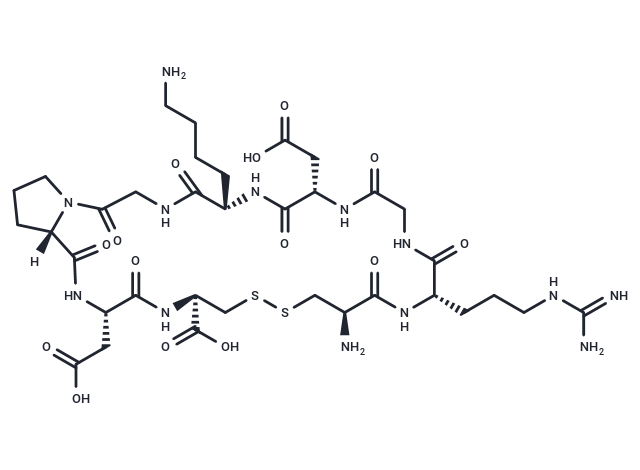
| Description | iRGD peptide (c(CRGDKGPDC)) is a 9-amino acid cyclic peptide (sequence: CRGDKGPDC) and a molecular mimicry agent that was originally identified in an in vivo screening of phage display libraries in tumor-bearing mice. |
| In vitro | iRGD peptide-mediated tumor penetration involves a three-step process: initial binding to αv-integrins present on tumor vasculature or cells, the revelation of a C-terminal motif capable of binding to neuropilin-1 (NRP-1) through proteolysis, and subsequent cell internalization. Incorporation of the iRGD peptide into the ICOVIR15K fiber's C terminus specifically improves binding and internalization in MCF7 cells, known to express NRP-1 and integrins, without affecting the virus's ability to infect and replicate[1]. Alone, the iRGD peptide does not significantly impact gastric cancer cells. However, when combined with 5-FU, it notably enhances the chemotherapy's efficacy against gastric cancer cells via NRP1, at a concentration of 0.3 μmol/mL[2]. |
| In vivo | iRGD inserted in the oncolytic adenovirus ICOVIR15K (ICOVIR15K-iRGD) enhances early adenovirus dissemination through the tumor mass and elevates the antitumor effect in mice[1]. In vivo, iRGD did not alter the normal organ transduction pattern, with liver and spleen as main targeted organs. iRGD (4 mmol/kg, i.v.) combined with 5-FU significantly suppresses tumor growth in nude mice bearing human gastric cancer cells[2]. |
| Synonyms | c(CRGDKGPDC) |
| Molecular Weight | 948.04 |
| Formula | C35H57N13O14S2 |
| Cas No. | 1392278-76-0 |
| Smiles | O=C1[C@]2(N(CCC2)C(=O)CNC(=O)[C@H](CCCCN)NC(=O)[C@H](CC(O)=O)NC(=O)CNC(=O)[C@H](CCCNC(=N)N)NC(=O)[C@@H](N)CSSC[C@@H](C(O)=O)NC(=O)[C@H](CC(O)=O)N1)[H] |
| Relative Density. | 1.68 g/cm3 (Predicted) |
| Sequence | Cys-Arg-Gly-Asp-Lys-Gly-Pro-Asp-Cys (Disulfide bridge:Cys1-Cys9) |
| Sequence Short | CRGDKGPDC |
| Storage | Keep away from moisture Powder: -20°C for 3 years | In solvent: -80°C for 1 year Shipping with blue ice/Shipping at ambient temperature. |
| Solubility Information | DMSO: Insoluble H2O: < 1 mg/mL (insoluble), Sonication is recommended.  |
 For example, if the intended dosage is 10 mg/kg for animals weighing 20 g , with a dosing volume of 100 μL per animal, and a total of 10 animals are to be administered, using a formulation of
  10% DMSO+ 40% PEG300+ 5% Tween 80+ 45% Saline/PBS/ddH2O , the resulting working solution concentration would be 2 mg/mL.
Dissolve 2 mg of the compound in 100 μL DMSO to obtain a stock solution at a concentration of 20 mg/mL . If the required concentration exceeds the compound's known solubility, please contact us for technical support before proceeding.
1) Add 100 μL of the DMSO stock solution to 400 µL PEG300 and mix thoroughly until the solution becomes clear.
2) Add 50 µL Tween 80 and mix well until fully clarified.
3) Add 450 µL Saline,PBS or ddH2O and mix thoroughly until a homogeneous solution is obtained.
| Size | Quantity | Unit Price | Amount | Operation |
|---|
 Feedback
 Hello! How can I help you today?
Copyright © 2015-2026 TargetMol Chemicals Inc. All Rights Reserved.
