


Shopping Cart
Remove All Your shopping cart is currently empty


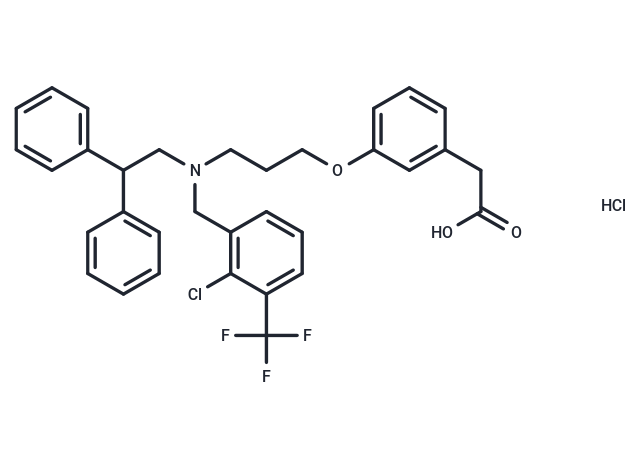
Synonyms: GW3965 HCl
| Pack Size | Price | USA Stock | Global Stock | Quantity |
|---|---|---|---|---|
| 2 mg | $35 | In Stock | In Stock | |
| 5 mg | $57 | In Stock | In Stock | |
| 10 mg | $90 | In Stock | In Stock | |
| 25 mg | $197 | In Stock | In Stock | |
| 50 mg | $317 | In Stock | In Stock | |
| 100 mg | $497 | In Stock | In Stock | |
| 1 mL x 10 mM (in DMSO) | $79 | In Stock | In Stock |
| Description | GW3965 hydrochloride (GW3965 HCl) belongs to synthetic small molecules and is a liver X receptor (LXR) agonist (hLXRα EC50 = 190 nM; hLXRβ EC50 = 30 nM) with subtype selectivity, cell permeability, and oral activity. This compound is used in research related to metabolism, inflammation, and neuropathic pain. |
| Targets & IC50 | LXRα (human):190 nM (EC50), LXRβ (human):30 nM (EC50) |
| In vitro | Methods: Spleen-derived myeloid-derived suppressor cells (MDSCs) from septic mice were incubated with 1 μM GW3965 hydrochloride for 1 hour, and cell apoptosis was detected by flow cytometry. Results: GW3965 hydrochloride induced apoptosis of spleen MDSCs. [1] Methods: Gefitinib-resistant non-small cell lung cancer PC9 cells were treated with 5 μM GW3965 hydrochloride alone or in combination with gefitinib for 48 hours. Cell viability was detected by MTT assay, autophagy-related proteins LC3 II/I and Beclin 1 expression were determined by Western blot, autophagosome formation was observed by AO staining, and cell apoptosis was evaluated by flow cytometry. Results: GW3965 hydrochloride combined with gefitinib synergistically inhibited cell viability compared to monotherapy groups, upregulated LC3 II/I ratio and Beclin 1 expression, and increased autophagosome accumulation and apoptosis rate. [2] |
| In vivo | Methods: A collagenase-induced intracerebral hemorrhage mouse model was used. GW3965 hydrochloride was administered by intraperitoneal injection at a dose of 10 mg/kg, dissolved in 50% DMSO, starting 1 hour post-surgery, once daily for 7 consecutive days. Results: The GW3965 hydrochloride treatment group showed reduced lesion volume, accelerated hematoma clearance, alleviated white matter injury, and promoted neurological functional recovery.[3] Methods: A cecal ligation and puncture (CLP)-induced sepsis mouse model was used. GW3965 hydrochloride was administered by subcutaneous injection at a dose of 3 mg/kg, dissolved in 5% DMSO/30% PEG300/5% Tween 80/60% ddH₂O, for a total of 6 doses at 1, 6, 12, 24, 48, and 72 hours post-surgery. Results: GW3965 hydrochloride improved mouse survival rate, alleviated multi-organ injury, and reduced serum inflammatory factor levels.[4] |
| Synonyms | GW3965 HCl |
| Kinase Assay | Steady-state drug accumulation assay: AuxB1 and CHrB30 cells are grown to confluency in 12-well (24 mm) tissue culture dishes and the steady-state accumulation of [3H]-vinblastine is measured. Accumulation is initiated by the addition of 0.1 μ Ci [3H]-vinblastine and unlabelled vinblastine to a final concentration of 100 nM . The accumulation of [3H]-paclitaxel is measured using 0.1 μ Ci [3H]-paclitaxel and unlabelled drug to a final concentration of 1 μM . Cells are incubated in a reaction volume of 1 mL for 60 min at 37 ℃ under 5% CO2 in order to reach steady-state. The effect of the modulators XR9576 on [3H]-ligand accumulation is investigated in the concentration range 10-9 - 10-6 M. Modulators are added from a DMSO stock giving a final solvent concentration of 0.2 % (v/v). Following cell harvesting, accumulated drug is measured by liquid scintillation counting and normalized for cell protein content. Plots of amount accumulated as a function of modulator concentration are fitted with the general dose-response equation: Y={(a-b)/(1+(X/c)d)}+b Where: Y=response; a=initial response; b=final response; c=EC50 concentration; d=slope value; X=drug concentration. |
| Cell Research | Cells are seeded in 96 wells and are treated after 24 hours with different drugs indicated in each experiment in medium containing 1% FBS or lipoprotein deficient serum. Relative proliferation is determined using Cell Proliferation Assay Kit. Cells are incubated 1.5 hrs after adding tetrazolium salt WST-1 [2-(4-iodophenyl)-3- (4-nitrophenyl)-5-(2, 4-disulfo-phenyl)-2H-tetrazolium, monosodium salt] at 5% CO2, 37oC and the absorbance of the treated and untreated cells are measured using a microplate reader at 420 to 480 nm. Cells seeded in 12 well plates are counted using a hemocytometer, and dead cells are assessed using trypan blue exclusion assays. |
| Molecular Weight | 618.51 |
| Formula | C33H31ClF3NO3·HCl |
| Cas No. | 405911-17-3 |
| Smiles | c1ccc(cc1)C(CN(CCCOc1cccc(c1)CC(=O)O)Cc1c(c(ccc1)C(F)(F)F)Cl)c1ccccc1.Cl |
| Relative Density. | no data available |
| Storage | Store at low temperature,Keep away from moisture Powder: -20°C for 3 years | In solvent: -80°C for 1 year Shipping with blue ice/Shipping at ambient temperature. | ||||||||||||||||||||||||||||||||||||||||
| Solubility Information | DMSO: 71.2 mg/mL (115.12 mM), Sonication is recommended.  Ethanol: 12.4 mg/mL (20.05 mM), Sonication is recommended. | ||||||||||||||||||||||||||||||||||||||||
| In Vivo Formulation | 10% DMSO+40% PEG300+5% Tween 80+45% Saline: 2 mg/mL (3.23 mM), Sonication is recommended. Please add the solvents sequentially, clarifying the solution as much as possible before adding the next one. Dissolve by heating and/or sonication if necessary. Working solution is recommended to be prepared and used immediately. The formulation provided above is for reference purposes only. In vivo formulations may vary and should be modified based on specific experimental conditions. | ||||||||||||||||||||||||||||||||||||||||
Solution Preparation Table | |||||||||||||||||||||||||||||||||||||||||
Ethanol/DMSO
DMSO
Note : The dilution table applies only to solid products. For liquid products, please calculate the stock solution based on the stated concentration and/or density. | |||||||||||||||||||||||||||||||||||||||||
 For example, if the intended dosage is 10 mg/kg for animals weighing 20 g , with a dosing volume of 100 μL per animal, and a total of 10 animals are to be administered, using a formulation of
  10% DMSO+ 40% PEG300+ 5% Tween 80+ 45% Saline/PBS/ddH2O , the resulting working solution concentration would be 2 mg/mL.
Dissolve 2 mg of the compound in 100 μL DMSO to obtain a stock solution at a concentration of 20 mg/mL . If the required concentration exceeds the compound's known solubility, please contact us for technical support before proceeding.
1) Add 100 μL of the DMSO stock solution to 400 µL PEG300 and mix thoroughly until the solution becomes clear.
2) Add 50 µL Tween 80 and mix well until fully clarified.
3) Add 450 µL Saline,PBS or ddH2O and mix thoroughly until a homogeneous solution is obtained.
| Size | Quantity | Unit Price | Amount | Operation |
|---|
 Feedback
 Hello! How can I help you today?
Copyright © 2015-2026 TargetMol Chemicals Inc. All Rights Reserved.
