


Shopping Cart
Remove All Your shopping cart is currently empty

Synonyms: GSK189254
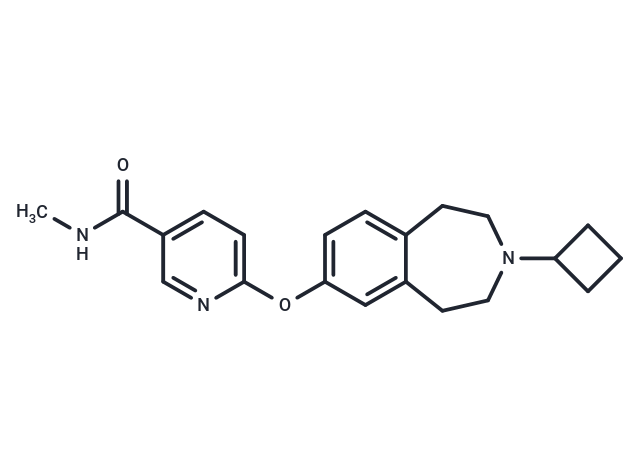
| Pack Size | Price | USA Stock | Global Stock | Quantity |
|---|---|---|---|---|
| 1 mg | $48 | In Stock | In Stock | |
| 5 mg | $81 | In Stock | In Stock | |
| 10 mg | $123 | In Stock | In Stock | |
| 25 mg | $228 | In Stock | In Stock | |
| 50 mg | $369 | - | In Stock | |
| 100 mg | $531 | - | In Stock | |
| 200 mg | $766 | - | In Stock | |
| 1 mL x 10 mM (in DMSO) | $62 | In Stock | In Stock |
| Description | GSK189254A (GSK189254) is a potent and specific histamine H3 receptor antagonist (pKi values: 9.59-9.90 and 8.51-9.17 for human and rat H3). |
| Targets & IC50 | H3 receptor (mouse):8.51-9.17 (pKi), H3 receptor (human):9.59-9.90 (pKi) |
| In vitro | GSK189254 has a high affinity for both recombinant H3 receptors expressed in HEK-293-MSR-II cells and native H3 receptors expressed in the cerebral cortex of several species. GSK189254 generally exhibits a higher affinity for human and pig H3 receptors compared with mouse, rat, and dog H3 receptors. GSK189254 may have therapeutic potential for the symptomatic treatment of dementia in Alzheimer’s disease and other cognitive disorders [1]. |
| In vivo | In both Ox+/+ and Ox?/? mice, acute GSK189254 administration effectively increases wakefulness and reduces both slow wave and paradoxical sleep comparably to modafinil, additionally decreasing narcoleptic episodes in Ox?/? mice [2]. At doses ranging from 0.3 to 3 mg/kg administered orally, GSK189254 enhances the release of acetylcholine, noradrenaline, and dopamine in the anterior cingulate cortex, and elevates acetylcholine levels in the dorsal hippocampus. Significantly, GSK189254 enhances rats' cognitive performance across various paradigms, including passive avoidance, water maze, object recognition, and attentional set shift tasks [1]. |
| Synonyms | GSK189254 |
| Animal Research | Pharmacokinetic studies with GSK189254 are conducted in conscious male Sprague-Dawley rats. Animals receive an intravenous infusion of GSK189254 (n=3) administered at a nominal dose level of 1 mg of free base/kg for 1 h via the femoral vein cannula (10 mL/h/kg). GSK189254 is dissolved in 0.9% (w/v) saline at a target concentration of 0.1 mg free base/mL and filtered with a 0.22-mm Millex-GV filter before administration. After an ish out of at least 2 days, the same rats received a single oral administration of GSK189254 by gastric gavage to achieve a target dose of 2 mg of free base/kg. GSK189254 is formulated in 1% (w/v) aqueous methylcellulose at a target concentration of 0.4 mg free base/mL [1]. The vehicle consists of 0.05 mL NaCl at 0.9% containing methylcellulose at 1%. GSK189254 is a dissolved in-vehicle solution. The effects of acute and repeat administration of GSK189254 on the sleep-wake cycle in wild-type (Ox+/+) and orexin knockout (Ox?/?) mice is investigated. GSK189254 (3 and 10 mg/kg, p.o.) is administered on the sleep-wake cycle in Ox+/+ and Ox?/? mice, dosed at 10 h. The oral administration dose of GSK189254 is 10 mg/kg [2]. |
| Molecular Weight | 351.44 |
| Formula | C21H25N3O2 |
| Cas No. | 720690-73-3 |
| Smiles | CNC(=O)c1ccc(Oc2ccc3CCN(CCc3c2)C2CCC2)nc1 |
| Relative Density. | 1.195 g/cm3 (Predicted) |
| Storage | Store at low temperature Powder: -20°C for 3 years | In solvent: -80°C for 1 year Shipping with blue ice/Shipping at ambient temperature. | ||||||||||||||||||||||||||||||
| Solubility Information | DMSO: 24 mg/mL (68.29 mM), Sonication is recommended. | ||||||||||||||||||||||||||||||
| In Vivo Formulation | 10% DMSO+40% PEG300+5% Tween 80+45% Saline: 2 mg/mL (5.69 mM), Sonication is recommended. Please add the solvents sequentially, clarifying the solution as much as possible before adding the next one. Dissolve by heating and/or sonication if necessary. Working solution is recommended to be prepared and used immediately. The formulation provided above is for reference purposes only. In vivo formulations may vary and should be modified based on specific experimental conditions. | ||||||||||||||||||||||||||||||
Solution Preparation Table | |||||||||||||||||||||||||||||||
DMSO
Note : The dilution table applies only to solid products. For liquid products, please calculate the stock solution based on the stated concentration and/or density. | |||||||||||||||||||||||||||||||
 For example, if the intended dosage is 10 mg/kg for animals weighing 20 g , with a dosing volume of 100 μL per animal, and a total of 10 animals are to be administered, using a formulation of
  10% DMSO+ 40% PEG300+ 5% Tween 80+ 45% Saline/PBS/ddH2O , the resulting working solution concentration would be 2 mg/mL.
Dissolve 2 mg of the compound in 100 μL DMSO to obtain a stock solution at a concentration of 20 mg/mL . If the required concentration exceeds the compound's known solubility, please contact us for technical support before proceeding.
1) Add 100 μL of the DMSO stock solution to 400 µL PEG300 and mix thoroughly until the solution becomes clear.
2) Add 50 µL Tween 80 and mix well until fully clarified.
3) Add 450 µL Saline,PBS or ddH2O and mix thoroughly until a homogeneous solution is obtained.
| Size | Quantity | Unit Price | Amount | Operation |
|---|
 Feedback
 Hello! How can I help you today?
Copyright © 2015-2026 TargetMol Chemicals Inc. All Rights Reserved.
