


Shopping Cart
Remove All Your shopping cart is currently empty


Synonyms:
| Pack Size | Price | USA Stock | Global Stock | Quantity |
|---|---|---|---|---|
| 5 mg | $39 | In Stock | In Stock | |
| 10 mg | $64 | In Stock | In Stock | |
| 25 mg | $128 | In Stock | In Stock | |
| 50 mg | $213 | In Stock | In Stock | |
| 100 mg | $347 | In Stock | In Stock | |
| 200 mg | $498 | In Stock | In Stock | |
| 1 mL x 10 mM (in DMSO) | $59 | In Stock | In Stock |
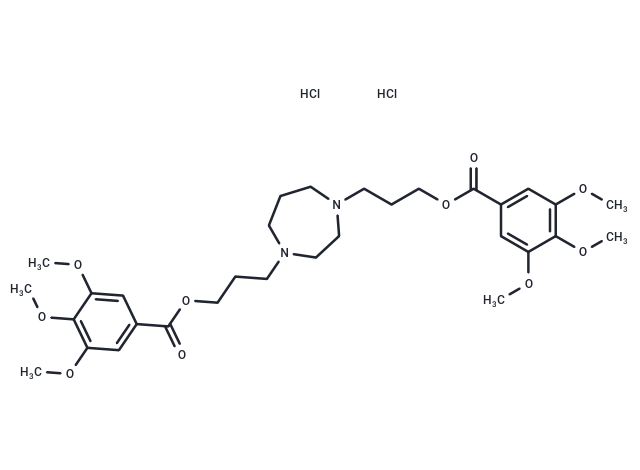
| Description | Dilazep dihydrochloride is an adenosine uptake inhibitor. Dilazep dihydrochloride also inhibits the ischemic damage, membrane transport of nucleosides and platelet aggregation. Dilazep dihydrochloride has cerebral and coronary vasodilating action through enhancement of effect of adenosine. |
| In vitro | Dilazep, NBI and Dipyridamole have been reported to inhibit the uptake of adenosine into different cells. The uptake mechanism has been studied extensively in vitro. In these compounds, Dilazep and NBI are almost 10 times more effective than Dipyridamole. Only Dilazep is water soluble and no solubility aiding organic solvent is needed for preparing an aqueous solution[1]. |
| In vivo | Dilazep acts by inhibiting phospholipase activation in reperfused heart mitochondria and preventing lipid peroxidation in cerebral ischemia and reperfusion, potentially reducing ischemic cerebral injury through increased cerebral blood flow and protection of vascular endothelial cell membranes. Importantly, low doses (0.04-0.1 mg/kg/min) amplify the effects of adenosine, significantly enhancing superior mesenteric arterial conductance (SMAC) and raising arterial plasma adenosine levels, with a clear correlation observed between adenosine levels and SMAC changes, showing a 193.4% change in SMAC and an EC50 value of 2.8 μM. However, the vasodilatory potentiation by Dilazep is nullified by 8-phenyltheophylline, though this does not interfere with isoproterenol-induced relaxation. |
| Molecular Weight | 677.61 |
| Formula | C31H46Cl2N2O10 |
| Cas No. | 20153-98-4 |
| Smiles | Cl.Cl.COc1cc(cc(OC)c1OC)C(=O)OCCCN1CCCN(CCCOC(=O)c2cc(OC)c(OC)c(OC)c2)CC1 |
| Relative Density. | no data available |
| Storage | Powder: -20°C for 3 years | In solvent: -80°C for 1 year Shipping with blue ice/Shipping at ambient temperature. | |||||||||||||||||||||||||||||||||||
| Solubility Information | DMSO: 71.4 mg/mL (105.37 mM), Sonication is recommended.  H2O: 80 mg/mL (118.06 mM), Sonication is recommended. | |||||||||||||||||||||||||||||||||||
| In Vivo Formulation | 10% DMSO+90% Saline: 7.14 mg/mL (10.54 mM), Solution. 10% DMSO+40% PEG300+5% Tween 80+45% Saline: 2 mg/mL (2.95 mM), Sonication is recommended. Please add the solvents sequentially, clarifying the solution as much as possible before adding the next one. Dissolve by heating and/or sonication if necessary. Working solution is recommended to be prepared and used immediately. The formulation provided above is for reference purposes only. In vivo formulations may vary and should be modified based on specific experimental conditions. | |||||||||||||||||||||||||||||||||||
Solution Preparation Table | ||||||||||||||||||||||||||||||||||||
DMSO/H2O
Note : The dilution table applies only to solid products. For liquid products, please calculate the stock solution based on the stated concentration and/or density. | ||||||||||||||||||||||||||||||||||||
 For example, if the intended dosage is 10 mg/kg for animals weighing 20 g , with a dosing volume of 100 μL per animal, and a total of 10 animals are to be administered, using a formulation of
  10% DMSO+ 40% PEG300+ 5% Tween 80+ 45% Saline/PBS/ddH2O , the resulting working solution concentration would be 2 mg/mL.
Dissolve 2 mg of the compound in 100 μL DMSO to obtain a stock solution at a concentration of 20 mg/mL . If the required concentration exceeds the compound's known solubility, please contact us for technical support before proceeding.
1) Add 100 μL of the DMSO stock solution to 400 µL PEG300 and mix thoroughly until the solution becomes clear.
2) Add 50 µL Tween 80 and mix well until fully clarified.
3) Add 450 µL Saline,PBS or ddH2O and mix thoroughly until a homogeneous solution is obtained.
| Size | Quantity | Unit Price | Amount | Operation |
|---|
 Feedback
 Hello! How can I help you today?
Copyright © 2015-2026 TargetMol Chemicals Inc. All Rights Reserved.
