


Shopping Cart
Remove All Your shopping cart is currently empty


Synonyms: Dequafungan, Decabis, Danical
| Pack Size | Price | USA Stock | Global Stock | Quantity |
|---|---|---|---|---|
| 25 mg | $39 | In Stock | In Stock | |
| 50 mg | $55 | In Stock | In Stock | |
| 100 mg | $73 | In Stock | In Stock | |
| 200 mg | $106 | In Stock | In Stock |
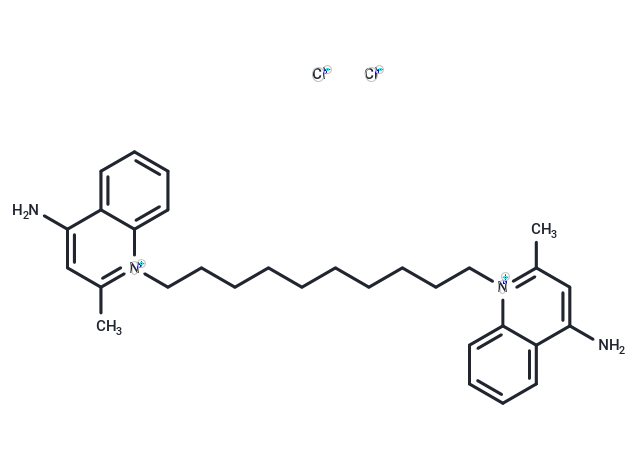
| Description | Dequalinium chloride (Decabis) , a topical bacteriostat, is a selective blocker of apamin-sensitive K+ channels. It is used in wound dressings and mouth infections and may also have antifungal action, but may cause skin ulceration. |
| Targets & IC50 | PKC:7 μM-18 μM |
| In vitro | Dequalinium chloride effectively inhibits nicotinic responses in skeletal muscles and potassium ion channels sensitive to apamin in bee venom in hepatocytes. It also acts as a ganglionic blocking agent (EC50: 2 μM) and, as a cationic lipophilic PKC inhibitor, shares a similar structure with the dye Rhodamine 123. Dequalinium chloride irreversibly inhibits PKCα/β through covalent binding under UV irradiation. It selectively accumulates in the mitochondria of tumor cells, inducing mitochondrial toxicity by blocking mitochondrial enzymes, thereby disrupting cellular energy production and leading to cell death. Dequalinium inhibits the binding of 125I-monoiodoapamin (Ki: 1.1 μM) and prevents potassium ion loss (induced by angiotensin II, IC50: 1.5 μM). In cultured rat sympathetic neurons, Dequalinium reversibly inhibits the slow component of the afterhyperpolarization (AHP) sensitive to apamin, subsequently generating a single action potential. |
| In vivo | In mice bearing MB49 bladder tumor xenografts, Dequalinium chloride (2 mg/kg/day i.p.) exhibited anticancer activity with a T/C value of 210%. |
| Synonyms | Dequafungan, Decabis, Danical |
| Molecular Weight | 527.59 |
| Formula | C30H40Cl2N4 |
| Cas No. | 522-51-0 |
| Smiles | [Cl-].[Cl-].Cc1cc(N)c2ccccc2[n+]1CCCCCCCCCC[n+]1c(C)cc(N)c2ccccc12 |
| Relative Density. | no data available |
| Storage | Powder: -20°C for 3 years | In solvent: -80°C for 1 year Shipping with blue ice/Shipping at ambient temperature. | ||||||||||
| Solubility Information | DMSO: Insoluble H2O: 1 mg/mL (1.9 mM), Sonication is recommended.  Ethanol: <1mg/mL (insoluble) | ||||||||||
Solution Preparation Table | |||||||||||
H2O
Note : The dilution table applies only to solid products. For liquid products, please calculate the stock solution based on the stated concentration and/or density. | |||||||||||
 For example, if the intended dosage is 10 mg/kg for animals weighing 20 g , with a dosing volume of 100 μL per animal, and a total of 10 animals are to be administered, using a formulation of
  10% DMSO+ 40% PEG300+ 5% Tween 80+ 45% Saline/PBS/ddH2O , the resulting working solution concentration would be 2 mg/mL.
Dissolve 2 mg of the compound in 100 μL DMSO to obtain a stock solution at a concentration of 20 mg/mL . If the required concentration exceeds the compound's known solubility, please contact us for technical support before proceeding.
1) Add 100 μL of the DMSO stock solution to 400 µL PEG300 and mix thoroughly until the solution becomes clear.
2) Add 50 µL Tween 80 and mix well until fully clarified.
3) Add 450 µL Saline,PBS or ddH2O and mix thoroughly until a homogeneous solution is obtained.
| Size | Quantity | Unit Price | Amount | Operation |
|---|
 Feedback
 Hello! How can I help you today?
Copyright © 2015-2026 TargetMol Chemicals Inc. All Rights Reserved.
