Shopping Cart
Remove All
  • TargetMol
    Your shopping cart is currently empty

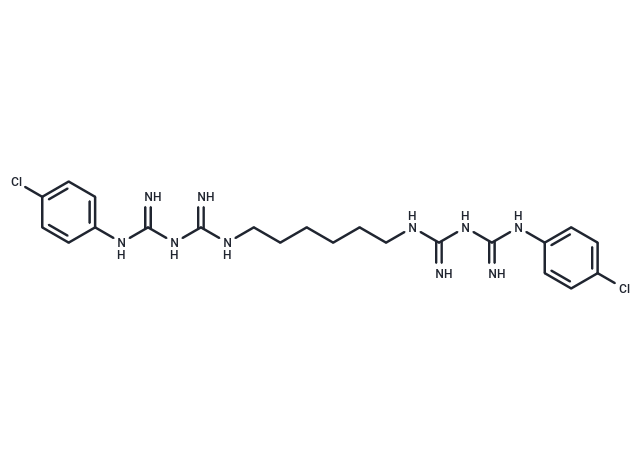
Chlorhexidine

Copy Product Info
😃Good
Catalog No. T1000Cas No. 55-56-1
Alias Rotersept, Nolvasan, Chlorhexidinum

Chlorhexidine (Rotersept) is a biguanide compound used as an antiseptic agent with topical antibacterial activity. Chlorhexidine is positively charged and reacts with the negatively charged microbial cell surface, thereby destroying the integrity of the cell membrane. Subsequently, chlorhexidine penetrates into the cell and causes leakage of intracellular components leading to cell death. Since gram-positive bacteria are more negatively charged, they are more sensitive to this agent.

Chlorhexidine

Chlorhexidine

Copy Product Info
😃Good
Purity: 99.85%
Catalog No. T1000Alias Rotersept, Nolvasan, ChlorhexidinumCas No. 55-56-1
Chlorhexidine (Rotersept) is a biguanide compound used as an antiseptic agent with topical antibacterial activity. Chlorhexidine is positively charged and reacts with the negatively charged microbial cell surface, thereby destroying the integrity of the cell membrane. Subsequently, chlorhexidine penetrates into the cell and causes leakage of intracellular components leading to cell death. Since gram-positive bacteria are more negatively charged, they are more sensitive to this agent.
Pack SizePriceUSA WarehouseGlobal WarehouseQuantity
500 mg$40In StockIn Stock
1 g$56In StockIn Stock
5 g$133-In Stock
10 g$198-In Stock
1 mL x 10 mM (in DMSO)$50In StockIn Stock
Add to Cart
Add to Quotation
In Stock Estimated shipping dateUSA Warehouse[1-2 days] Global Warehouse[5-7 days]
All TargetMol products are for research purposes only and cannot be used for human consumption. We do not provide products or services to individuals. Please comply with the intended use and do not use TargetMol products for any other purpose.
Questions
TargetMol
View More

Batch Information

Select Batch
Purity:99.85%
Color:White
Contact us for more batch information

Resource Download

Product Introduction

Chlorhexidine AI Summary
Chlorhexidine exhibits a broad spectrum of bioactivity, including significant antibacterial properties against a variety of bacterial strains such as Streptococcus mutans, Staphylococcus aureus, Escherichia coli, Klebsiella pneumonia, Pseudomonas aeruginosa, and Porphyromonas gingivalis. The minimum inhibitory concentrations (MICs) range from 0.0007 μg/mL to over 50 μg/mL, with notable antimicrobial effects against Staphylococcus aureus, Bacillus subtilis, Providencia stuartii, and Streptococcus sobrinus. Additionally, it shows strong antibiofilm activity against Streptococcus mutans and Candida albicans. Chlorhexidine also inhibits HIV-1 integrase with significant inhibition above 50% at 1 mM concentration. It demonstrates antiviral activity against SARS-CoV-2 in Vero E6 cells, albeit with lower potency. The compound shows notable enzyme inhibition, including Trypanosoma cruzi trypanothione reductase and human glutathione reductase. It inhibits the phosphatase activities of SYNJ1 and SYNJ2, with IC50 values of 10,000 nM and ≤15,900 nM, respectively. In terms of transporter activity, Chlorhexidine inhibits organic cation transporters OCT1, OCT2, OCT3, MATE1, and MATE2K with IC50 values ranging from 210 nM to 700 nM. Additionally, it displaces neuropeptide Y1 and ETA receptors with high efficacy and exhibits potent inhibition of gelatinase A and B in human cells. Although Chlorhexidine shows no significant prediction for liver injury, it does exhibit moderate acute liver toxicity and cytotoxicity in human and mouse cell lines with variations in selectivity indices and CC50 values. The compound has a high partition coefficient (LogP = 4.78) and displays high activity in displacing [3H]NPY and [3H]BQ-123 from their respective receptors, indicating potential relevance in pharmacokinetics. Overall, Chlorhexidine shows promise as an antimicrobial agent, enzyme inhibitor, and modulator of organic cation transport, with diverse bioactivities across various assays and conditions..
Note: Summary generated by AI. Data source: ChEMBL
Bioactivity
Description
Chlorhexidine (Rotersept) is a biguanide compound used as an antiseptic agent with topical antibacterial activity. Chlorhexidine is positively charged and reacts with the negatively charged microbial cell surface, thereby destroying the integrity of the cell membrane. Subsequently, chlorhexidine penetrates into the cell and causes leakage of intracellular components leading to cell death. Since gram-positive bacteria are more negatively charged, they are more sensitive to this agent.
SynonymsRotersept, Nolvasan, Chlorhexidinum
Chemical Properties
Molecular Weight505.45
FormulaC22H30Cl2N10
Cas No.55-56-1
SmilesClc1ccc(NC(=N)NC(=N)NCCCCCCNC(=N)NC(=N)Nc2ccc(Cl)cc2)cc1
Relative Density.1.39 g/cm3
Storage & Solubility Information
StorageIn solvent: -80°C for 1 year | Shipping with blue ice/Shipping at ambient temperature.
Solubility Information
DMSO: 22.73 mg/mL (44.97 mM), Sonication is recommended.

In Vivo Formulation
10% DMSO+40% PEG300+5% Tween 80+45% Saline: 2 mg/mL (3.96 mM), Sonication is recommended.
Please add the solvents sequentially, clarifying the solution as much as possible before adding the next one. Dissolve by heating and/or sonication if necessary. Working solution is recommended to be prepared and used immediately. The formulation provided above is for reference purposes only. In vivo formulations may vary and should be modified based on specific experimental conditions.
Solution Preparation Table
DMSO
1mg5mg10mg50mg
1 mM1.9784 mL9.8922 mL19.7844 mL98.9218 mL
5 mM0.3957 mL1.9784 mL3.9569 mL19.7844 mL
10 mM0.1978 mL0.9892 mL1.9784 mL9.8922 mL
20 mM0.0989 mL0.4946 mL0.9892 mL4.9461 mL

Calculator

  • Molarity Calculator
  • Dilution Calculator
  • Reconstitution Calculator
  • Molecular Weight Calculator

In Vivo Formulation Calculator (Clear solution)

Please enter your animal experiment information in the following box and click Calculate to obtain the stock solution preparation method and in vivo formula preparation method:
TargetMol | Animal experiments For example, if the intended dosage is 10 mg/kg for animals weighing 20 g , with a dosing volume of 100 μL per animal, TargetMol | Animal experiments and a total of 10 animals are to be administered, using a formulation of TargetMol | reagent 10% DMSO+ 40% PEG300+ 5% Tween 80+ 45% Saline/PBS/ddH2O , the resulting working solution concentration would be 2 mg/mL.

Stock Solution Preparation:

Dissolve 2 mg of the compound in 100 μL DMSOTargetMol | reagent to obtain a stock solution at a concentration of 20 mg/mL . If the required concentration exceeds the compound's known solubility, please contact us for technical support before proceeding.

Preparation of the In Vivo Formulation:

1) Add 100 μL of the DMSOTargetMol | reagent stock solution to 400 μL PEG300TargetMol | reagent and mix thoroughly until the solution becomes clear.

2) Add 50 μL Tween 80 and mix well until fully clarified.

3) Add 450 μL Saline,PBS or ddH2OTargetMol | reagent and mix thoroughly until a homogeneous solution is obtained.

This example is provided solely to demonstrate the use of the In Vivo Formulation Calculator and does not constitute a recommended formulation for any specific compound. Please select an appropriate dissolution and formulation strategy based on your experimental model and route of administration.
All co-solvents required for this protocol, includingDMSO, PEG300/PEG400, Tween 80, SBE-β-CD, and Corn oil, are available for purchase on the TargetMol website.
1 Enter information below:
mg/kg
g
μL
2 Enter the in vivo formulation:
% DMSO
%
% Tween 80
% Saline/PBS/ddH2O

Dose Conversion

You can also refer to dose conversion for different animals. More Dose Conversion

Tech Support

Please see Inhibitor Handling Instructions for more frequently ask questions. Topics include: how to prepare stock solutions, how to store products, and cautions on cell-based assays & animal experiments, etc

Keywords

Related Tags: buy Chlorhexidine | purchase Chlorhexidine | Chlorhexidine cost | order Chlorhexidine | Chlorhexidine chemical structure | Chlorhexidine formula | Chlorhexidine molecular weight