


Shopping Cart
Remove All Your shopping cart is currently empty

Synonyms: Nitrumon, Gliadel, Carmubris, bis-chloroethylnitrosourea, BiCNU, BCNU
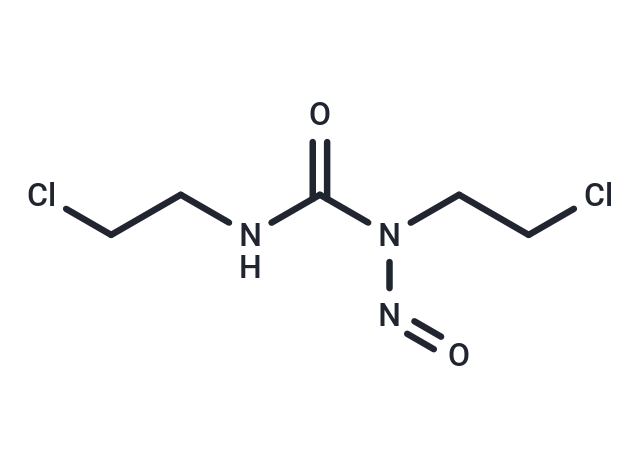

| Pack Size | Price | USA Stock | Global Stock | Quantity |
|---|---|---|---|---|
| 10 mg | $40 | In Stock | In Stock | |
| 25 mg | $52 | In Stock | In Stock | |
| 50 mg | $64 | In Stock | In Stock | |
| 100 mg | $108 | In Stock | In Stock | |
| 200 mg | $168 | In Stock | In Stock | |
| 500 mg | $297 | - | In Stock |
| Description | Carmustine (bis-chloroethylnitrosourea) is a cell-cycle phase nonspecific alkylating antineoplastic agent. |
| Targets & IC50 | DNA Alkylator: |
| In vitro | Carmustine is an antitumor chemotherapeutic agent. Carmustine (8, 80, and 800 μM) decreases N-acetyltransferase (NAT) activities for 2-aminofluorene (AF) and p-aminobenzoic acid (PABA) in rat glial tumor cytosol and intact cells. The carmustine decreases the formation of DNA-AF adduct when the DNA-AF adduct increases in rat glial tumor cell. |
| In vivo | Carmustine (BCNU; 25 mg/kg, i.p.) increases the ratio of liver weight to body weight and levels of plasma conjugated bilirubin, while reducing biliary flow and oxidized glutathione levels (GSSG), along with a decrease in the ratio of reduced glutathione (GSH) to GSSG, compared to control rats. |
| Synonyms | Nitrumon, Gliadel, Carmubris, bis-chloroethylnitrosourea, BiCNU, BCNU |
| Kinase Assay | The determination of Acetyl-CoAdependent N-acetylation of 2-aminofluorene (AF) and p-aminobenzoic acid (PABA) are performed. Incubation mixtures in the assay system consists of a total volume of 90 μL: glial tumor cells cytosols, diluted as required, in 50 μL of lysis buffer (20 mM Tris/HCl, pH 7.5, 1 mM DTT and 1 mM EDTA), 20 μL of an Acetyl-CoA recycling mixture of 50 mM Tris-HCl (pH7.5), 0.2 mM EDTA, 2 mM DTT, 15 mM acetylcamitine, 2U/mL carnitine acetyltransferase, and AF or PABA at specific concentrations. The reactions are started by addition of 20 μL of Acetyl-CoA. The control reactions have 20 μL distilled water in place of Acetyl-CoA. For the single point activity measurements, the final concentration of AF or PABA is 0.1 mM and AcCoA is 0.5 mM. The reaction mixtures with or without specific concentrations of Carmustine and lomustine are incubated at 37°C for 10 min and stopped with 50 μL of 20% trichloroacetic acid for the PABA reactions, and 100 μL of acetonitrile for the AF reactions. All of the reactions (experiments and controls) are run in triplicate |
| Animal Research | Carmustine is formulated in corn oil.RatsIndividual rats are weighted prior to enter the study; their weights are recorded, and they are randomLy assigned to four groups. Group I (saline group); This group consists of 12 rats. These rats are injected with 2 mL/kg of saline intraperitoneally (IP) 48 h before the study, being included by the study 48 h later. Group II (corn oil group) consists of 15 rats. These rats are injected with 2 mL/kg of corn oil (vehicle) IP 48 h before the study. Group III (Carmustine group) consists of 16 rats. These rats are injected with 1 mL per day of saline IP, administered at the same hour of the day as a single-dose for 3 days. Twelve hours after the first dose of saline, corn oil 2 mL/kg + Carmustine 25 mg/kg IP are injected, and the rats are included in the study 48 h after the administration of corn oil + Carmustine. Group IV (trimetazidine group) consists of 12 rats. These rats are injected with 2.5 mg/kg per day of trimetazidine (TMZ) IP, administered at the same hour of the day as a single-dose for 3 days. 12 h after the first dose of TMZ, corn oil 2 mL/kg + Carmustine 25 mg/kg IP are injected, and the rats are included in the study 48 h after the administration of corn oil + Carmustine |
| Molecular Weight | 214.05 |
| Formula | C5H9Cl2N3O2 |
| Cas No. | 154-93-8 |
| Smiles | N(C(NCCCl)=O)(CCCl)N=O |
| Relative Density. | 1.46 g/ml |
| Storage | Keep away from direct sunlight Powder: -20°C for 3 years | In solvent: -80°C for 1 year Shipping with blue ice/Shipping at ambient temperature. | |||||||||||||||||||||||||||||||||||
| Solubility Information | DMSO: 62.5 mg/mL (291.99 mM), Sonication is recommended.  | |||||||||||||||||||||||||||||||||||
| In Vivo Formulation | 10% DMSO+90% Saline: 6.25 mg/mL (29.2 mM), Suspension. 10% DMSO+40% PEG300+5% Tween 80+45% Saline: 2 mg/mL (9.34 mM), Sonication is recommended. Please add the solvents sequentially, clarifying the solution as much as possible before adding the next one. Dissolve by heating and/or sonication if necessary. Working solution is recommended to be prepared and used immediately. The formulation provided above is for reference purposes only. In vivo formulations may vary and should be modified based on specific experimental conditions. | |||||||||||||||||||||||||||||||||||
Solution Preparation Table | ||||||||||||||||||||||||||||||||||||
DMSO
Note : The dilution table applies only to solid products. For liquid products, please calculate the stock solution based on the stated concentration and/or density. | ||||||||||||||||||||||||||||||||||||
 For example, if the intended dosage is 10 mg/kg for animals weighing 20 g , with a dosing volume of 100 μL per animal, and a total of 10 animals are to be administered, using a formulation of
  10% DMSO+ 40% PEG300+ 5% Tween 80+ 45% Saline/PBS/ddH2O , the resulting working solution concentration would be 2 mg/mL.
Dissolve 2 mg of the compound in 100 μL DMSO to obtain a stock solution at a concentration of 20 mg/mL . If the required concentration exceeds the compound's known solubility, please contact us for technical support before proceeding.
1) Add 100 μL of the DMSO stock solution to 400 µL PEG300 and mix thoroughly until the solution becomes clear.
2) Add 50 µL Tween 80 and mix well until fully clarified.
3) Add 450 µL Saline,PBS or ddH2O and mix thoroughly until a homogeneous solution is obtained.
| Size | Quantity | Unit Price | Amount | Operation |
|---|
 Feedback
 Hello! How can I help you today?
Copyright © 2015-2026 TargetMol Chemicals Inc. All Rights Reserved.
