


Shopping Cart
Remove All Your shopping cart is currently empty

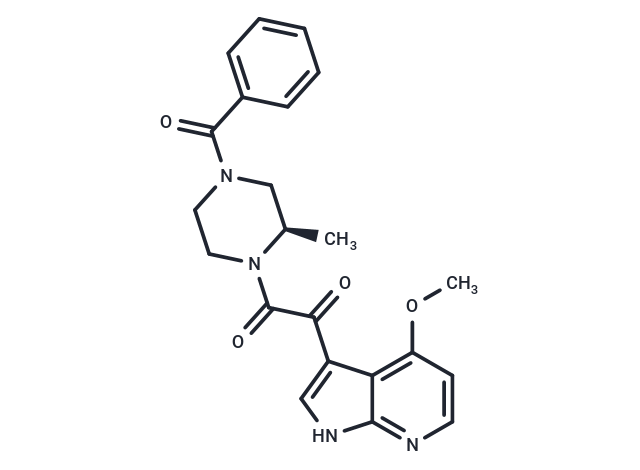
Synonyms: BMS-806, BMS378806
| Pack Size | Price | USA Stock | Global Stock | Quantity |
|---|---|---|---|---|
| 2 mg | $35 | - | In Stock | |
| 5 mg | $55 | - | In Stock | |
| 10 mg | $89 | - | In Stock | |
| 25 mg | $189 | - | In Stock | |
| 50 mg | $297 | - | In Stock | |
| 100 mg | $446 | - | In Stock | |
| 200 mg | $645 | - | In Stock | |
| 1 mL x 10 mM (in DMSO) | $60 | - | In Stock |
| Description | BMS-378806 (BMS-806) selectively inhibits the binding of HIV-1 gp120 to the CD4 receptor with EC50 of 0.85-26.5 nM in virus. |
| Targets & IC50 | CD4-gp120:0.85 nM-26.5 nM(EC50) |
| In vitro | BMS-806, a 7-azaindole derivative, binds gp120 and interferes with the interaction of HIV surface protein gp120 with the host cell receptor CD4. BMS-806 inhibits a panel of macrophage- and T cell-tropic HIV-1 strains, which are laboratory strains that use either CCR5 (M-tropic) or CXR4 (T-tropic) co-receptors to enter cells and are classified as B subtypes. The aqueous solubility from the crystalline form of BMS-806 (BMS 378806) is 170 μg/mL. The solubility of BMS-806 is 1.3 mg/mL at pH=2.1 and 3.3 mg/mL at pH=11, a solubility profile that reveals the amphoteric nature of BMS-806 and estimates the pKa of the protonated form as 2.9 while that of the free base is approximately 9.6. BMS-806 competes with soluble CD4 binding to a monomeric form of gp120 in an ELISA assay with IC50 = ~ 100 nM. BMS-806 is specific towards HIV-1, with no significant inhibitory activity against HIV-2, SIV, MuLV, RSV, HCMV, BVDV, VSV, and influenza virus observed at concentrations ranging from 10 to 30 μM and no overt cytotoxicity toward host cells, CC50 values > 225 μM. [1] BMS-806 binds directly to gp120 at a stoichiometry of approximately 1:1, with a binding affinity similar to that of soluble CD4. The potential BMS-806 target site is localized to a specific region within the CD4 binding pocket of gp120 by using HIV-1 gp120 variants carrying either compound-selected resistant substitutions or gp120-CD4 contact site mutations. [2] |
| In vivo | When BMS-806 is administered dose-proportional increases in the AUC and Cmax is observed. In rat, dog and monkey, plasma levels of drug exceeded the concentrations required to half-maximally inhibit virus replication in vitro. The volume of distribution of BMS-806 ranges from 0.4 to 0.6 L/kg, indicative of partitioning beyond plasma; however, examination of brain levels in the rat revealed minimal CNS penetration. [1] BMS-806 is stable in human, rat, dog and monkey blood at 37 °C during a 2-h incubation. The blood-to-plasma concentration ratios in humans, rats, dogs and monkeys are 1.1, 0.77, 1.2 and 0.92 (n=3), respectively, suggesting that BMS-806 is distributed to approximately the same extent between plasma and blood cells. The human clearance of BMS-806 predicted from microsomes is 9.2 ml/min/kg (46% of the hepatic blood flow). [3] |
| Synonyms | BMS-806, BMS378806 |
| Kinase Assay | Drug susceptibility Assay: In general, host cells are infected with HIV-1 at a multiplicity of infection (MOI) of 0.005 50% tissue culture infective doses (TCID50)/cell followed by incubation in the presence of serially diluted inhibitors for 4 to 7 days. Virus yields are quantitated using an RT assay or a p24 enzyme-linked immunosorbent assay (ELISA) (NEN). The results from at least three experiments are used to calculate the 50% effective concentrations (EC50s). The EC50s of IDV, SQV, RTV, and NFV are compared to that of BMS-806 using Dunnett's test. These comparisons are made separately within each assay system. Dunnett's test is used to reduce the probability of false-positive results when a number of treatments are being compared to a control. Confidence bounds for the fold increases in EC50s observes when the same drug is tested in two different assay systems are computed using Fieller's theorem. The use of this theorem is necessary because ratios of parameters (in this case, EC50s) are known not to follow a standard probability distribution, such as the normal distribution. Numbers within the confidence interval are not significantly different from the observed fold increase at the 95% level. |
| Cell Research | To determine cytotoxicity, MT-2 cells are incubated in the presence of serially diluted BMS-806 for 6 days and cell viability is quantitated using an XTT [2,3-bis(2-methoxy-4-nitro-5-sulfophenyl-2H-tetrazolium-5-carboxanilide] assay to calculate the 50% cytotoxic concentrations (CC50s). (Only for Reference) |
| Molecular Weight | 406.43 |
| Formula | C22H22N4O4 |
| Cas No. | 357263-13-9 |
| Smiles | COc1ccnc2[nH]cc(C(=O)C(=O)N3CCN(C[C@H]3C)C(=O)c3ccccc3)c12 |
| Relative Density. | 1.328 g/cm3 |
| Storage | Powder: -20°C for 3 years | In solvent: -80°C for 1 year Shipping with blue ice/Shipping at ambient temperature. | ||||||||||||||||||||||||||||||||||||||||
| Solubility Information | Ethanol: 3 mg/mL (7.38 mM), Sonication is recommended. H2O: < 1 mg/mL (insoluble or slightly soluble) DMSO: 81 mg/mL (199.3 mM), Sonication is recommended. | ||||||||||||||||||||||||||||||||||||||||
| In Vivo Formulation | 10% DMSO+40% PEG300+5% Tween 80+45% Saline: 3.3 mg/mL (8.12 mM), Sonication is recommended. Please add the solvents sequentially, clarifying the solution as much as possible before adding the next one. Dissolve by heating and/or sonication if necessary. Working solution is recommended to be prepared and used immediately. The formulation provided above is for reference purposes only. In vivo formulations may vary and should be modified based on specific experimental conditions. | ||||||||||||||||||||||||||||||||||||||||
Solution Preparation Table | |||||||||||||||||||||||||||||||||||||||||
Ethanol/DMSO
DMSO
Note : The dilution table applies only to solid products. For liquid products, please calculate the stock solution based on the stated concentration and/or density. | |||||||||||||||||||||||||||||||||||||||||
 For example, if the intended dosage is 10 mg/kg for animals weighing 20 g , with a dosing volume of 100 μL per animal, and a total of 10 animals are to be administered, using a formulation of
  10% DMSO+ 40% PEG300+ 5% Tween 80+ 45% Saline/PBS/ddH2O , the resulting working solution concentration would be 2 mg/mL.
Dissolve 2 mg of the compound in 100 μL DMSO to obtain a stock solution at a concentration of 20 mg/mL . If the required concentration exceeds the compound's known solubility, please contact us for technical support before proceeding.
1) Add 100 μL of the DMSO stock solution to 400 µL PEG300 and mix thoroughly until the solution becomes clear.
2) Add 50 µL Tween 80 and mix well until fully clarified.
3) Add 450 µL Saline,PBS or ddH2O and mix thoroughly until a homogeneous solution is obtained.
| Size | Quantity | Unit Price | Amount | Operation |
|---|
 Feedback
 Hello! How can I help you today?
Copyright © 2015-2026 TargetMol Chemicals Inc. All Rights Reserved.
