


Shopping Cart
Remove All Your shopping cart is currently empty


Synonyms:

| Pack Size | Price | USA Stock | Global Stock | Quantity |
|---|---|---|---|---|
| 2 mg | $30 | In Stock | In Stock | |
| 5 mg | $48 | In Stock | In Stock | |
| 10 mg | $77 | In Stock | In Stock | |
| 25 mg | $128 | In Stock | In Stock | |
| 50 mg | $207 | In Stock | In Stock | |
| 100 mg | $338 | In Stock | In Stock | |
| 1 mL x 10 mM (in DMSO) | $53 | In Stock | In Stock |
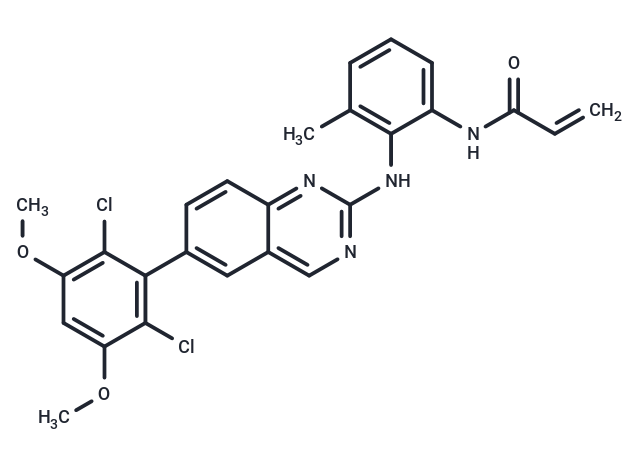
| Description | BLU9931 is the first selective small molecule inhibitor of FGFR4. |
| Targets & IC50 | FGFR1:591 nM, FGFR2:493 nM, FGFR4:3 nM, FGFR3:150 nM |
| In vitro | In MDA-MB-453 cells, BLU9931 potently inhibits phosphorylation of FGFR4 signaling pathway. BLU9931 inhibits proliferation of HCC cell lines that express an intact FGFR4 signaling complex, such as Hep 3B, HUH-7, and JHH-7 cell lines, with EC50 of <1 μM. BLU9931 also inhibits proliferation in PDX-derived cell lines with an intact FGFR4 signaling pathway. [1] |
| In vivo | In mice bearing the FGF19-amplified Hep 3B liver tumors, BLU9931 (300 mg/kg, p.o.) leads to tumor regression and prevents this weight loss induced by tumors. In mice bearing the FGF19-overexpressing PDX-derived LIXC012 xenografts, treatment with BLU9931 (300 mg/kg, p.o.) also leads to tumor regression. [1] |
| Kinase Assay | FGFR1-4 Biochemical Assays: FGFR kinase inhibition assays are performed at KM for ATP. Picomolar to low nanomolar concentrations of FGFR proteins are incubated in 1× Kinase Reaction Buffer (KRB) with 1 μM of CSKtide and 50 to 250 of μM ATP at 25°C for 90 minutes in the presence or absence of a dosed concentration series of inhibitor. All reactions are terminated by the addition of Stop buffer, and plates are read on a Caliper EZReader2. IC50 values are fit with a four-parameter log[Inhibitor] versus response model with floating Hill Slope. |
| Cell Research | Established and PDX-derived HCC cell lines are seeded in 96-well plates in respective growth media, allowed to attach overnight, and treated with a dilution series of test compounds for two cell-doubling times. Cell viability is determined by CellTiter-Glo, and results represented as background-subtracted relative light units normalized to a DMSO-treated control. Relative EC50 values are determined at 50% inhibition between the top and bottom plateau of the dose–response curve.(Only for Reference) |
| Molecular Weight | 509.38 |
| Formula | C26H22Cl2N4O3 |
| Cas No. | 1538604-68-0 |
| Smiles | COc1cc(OC)c(Cl)c(c1Cl)-c1ccc2nc(Nc3c(C)cccc3NC(=O)C=C)ncc2c1 |
| Relative Density. | 1.361 g/cm3 (Predicted) |
| Storage | Powder: -20°C for 3 years | In solvent: -80°C for 1 year Shipping with blue ice/Shipping at ambient temperature. | |||||||||||||||||||||||||||||||||||
| Solubility Information | DMSO: 125 mg/mL (245.4 mM), Sonication is recommended.  | |||||||||||||||||||||||||||||||||||
| In Vivo Formulation | 10% DMSO+90% Saline: < 10 mg/mL (19.63 mM), Lower concentrations may be soluble, but exact solubility limit is unknown. 10% DMSO+40% PEG300+5% Tween 80+45% Saline: 10 mg/mL (19.63 mM), Solution. Please add the solvents sequentially, clarifying the solution as much as possible before adding the next one. Dissolve by heating and/or sonication if necessary. Working solution is recommended to be prepared and used immediately. The formulation provided above is for reference purposes only. In vivo formulations may vary and should be modified based on specific experimental conditions. | |||||||||||||||||||||||||||||||||||
Solution Preparation Table | ||||||||||||||||||||||||||||||||||||
DMSO
Note : The dilution table applies only to solid products. For liquid products, please calculate the stock solution based on the stated concentration and/or density. | ||||||||||||||||||||||||||||||||||||
 For example, if the intended dosage is 10 mg/kg for animals weighing 20 g , with a dosing volume of 100 μL per animal, and a total of 10 animals are to be administered, using a formulation of
  10% DMSO+ 40% PEG300+ 5% Tween 80+ 45% Saline/PBS/ddH2O , the resulting working solution concentration would be 2 mg/mL.
Dissolve 2 mg of the compound in 100 μL DMSO to obtain a stock solution at a concentration of 20 mg/mL . If the required concentration exceeds the compound's known solubility, please contact us for technical support before proceeding.
1) Add 100 μL of the DMSO stock solution to 400 µL PEG300 and mix thoroughly until the solution becomes clear.
2) Add 50 µL Tween 80 and mix well until fully clarified.
3) Add 450 µL Saline,PBS or ddH2O and mix thoroughly until a homogeneous solution is obtained.
| Size | Quantity | Unit Price | Amount | Operation |
|---|
 Feedback
 Hello! How can I help you today?
Copyright © 2015-2026 TargetMol Chemicals Inc. All Rights Reserved.
